

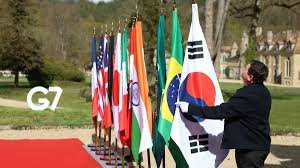
PARIS: Wars in the Middle East and Ukraine are expected to dominate next week’s Group of Seven (G7) summit in France, as host President Emmanuel Macron seeks to maintain unity among major Western economies amid growing geopolitical divisions.
The summit, scheduled for June 15–17 in Evian-les-Bains, will bring together leaders from France, the United States, Britain, Germany, Italy, Japan, Canada, and the European Union, with discussions centering on conflict management, global economic instability, and strategic resource security.
Diplomatic sources said the agenda has been carefully structured to avoid confrontation, particularly with U.S. President Donald Trump, whose return to office in 2025 has coincided with renewed tensions within the group over foreign policy and economic coordination.
Officials indicated that no major breakthrough decisions are expected, with discussions instead focusing on crisis management, including ongoing conflicts in the Middle East and the war in Ukraine.
The situation in the Middle East is likely to be a key focus, with fragile ceasefire arrangements under strain and broader negotiations involving Iran, Israel, and Gulf states remaining unresolved. Diplomatic engagement involving regional actors such as Saudi Arabia, Qatar, the United Arab Emirates, and Egypt is also expected on the sidelines of the summit.
In Ukraine, President Volodymyr Zelenskiy is expected to press Western allies for continued military and financial support as efforts to reach a negotiated settlement with Russia remain stalled. European officials are also seeking to reinforce coordination on sanctions and long-term security assistance for Kyiv.
The summit will also address global economic concerns, including supply chain vulnerabilities and competition over critical minerals, particularly in relation to China’s industrial output and global trade imbalances.
French officials have reportedly scaled back expectations for a comprehensive joint communiqué, opting instead for targeted statements on specific issues such as energy security, migration, and illicit trafficking.
Analysts say the G7 faces internal divisions on several fronts, with differences between members limiting the scope for collective action despite shared concerns over geopolitical instability and economic fragmentation.
The gathering is being viewed as a test of cohesion for the G7 at a time of shifting global power dynamics and growing uncertainty over long-term Western strategic alignment.