

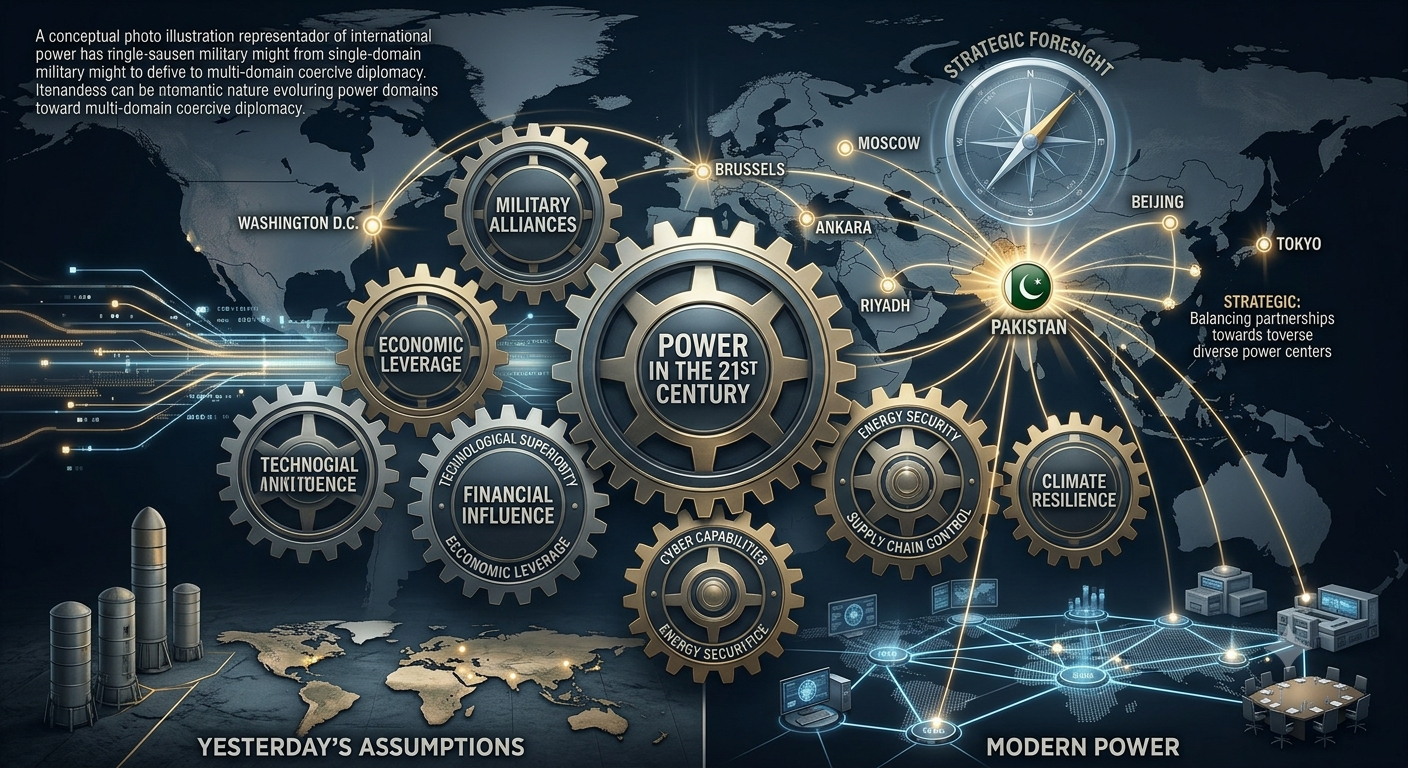
Understanding the New Instruments of Global Power
The language of international diplomacy has changed.
Military alliances are no longer the only means through which states pursue strategic objectives. Economic sanctions, technology restrictions, financial systems, cyber capabilities, supply-chain controls, intelligence cooperation, strategic communications, and control over critical resources have become powerful instruments of influence. Together, these tools have expanded the practice of what international relations scholars describe as coercive diplomacy-the use of pressure, deterrence, and leverage to influence the decisions of other states without necessarily resorting to full-scale war.
This transformation is reshaping the international system.
Decisions taken in Washington, Beijing, Brussels, Moscow, Riyadh, Ankara, Tokyo, and New Delhi increasingly influence markets, technology, energy security, investment, and political choices far beyond their own borders. In such an environment, Pakistan cannot formulate its foreign policy using assumptions rooted in a different era. It must understand how modern power is exercised and position itself to protect its sovereignty while expanding constructive partnerships across an increasingly competitive world.
Coercive Diplomacy Beyond the Battlefield
The modern practice of coercive diplomacy extends far beyond military deployments.
Economic sanctions can isolate a state’s financial system. Export controls can slow technological development. Restrictions on semiconductors, artificial intelligence, telecommunications, and critical minerals can shape industrial growth. Maritime security, investment screening, cyber operations, and information campaigns have become part of the wider strategic toolkit available to governments.
These instruments are now routinely used by major powers to protect national interests, influence strategic behaviour, and strengthen their positions within the international system.
Whether one agrees with these policies or not, their increasing use reflects an important reality: power in the twenty-first century is exercised across multiple domains simultaneously.
A Multipolar World Requires Multipolar Thinking
The international system is becoming more complex.
The United States remains a leading military, financial, and technological power. China continues to expand its economic reach, infrastructure investment, industrial capacity, and scientific capabilities. Europe is strengthening its strategic resilience while balancing economic competitiveness and security priorities. Regional powers in the Middle East, Africa, and Asia are pursuing greater strategic autonomy by diversifying their diplomatic and economic partnerships.
This is not simply a contest for territory. It is a competition to shape the rules governing technology, finance, trade, energy, infrastructure, and global standards.
The future will likely be determined less by who possesses the largest army alone and more by who builds the strongest networks of cooperation, innovation, resilience, and influence.
Climate and Technology Have Become Strategic Domains
Climate change is no longer only an environmental issue. It has become a strategic issue.
Water security, agricultural productivity, energy transition, critical minerals, disaster resilience, and public health increasingly influence national security and economic stability. Extreme weather events, supply disruptions, migration pressures, and food insecurity can shape political choices as profoundly as traditional security threats.
Similarly, leadership in artificial intelligence, advanced manufacturing, cybersecurity, quantum technologies, and digital infrastructure has become central to national competitiveness.
States that fail to invest in these areas risk losing strategic flexibility in an increasingly interconnected world.
The Middle East’s Strategic Transformation
The Middle East illustrates how rapidly strategic priorities are evolving.
While regional security remains important, Gulf countries are simultaneously investing in logistics, advanced technologies, renewable energy, finance, tourism, and global investment partnerships. Their objective is clear: economic strength should complement security, not depend solely upon it.
By strengthening connectivity between Asia, Europe, and Africa, these countries are redefining their international influence.
This shift offers important lessons for other developing states, including Pakistan.
Pakistan’s Strategic Opportunity
Pakistan occupies one of the world’s most strategically significant geographic locations, linking South Asia, Central Asia, the Middle East, and western China.
Geography alone, however, no longer guarantees influence.
Pakistan’s strategic future will depend upon its ability to combine credible national security with sustained economic reform, technological innovation, climate resilience, institutional effectiveness, and an active diplomatic engagement with diverse international partners.
Strategic autonomy should not be misunderstood as strategic isolation.
Rather, it means retaining the ability to make sovereign decisions while maintaining productive relations with multiple centres of global influence. Pakistan’s partnerships with China, its engagement with Gulf countries, its dialogue with the United States and Europe, its role in the Islamic world, and its regional relationships should be viewed as complementary elements of a balanced foreign policy rather than mutually exclusive choices.
The countries that succeed in this century will be those capable of engaging with competing powers without becoming overly dependent on any single one.
Rethinking National Security
National security can no longer be measured solely through conventional military indicators.
Economic resilience, scientific research, education, energy security, climate adaptation, food systems, cyber capability, and institutional credibility now form essential components of comprehensive national power.
Pakistan has already recognised many of these priorities through its focus on economic connectivity, regional cooperation, disaster management, and technological development. The challenge now lies in integrating these elements into a coherent long-term national strategy capable of responding to an increasingly complex international environment.
Looking Beyond Yesterday’s Debates
Public debate often remains trapped in outdated frameworks that divide international politics into simple binaries of allies and adversaries.
The world has moved beyond those categories.
Today’s international environment rewards countries that are pragmatic, adaptive, and strategically flexible. It demands leaders who understand that competition and cooperation frequently exist simultaneously, and that diplomacy, economics, technology, defence, and climate policy are now deeply interconnected.
Responding to twenty-first century challenges with twentieth century assumptions risks strategic irrelevance.
The Compass Needle
Current Direction
Coercive diplomacy is becoming a central feature of international relations. Military capability remains important, but economic leverage, technological leadership, financial influence, climate resilience, and strategic partnerships are increasingly determining global power.
Key Risk
States that fail to recognise this transformation risk strategic dependence, economic vulnerability, and diminished influence in an increasingly competitive international system.
Signal to Watch
Observe not only military developments but also semiconductor policies, artificial intelligence partnerships, energy transition investments, critical mineral agreements, climate financing, digital infrastructure, trade corridors, and emerging diplomatic coalitions. These developments often reveal the future direction of global politics long before military crises do.
Pakistan’s strategic future will not be determined by reacting to every global rivalry. It will be determined by understanding how the international system is changing and by building the national capacity to navigate that change with confidence, balance, and strategic foresight.
The future belongs not to those who resist change, but to those who understand it before others do.
Disclaimer: The views and opinions expressed in this article are solely those of the author and do not necessarily reflect the views, policies, or position of this website. The website does not endorse or oppose any opinion presented herein.