

Institutional Reality of International Engagement
International engagement operates through layers of continuity that extend beyond formal agreements. Governments sign documents, institutions establish frameworks, and diplomats create channels of communication. The durability of relationships, however, depends upon something deeper: the ability of engagement to survive changing administrations, shifting priorities, and evolving political circumstances.
The contemporary international environment moves at extraordinary speed. Narratives rise and disappear within days. Political attention shifts rapidly. Strategic priorities are frequently recalibrated. Under such conditions, continuity becomes a strategic resource rather than a procedural preference. Relationships that endure acquire a value that cannot be replicated through temporary alignment alone.
Oslo-Islamabad Engagement as an Emerging Structure
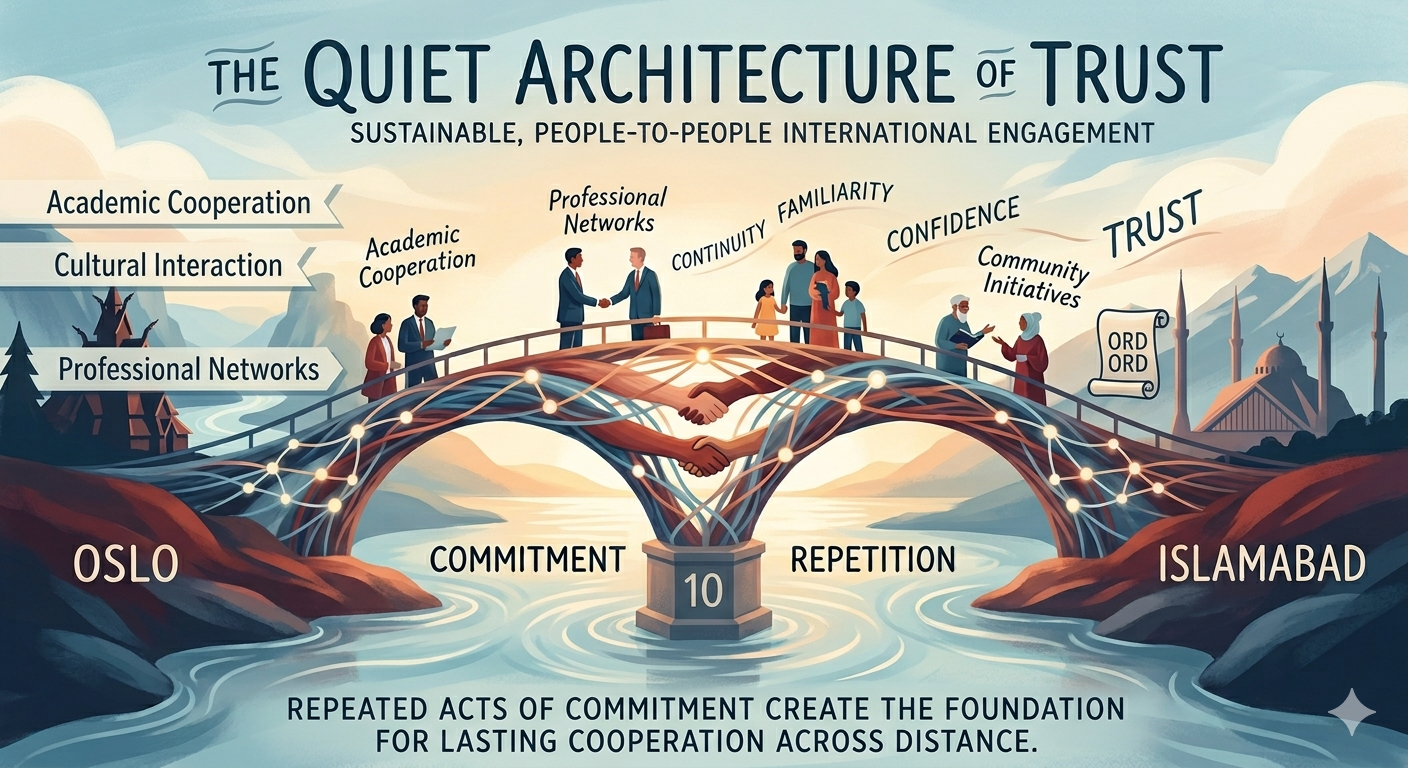
The developing interaction between Oslo and Islamabad reflects this broader reality. Diplomatic exchanges provide formal structure. Alongside these institutional connections, academic cooperation, cultural interaction, professional networks, and community initiatives contribute to a wider architecture of engagement.
This architecture derives its strength from repetition. Familiarity grows through sustained contact. Confidence develops through consistent interaction. Trust emerges through accumulated experience. The significance of such engagement extends beyond individual projects or events. It establishes a foundation capable of supporting cooperation across generations.
Dosti Welfare Group Norway – Continuity Without Authority
Dosti Welfare Group Norway operates within this societal dimension of engagement. Its contribution is not measured through formal authority or political influence. Its relevance is rooted in continuity of participation and voluntary commitment. Through sustained interaction, it strengthens human connections that remain active regardless of institutional transitions.
Many relationships between societies begin through official channels. Their longevity is frequently secured by ordinary citizens who continue building bridges long after formal meetings conclude. The strength of a bridge is revealed through its ability to carry weight across time.
Islamabad-Oslo Friendship Initiative – Structured Familiarity
The Islamabad-Oslo Friendship Initiative reflects a similar principle.
Its value lies in creating structured familiarity between two societies separated by geography, language, and historical experience. Repeated engagement transforms distance into understanding and replaces abstraction with human connection.
Friendship in this context serves a practical function. It creates channels through which cooperation can expand, misunderstandings can be reduced, and confidence can develop through direct interaction. International relationships become more resilient when supported by people who know one another beyond headlines and political narratives.
Ord er Ord – The Discipline of Commitment
During a recent interaction, a Norwegian counterpart used a simple expression:
“Ord er Ord.” A word is a word. The phrase carries a meaning far greater than its simplicity suggests. It reflects an expectation that commitments possess weight. Words establish expectations. Actions determine credibility. Consistency transforms intention into trust.
Reliability is not created through declarations. It is established through repetition. The same conduct observed repeatedly over time becomes reputation. This principle applies equally to individuals, institutions, and states. Credibility grows where commitments remain recognizable across changing circumstances. Trust develops where words and actions move in the same direction.
Continuity in an Age of Volatility
Contemporary international affairs display increasing volatility. Alliances evolve, narratives shift, and strategic priorities undergo continual adjustment.
Such conditions elevate the importance of continuity mechanisms capable of preserving engagement through periods of uncertainty. Societal relationships perform this function. They maintain communication across institutional transitions. They preserve familiarity during moments of political change. They sustain dialogue when formal processes slow or encounter obstacles. Friendship often receives recognition as a social virtue. Its strategic value receives far less attention.
In practice, friendship performs a stabilizing function. It preserves relationships through periods that test them. It protects communication from becoming hostage to temporary disagreements. It creates a reservoir of trust available when circumstances require cooperation.
For this reason, friendship belongs within the architecture of international engagement rather than at its margins.
Pakistan’s Engagement and Long-Term Positioning
Pakistan’s participation in such frameworks reflects an appreciation of the long-term dimension of international relations. Institutional diplomacy remains essential. Societal engagement extends its reach. Together they create a broader foundation for sustained interaction.
The Oslo-Islamabad relationship illustrates this process. Its significance emerges through continuity, repetition, and the gradual accumulation of familiarity. Trust develops incrementally. Understanding deepens through contact. Cooperation expands through confidence.
These developments rarely attract dramatic headlines. Their impact becomes visible over time.
The Quiet Architecture of Trust “Ord er Ord.”
A word acquires meaning through conduct. Conduct establishes reliability. Reliability generates trust. Trust creates continuity. Continuity sustains engagement across distance, difference, and change.
The strongest relationships between societies are rarely built through a single agreement, a single meeting, or a single initiative. They emerge through repeated acts of commitment carried forward by institutions, communities, and individuals who understand the value of staying connected.
Friendship, viewed through this lens, is far more than goodwill. It is a form of strategic continuity. It transforms acquaintance into confidence. Confidence into trust. Trust into cooperation. And cooperation into a lasting connection between societies that choose to remain engaged with one another across time
Disclaimer: The views and opinions expressed in this article are solely those of the author and do not necessarily reflect the views, policies, or position of this website. The website does not endorse or oppose any opinion presented herein.