

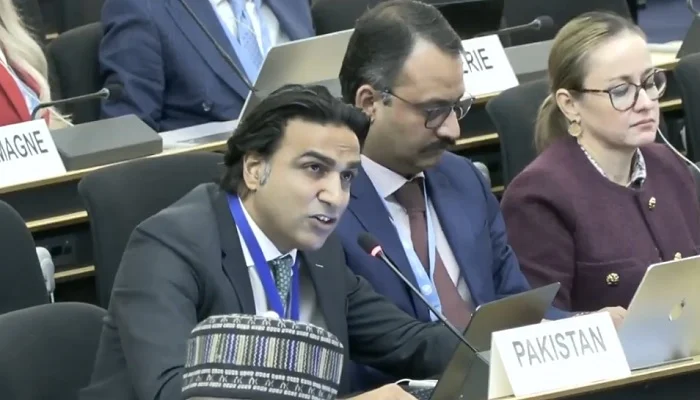
Switzerland: Pakistan warned India against using shared water resources as a means of political pressure, raising concerns over the treatment of transboundary water cooperation during the 63rd session of the United Nations Human Rights Council in Geneva.
Pakistan’s First Secretary Adeel Mumtaz Khokhar said shared water resources carry shared responsibilities and stressed that water should not be used as an instrument of political pressure, coercion or war.
The remarks came as the Human Rights Council considered a resolution on the human right to safe drinking water and sanitation, which was adopted without a vote.
Why did Pakistan raise the issue of transboundary water cooperation?
Pakistan argued that cooperation over shared rivers is directly connected to access to safe drinking water and sanitation and should therefore remain part of the human rights discussion.
Khokhar said no upstream country should use water as a tool of political pressure or influence. He also described India’s actions concerning the Indus Waters Treaty as the “weaponisation of water.”
“Where water is shared, responsibilities are also shared,” Khokhar said, stressing that cooperation over shared waters is a responsibility rather than a concession.
Pakistan also welcomed the retention of an explicit reference to transboundary water cooperation in the final resolution.
What happened to the UN resolution?
The resolution, titled “The human rights to safe drinking water and sanitation,” was presented by Germany and Spain and adopted without a vote.
Pakistan said India had sought to remove the reference to transboundary water cooperation, arguing that the issue fell outside the scope of a human rights resolution.
Two proposed amendments, L.39 and L.40, were rejected before the main resolution was adopted. Both amendments received 10 votes in favour, 17 against and nine abstentions.
The resolution was considered during the Human Rights Council’s 63rd session, which ran from September 7 to October 7, 2026.