

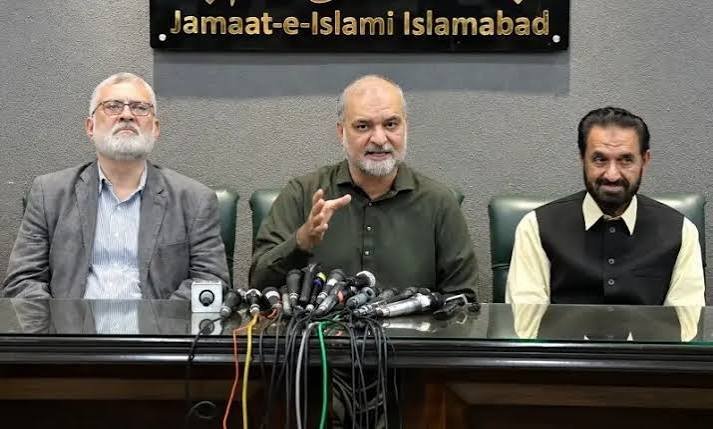
Pakistan: Jamaat-i-Islami (JI) chief Hafiz Naeemur Rehman has ruled out meeting Prime Minister Shehbaz Sharif unless the government commits to abolishing the petroleum levy, warning that the party will announce a date for its march to Islamabad after October 12 if relief is not provided.
Speaking at a press conference at Mansoorah on Saturday, Rehman said recent statements by government ministers indicated that the levy would remain in place. He said the party had no reason to meet the prime minister without an assurance that its demand would be accepted.
The prime minister had sought a meeting with the JI chief after asking the party to suspend its protest march against the levy. Planning Minister Ahsan Iqbal had conveyed the premier’s message to JI Vice Chief Liaqat Baloch earlier this week.
Why Is JI Demanding the Levy’s Abolition?
Rehman called for meaningful relief for consumers and urged the government to pass on the benefit of Saudi Arabia’s reported $5-per-barrel reduction in oil prices for Asian countries.
He said JI had staged sit-ins for 42 days against the petroleum levy and was continuing nationwide public meetings and a signature campaign. A public meeting was scheduled in Okara for Sunday.
Rejecting the government’s argument that its options were limited by conditions imposed by the International Monetary Fund (IMF), Rehman questioned government spending on luxury items, citing an aircraft reportedly worth Rs11 billion.
He warned that the party would announce its Islamabad march date after October 12 if the government failed to provide relief.
What Other Issues Did the JI Chief Raise?
Rehman criticised Punjab’s governance, blaming what he described as four decades of family rule for problems in education and agriculture. He claimed that 11,000 schools had been sold and another 25,000 were reportedly listed for sale.
He also highlighted rising agricultural costs, saying the price of a 50-kilogram bag of diammonium phosphate (DAP) fertiliser had increased by Rs3,000. He said farmers had received Rs3,000 per maund for wheat, while flour prices had exceeded Rs6,000 per maund and wheat prices had crossed Rs5,000 per maund.
Citing poverty estimates, Rehman said the World Bank had placed Pakistan’s poverty rate at 23 per cent, while the rate exceeded 40 per cent under the country’s own criteria. He added that Punjab had recorded the largest increase in poverty over the previous five years.