

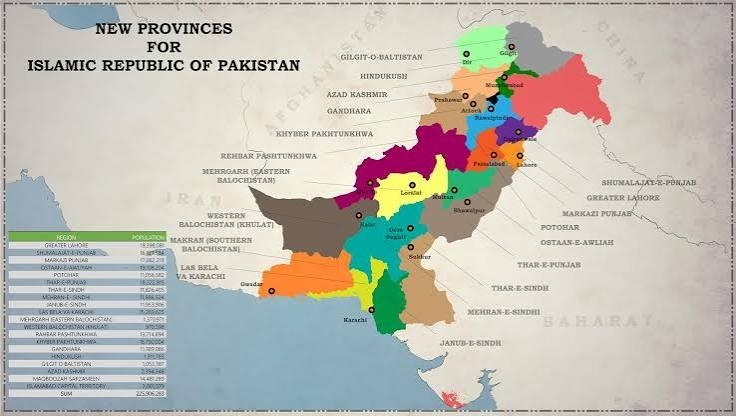
Discussion about creation of new provinces should start with economic geography and not political geography. It should be always focused on the issue of political representation. While South Punjab claims its right to existence, Hazara wants its own province, and Bahawalpur is demanding its recognition due to its rich history; administrative reforms are periodically raised by other regions of the country. But the issue of whether Pakistani administrative map is consistent with economic map of the country is not even raised.
Pakistan has changed tremendously since the time when the current system of provincial government was created. The country has already reached a point where its population has surpassed 241 million, its cities have grown immensely, internal migrations have changed its economy and new pressures on water, energy, climate, infrastructure and employment have arisen.
However, this does not imply that each and every big province should be necessarily subdivided. Furthermore, mere size of population cannot be taken as an adequate argument for forming new provinces. What really matters is whether such territorial units have enough potential to formulate and implement appropriate policies according to the economic geography of their region.
The case of Punjab is indicative in this regard. Punjab is the most populated province of Pakistan, but economic and social conditions of Lahore, Faisalabad, Multan, Bahawalpur, Dera Ghazi Khan and southern part of Punjab where irrigated farming takes place are not quite similar. Thus, one has to run both the affairs of a big metropolitan area economy as well as industry centers, agriculture, fast growing secondary towns and also underdeveloped districts.
Same situation is seen in other areas as well. Karachi works not only as a national economic center but also as a part of Sindh province as a whole. Similarly, the northern part of Khyber Pakhtunkhwa has totally different geographical and connectivity issues than the southern regions of the same province. However, Balochistan is the best case which shows the link between territory and administration capacity due to huge distance involved.
That is why Pakistan must stop asking the question, “Where does the next province need to be formed?” and rather ask, “What is the best territorial scale for each region?”
This question would bring many options on the table. Some regions might need full provincial status, while others might require a more robust administrative division, regional autonomy, metropolitan government, or strong local government institutions. Viewing all governance issues through the prism of the province is a costly approach to solving the problems that may require decentralization of the administration.
Moreover, there is an economic angle to this issue that needs to be considered. Instead of simply being created according to the geography of a region, the new province needs to have an economic policy behind its creation. For instance, the southern part of Punjab might be arranged as a province that would focus on agriculture, irrigation, agro-processing, logistics, and emerging cities. The northern region might arrange an economic policy focusing on tourism, hydroelectricity generation, transportation and trade with foreign countries.
That would mark an entirely different approach to the politics of provincial restructuring. Rather than debate the merits of having a flag and assembly and secretariat for the area, policymakers would need to prove what the economic rationale was behind the creation of this unit.
There is one more threat. Without moving towards decentralization within the provinces, reducing their size would simply mean reproducing the same pattern at a smaller scale. Islamabad could devolve power to the capital of a province, which would itself become the center of power. Article 140A already offers constitutional justification for devolving powers to elected local governments. The unresolved question is what prevented from making this a basis of governance in Pakistan.
Thus, perhaps the solution can be found in a multi-level redesign of the state: a federal government for national affairs, provinces for regional economic and social policies, and local governments with real power for the provision of services close to citizens. In such an arrangement, forming new provinces will be only one way out of many.
Pakistan needs to set up a State Reorganisation Commission that studies this issue independently of any preconceived provincial borders. Based on data from the census, fiscal capacities, infrastructure, geography, economic opportunities, and citizen access to state structures, such a commission will be able to determine the regions where new provinces are necessary and those where administrative reforms should be carried out.
The point should not be to draw a new map of Pakistan to suit some political interests. The point should be to make the map correspond to the country Pakistan has become.
Thus, the question about provinces provides Pakistan with much greater possibilities than just creating some administrative divisions. What Pakistan has to do is rethink the relationship between territory, economy and political power. The criterion for the success of such reforms should not be the number of the provinces Pakistan will get – four, eight or more.
The criterion is that no matter where a citizen lives, he or she has the ability to reach the institution that has both the right and ability to resolve his or her problem. It does not matter how many provinces Pakistan has. What matters is whether they match reality.
Disclaimer: The views and opinions expressed in this article are solely those of the author and do not necessarily reflect the views, policies, or position of this website. The website does not endorse or oppose any opinion presented herein.
