

“The only thing worse than being blind is having sight but no vision.”
Helen Keller, who became blind at a very young age and lived from 1880 to 1968, is widely associated with these words. They speak to something much larger than physical blindness. A person can have sight and still fail to understand what is unfolding in front of them. Governments and nations can face the same problem. They may possess intelligence, surveillance, military capability and an abundance of information, yet still miss the meaning of the moment.
That distinction between seeing and understanding is particularly relevant to the Middle East today.
Saudi Arabia is facing renewed attacks from the Houthis in Yemen, with the latest escalation bringing the conflict closer to the kingdom’s most sensitive areas. A Houthi drone was reported to have been intercepted south of Makkah, while Saudi Arabia has also faced attacks affecting civilian and economic infrastructure. The immediate security concern is therefore no longer an abstract regional possibility; it is part of the environment in which the newly established Makkah Joint Defence Agreement now exists.
This makes a recent exchange involving Pakistan’s military spokesperson far more interesting than it might initially appear.
During an interview with Al Arabiya English, presenter Tom Burges Watson asked Director General ISPR Lieutenant General Ahmed Sharif Chaudhry what the agreement actually committed Pakistan to. The discussion then moved to the question that naturally follows from any mutual-defence arrangement: if one of the three countries were attacked, would the other two have an obligation to respond, and what would Pakistan actually do?
The answer was revealing because the DG ISPR did not attempt to satisfy the curiosity surrounding the question with a detailed military scenario. He pointed to the public text of the agreement and made the distinction between the commitment itself and the manner in which that commitment would be carried out. When asked about the “how”, he made clear that such matters belong to the three governments and are not normally disclosed as operational information.
That answer deserves to be understood on its own terms.
In international affairs, there is a considerable difference between announcing what a country has agreed to do and explaining precisely how it would do it. The first is diplomacy and public policy. The second can involve military planning, intelligence assessments, deployment arrangements, timing, capabilities and contingencies. Once those details are placed in the public domain, they are no longer available only to the people who need them for decision-making; they become information for everyone, including those who may be trying to anticipate the response.
The important point, therefore, is not that Pakistan declined to answer the question. It is why the question could not responsibly be answered in the form in which it was asked.
The same issue surfaced at the Foreign Office briefing when journalists asked how Pakistan intended to meet its obligations under the Makkah agreement while Saudi Arabia was facing Houthi attacks. The Foreign Office reaffirmed Pakistan’s commitment, but again drew a line around the details, saying that questions concerning when, where, how and with what force a response might occur involved confidentiality.
There is something important in that consistency.
The public has been told enough to understand the political commitment. The three countries have described the agreement as a defensive arrangement aimed at protecting regional security and strengthening their ability to discourage aggression. They have also begun putting a permanent structure around their cooperation rather than leaving the agreement as a ceremonial document.
But the public has not been given a military instruction manual.
And perhaps it should not be.
We live in a period when almost every political statement is immediately dissected, broadcast, translated and circulated across social media. There is enormous pressure on governments to explain everything, immediately and in detail. Yet national security sometimes requires the opposite discipline: say enough to establish certainty, but not so much that an opponent can turn the statement into a map of your intentions.
That is the real meaning of the title of this column.
We know more than we say is not an argument for secrecy without accountability. It is an argument for recognising that not every piece of information has the same public purpose. Citizens need to know the commitments their governments make. They do not necessarily need to know the precise military arrangements prepared for every conceivable crisis.
The distinction becomes even more important when the situation on the ground is changing.
The Makkah agreement was signed before the present phase of Houthi attacks had fully developed. Now the agreement exists alongside a real security problem involving Saudi Arabia, Yemen and the wider Red Sea region. That makes every public statement more consequential, because words issued during a crisis can themselves influence the calculations of governments and armed groups.
This is precisely why restraint in language matters.
The region has already experienced enough verbal escalation: warnings answered by counter-warnings, threats followed by stronger threats, and public statements that sometimes leave governments with less room to step back. The volume of rhetoric can rise long after the original political objective has been forgotten.
But the people living with the consequences do not experience rhetoric as rhetoric.
They experience it as an air-raid warning, a closed airport, a damaged refinery, a disrupted shipping route, a military mobilisation or a family waiting for someone to come home.
Nobody wants to die.
Saudi families do not want their country drawn deeper into another war. Pakistani families do not want to see their soldiers placed in unnecessary danger. Turkish families have no interest in another regional conflict becoming wider. And after years of devastation, Yemeni families have perhaps the strongest reason of all to want an end to the cycle.
That is why the purpose of defence should ultimately be to prevent the use of force rather than to celebrate it.
A serious defence arrangement should give an adversary reason to reconsider aggression before the first shot is fired. If that calculation succeeds, there may be no dramatic military response to report because the response never becomes necessary. The absence of war can sometimes be the clearest evidence that a security arrangement has achieved something.
The Makkah agreement is still developing, and its real character will become clearer through the institutions the three countries build around it. The first formal meetings have already moved the relationship towards regular consultation and structured defence cooperation. The agreement is therefore becoming something more substantial than a declaration made at a summit.
But its success should not be measured by how frequently its members mention military power.
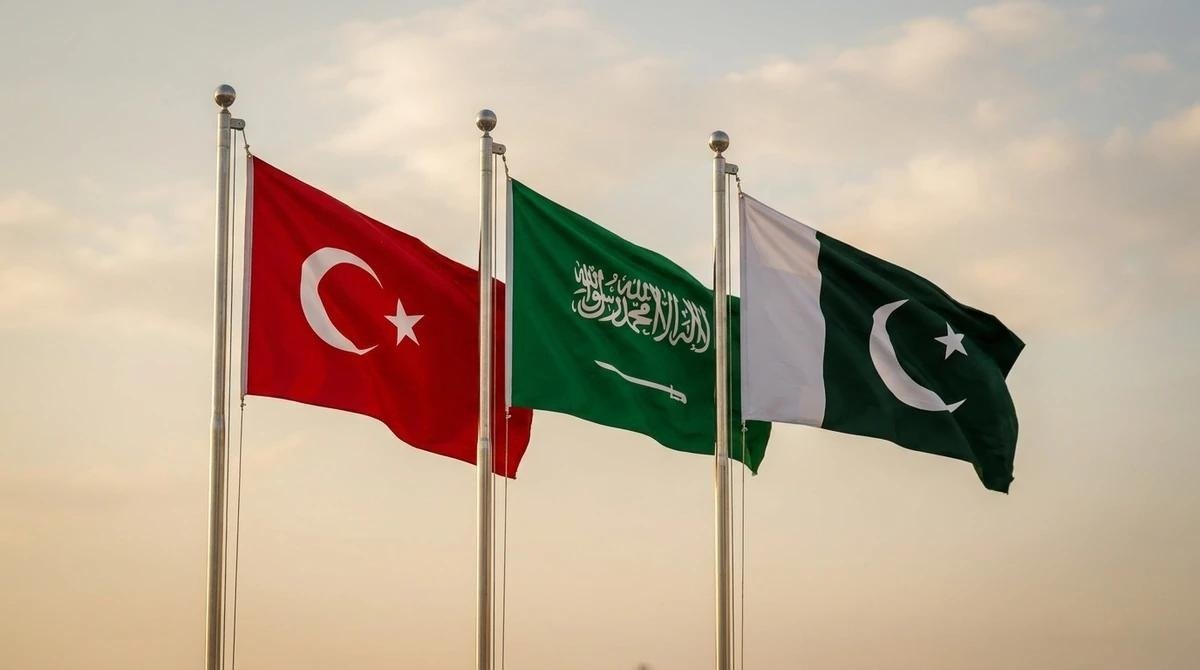
The more meaningful question is whether Pakistan, Saudi Arabia and Türkiye can use their relationship to create greater security while keeping open the diplomatic space necessary to prevent escalation.
That balance will not be easy.
Saudi Arabia has genuine security concerns. Pakistan has its own regional interests and diplomatic responsibilities. Türkiye has its own strategic calculations. Iran has its own security concerns and regional relationships. None of these states is simply an extension of another, and none will surrender its national interests merely because a new agreement has been signed.
That is precisely why the Iranian question deserves a careful examination rather than another round of accusation.
Iran has spent years developing relationships and supporting partners across the region as part of a strategy intended to protect its interests and extend its strategic reach. But every regional strategy produces reactions from other states. When neighbours conclude that one country’s growing influence creates new risks for them, they begin looking for ways to strengthen their own position.
The question Tehran eventually has to confront is therefore a strategic one: At what point does a strategy intended to make Iran more secure begin producing the very regional alignments that make Iran’s own security environment more contested?
The emergence of closer cooperation between Saudi Arabia, Pakistan and Türkiye does not by itself answer that question, and it would be premature to assume that the three countries will automatically act together in every future crisis. Their interests remain distinct. But their decision to formalise a closer security relationship is nevertheless part of a changing regional picture, and that picture deserves to be understood rather than dismissed as another temporary alliance.
There is another lesson here that extends beyond military affairs.
Countries need a vision that reaches further than the crisis immediately in front of them. Security matters, but so do functioning institutions, economic opportunity, education, social confidence and the ability of one generation to leave the next with better choices than it inherited.
This is particularly important for those who have already lived through several decades of political and regional turbulence. Older generations have seen policies succeed and fail, promises kept and broken, and decisions that were once described as temporary become permanent features of national life. Their responsibility is not to decide the future for younger people, but to give them the knowledge and institutions with which they can shape it themselves.
That requires honesty about the past.
A society does not become stronger by pretending that every decision of an earlier generation was correct. Experience becomes useful only when it includes the courage to acknowledge mistakes. What worked should be preserved; what failed should be understood; and what caused unnecessary suffering should not simply be passed forward as inherited wisdom.
That is also what vision means.
It is possible to have extraordinary amounts of information and still fail to understand the direction in which events are moving. It is possible to have military strength and still make decisions that create greater insecurity. And it is possible to speak constantly about peace while allowing every crisis to become another step towards confrontation.
The present Saudi situation offers a very different possibility.
The Makkah agreement can become a framework through which its members strengthen one another while maintaining enough restraint to prevent regional tensions from turning into a wider conflict. Its members have publicly described it as defensive, and the DG ISPR has emphasised that it has no regional ambitions and is intended for collective deterrence and stability.
But there is no need to know every military detail in order to understand the larger message.
When a foreign journalist asks, “What will you do if one of your partners is attacked?”, and the answer is that the public will not be told the operational details, that answer should not automatically be mistaken for uncertainty.
It may simply reflect an old and practical principle of statecraft: commitments can be public while methods remain private.
The public can know that the partners have made a commitment. The public can know the broad purpose of that commitment. What does not have to be placed before television cameras is the precise sequence by which that commitment would be implemented in a real crisis.
That is not evasion. It is the boundary between political communication and military planning.
And perhaps this is where Helen Keller’s words return to us.
Sight tells us that Saudi Arabia is under pressure, that the Houthis remain capable of striking, that regional relationships are changing and that new security arrangements are emerging. Vision asks a more difficult question: what should governments do with that knowledge before another crisis becomes another war?
The answer will not come from louder threats or more dramatic statements.
It will come from preparation, restraint, diplomacy and the quiet understanding that some of the most important decisions are the ones a government does not need to announce before the moment arrives.
The world can see the agreement.
The world can see the crisis.
The world can hear the questions.
What it does not necessarily need to see is the entire answer.
Because sometimes the clearest sign that a country understands the seriousness of its responsibility is that it knows exactly what it can say publicly – and exactly what it must keep to itself.
That is why the answer to the foreign journalist’s question may ultimately be more significant than a detailed military response would have been.
Pakistan has said what the agreement means.
It has not said exactly how it would be implemented.
And perhaps that is the point.
We know more than we say because, in matters of national security, knowing when to speak and knowing when not to speak are both parts of seeing clearly.
Disclaimer: The views and opinions expressed in this article are solely those of the author and do not necessarily reflect the views, policies, or position of this website. The website does not endorse or oppose any opinion presented herein.