

Hajiani Lanjo grew up in a small village called Alamsir, near Mithi in Tharparkar, Sindh. Her family were landless peasants with almost nothing. She studied at a government primary school in a nearby village, walking through some of the toughest terrain in the country just to attend class. Against heavy odds, she became the first woman in her family to reach college, later trained as a lawyer, and built a women’s rights movement in her district. Her story shows how much extra distance and struggle it takes for someone from a remote district to get an education at all.
Not far away, in Nagarparkar, Dr. Najma Khoso worked for years as the only female gynecologist serving the entire area. Patients travelled from villages scattered across Tharparkar just to see her. When cases got serious, families had to go over 200 kilometers away to Hyderabad for proper treatment. These challenges highlight the difficulties Pakistan continues to face in delivering services across geographically large and diverse regions.
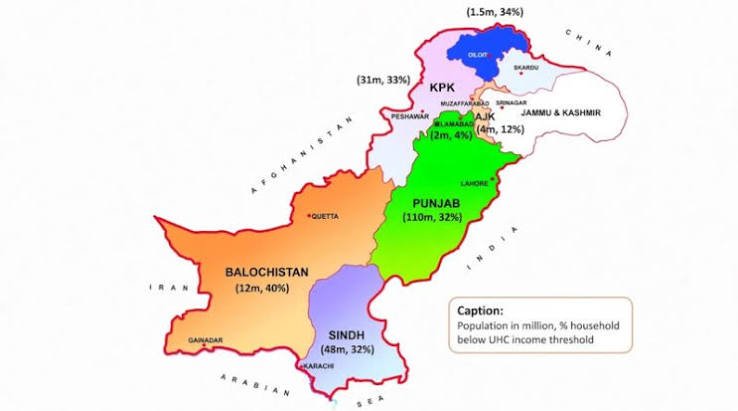
This is the real argument behind Pakistan’s debate on new provinces. Punjab alone has more than 127 million people, more than Japan’s entire population, governed from one city, Lahore. Sindh has almost 56 million people managed through just six divisions. One office, far away in Lahore or Karachi, tries to run daily life for tens of millions of people living hundreds of kilometers from that office. Many Pakistanis now believe it is time to create smaller provinces, so government comes closer to the people it serves.
The Cost of Distance
Someone living in Rajanpur, South Punjab, may need to travel over 500 kilometers to Lahore just for a provincial-level approval or a court hearing, a full day’s journey for basic government work. The same struggle repeats in interior Sindh, upper Balochistan, and Hazara, the struggle that shaped Hajiani Lanjo’s path to college and Dr. Khoso’s daily work as one doctor for thousands of patients.
Big provinces also mean overloaded bureaucracies. A single Chief Minister’s office in Lahore answers for a population larger than most European countries combined. The scale of provincial administration can make it challenging to ensure that development priorities and administrative attention reach distant districts with equal speed and effectiveness.
Smaller Provinces, Closer Government
Supporters argue that smaller units would put administration physically closer to ordinary people. Government offices would be a short trip away instead of a whole day’s journey. Local leaders, who understand local problems, would have more power and more direct responsibility. This is the basic principle behind the case for greater administrative decentralisation: people should not have to travel far or wait long to access essential government services.
This closeness matters most in health and education. Big hospitals and top government colleges are mostly built in provincial capitals, Lahore, Karachi, Peshawar, Quetta. A smaller province, with its own capital and budget, could build hospitals and colleges closer to home, cutting travel time and, in emergencies, saving lives. In parts of Pakistan, mothers still die during childbirth simply because the nearest proper hospital is too far away. Faster, closer access to healthcare directly affects maternal and child mortality rates, an issue Pakistan has struggled with for years.
The Money Question
There is also a financial side. Pakistan’s National Finance Commission (NFC) Award shares federal money mostly based on population. Balochistan possesses significant gas and mineral resources, while its relatively small population and vast geographical area create distinctive challenges for resource allocation and service delivery. South Punjab argues that most of the province’s development budget goes to central and northern Punjab, leaving the south behind.
If South Punjab, Hazara, or other regions became separate provinces, they would get their own direct share in the NFC Award, instead of depending on a distant provincial government with other priorities. Local roads, schools, and hospitals could then be funded based on local needs, not decisions made hundreds of kilometers away.
A Fairer Pakistan
The Analysts say this is not about dividing land apart, it is about making it work better for everyone. Smaller provinces would mean faster police response, hospitals built where they are actually needed, and schools with proper funding. People like Hajiani Lanjo would not need to beat impossible odds to reach a college, and doctors like Najma Khoso would not have to carry a district’s healthcare alone.
Pakistan’s experience with administrative decentralisation at the divisional level offers examples of how bringing administration closer to communities can support accessibility and service delivery. Extending this approach to the provincial level could help improve governance, accessibility and service delivery, creating meaningful and lasting benefits for millions of ordinary Pakistanis.
The demand for new provinces comes from a simple wish; government should not feel distant. It should be close enough to help when people need it most, in a hospital, a classroom, or an office down the road, not hundreds of kilometers away.
Disclaimer: The views and opinions expressed in this article are solely those of the author and do not necessarily reflect the views, policies, or position of this website. The website does not endorse or oppose any opinion presented herein.