

Pakistan’s future cannot be escorted by strategic minds alone. A nation certainly needs strategic vision, strong institutions, defence preparedness and the capacity to read the changing world. But long before a young Pakistani becomes a strategist, an officer, a scientist, a professional or a leader, someone must first teach that child how to read, how to think and how to understand where he or she comes from.
Sometimes that nation-building begins with nothing more than a pen, a piece of paper and a teacher who refuses to believe that his work is small.
The life ofMaster Bashir Ahmed Sahib is one such story.
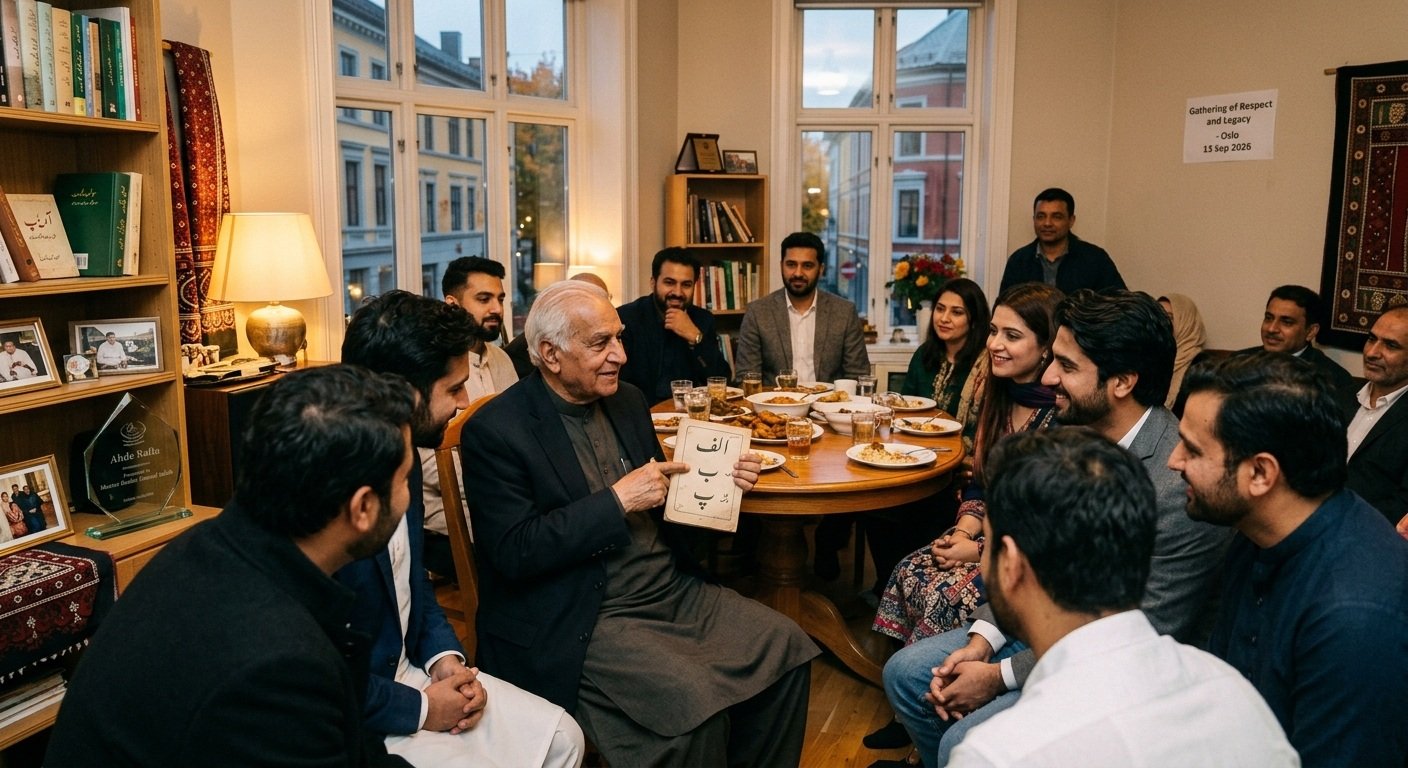
On 13 September 2026, in Oslo, we gathered around him for a lifetime gathering and dinner. The purpose was not simply to celebrate an elderly teacher, but to listen to a man whose decades of quiet service had left an imprint on generations of Pakistani families in Norway.
There was also an important context to our gathering. His services had already been formally recognised by Pakistan. On8 June 2026, at the cultural event“Ahde Rafta,” held in Oslo to commemoratefive hundred years of Mughal heritage in Pakistan, AmbassadorMadam Sadia Altaf Qazi presented Master Bashir Ahmed Sahib with a shield on behalf of Pakistan and the Embassy of Pakistan in Oslo. I had the privilege of being present and witnessing that moment.
Our September gathering was therefore not another ceremony of recognition. We wanted something different. We wanted to sit with him, hear his experiences, benefit from his knowledge and, most importantly, consider how the values of his life could be carried into the future.
His story reaches back to the 1970s, when he came to Norway with no great wealth or social standing. What he had was aB.Ed., a pen, paper and the ability to teach.
In a new country, where Pakistani families were establishing themselves and their children were growing up between two cultural worlds, he began teaching Urdu. His lessons started with the simplest foundations-Alif, Bay, Pay.
Yet those letters carried something much larger.
Through Urdu, children were introduced to the language of their parents and grandparents, to literature, history and cultural memory, and to a part of Pakistan that could otherwise have gradually become distant. He was teaching a language, but he was also helping a generation understand the country from which their families had come.
That distinction matters.
For an immigrant community, preserving a language is not merely an exercise in nostalgia. It can provide a child with access to family history and a sense of continuity between generations. In Oslo’s early Pakistani community, including what later became popularly known as“Little Pakistan,” teachers such as him played a quiet but important role in keeping that continuity alive.
A Generation That Remembers
His life also belongs to a wider generation of Pakistani immigrants whose personal histories are inseparable from the transformation of Norway.
The close friends with whom he now spends his later years are, in many ways, keepers of a shared memory. Some of them experienced the early days together-perhaps sharing accommodation, meals, winters, financial constraints and the uncertainties that accompany a new life in another country. They worked, raised families and watched Norway develop into the prosperous, orderly and highly organised society it is today.
Their conversations therefore contain more than personal reminiscence. They carry the memory of a migration story.
Norway’s remarkable development rests on its own democratic institutions, natural resources, responsible governance and the work of generations of Norwegians. But its modern story also includes the immigrants who became part of its society and responded to opportunity with work, responsibility and respect for the law.
The Pakistani community was among them.
People worked in factories and businesses, entered professions, paid taxes, raised children, pursued education and established lives that increasingly became part of the Norwegian social fabric. Their contribution was not separate from Norway’s story; it became part of it.
There is something deeply admirable in that reciprocal relationship: Norway provided an environment in which people could build dignified lives, and those people, in turn, contributed their labour, enterprise, skills and civic responsibility to the country that became their home.
Master Bashir Ahmed Sahib’s contribution came through a different door. His was the classroom.
The Measure of a Teacher
His simplicity is part of what makes his story compelling.
He does not represent success through expensive brands, elaborate clothing, luxury cars or visible status. His appearance is modest and dignified-a simple shalwar kameez, a neat blazer and the quiet confidence of a man who knows the value of what he has spent his life doing.
The real wealth is elsewhere: in knowledge acquired, knowledge shared and lives influenced.
A teacher rarely sees the full consequence of his work. A lesson may last an hour; its effect may last a lifetime. A child sitting before a teacher may later become a doctor, engineer, officer, entrepreneur, scholar, civil servant-or another teacher. The teacher may never know how far a single lesson travelled.
That is precisely why education deserves to be regarded as a form of national service.
For Pakistan, this is not a secondary consideration. Defence protects a nation’s sovereignty; education strengthens the people who must sustain that sovereignty. Strategic institutions may determine how a country responds to challenges, but the quality of its future depends upon the minds being prepared today.
This is why the story of one Urdu teacher in Oslo belongs, in its own modest way, to a much larger Pakistani conversation.
From One Generation to the Next
At our gathering on 13 September, we made a simple commitment in his presence.
When a new child enters school for the first time, we will try to pass on some of what we have received from our elders and teachers. Not merely information, but the value of learning itself.
That child may one day choose any profession. There is no guarantee that he or she will become a teacher. But if the chain of learning continues, another generation will inherit something more valuable than a memory.
Perhaps, somewhere among those children, there will be another person who discovers that a pen and a page can serve a nation just as surely as many other instruments of service.
This is also why the story of Pakistanis living abroad deserves to be viewed through a wider lens. Loyalty to the motherland is not expressed in only one form. Some serve in uniform, some through public life, some through their professions, some through their writing, and some through the quiet work of educating children far from Pakistan.
All of these forms of service have their own dignity.
For those of us accustomed to thinking about Pakistan through the vocabulary of strategy, security and defence, it is worth remembering that national strength has a human foundation. A country needs capable institutions, but institutions ultimately depend upon the quality of the people who enter them.
And the preparation of those people begins with teachers.
Master Bashir Ahmed Sahib spent his life working at that beginning.
The shield presented to him atAhde Rafta was a fitting acknowledgement from Pakistan of a service rendered over decades. What we sought to do in September was different: to listen to the man behind that service and to ensure that his example does not end as a chapter of the past.
Perhaps the most fitting tribute to a teacher is not another ceremony, but a child who learns.
And perhaps one day, when that child opens a book and begins withAlif, Bay, Pay, we will understand what Master Bashir Ahmed Sahib was really giving his students all those years ago.
He was not simply teaching them how to read Urdu.
He was helping them read themselves-and, through them, remain connected to Pakistan.
Disclaimer: The views and opinions expressed in this article are solely those of the author and do not necessarily reflect the views, policies, or position of this website. The website does not endorse or oppose any opinion presented herein.