

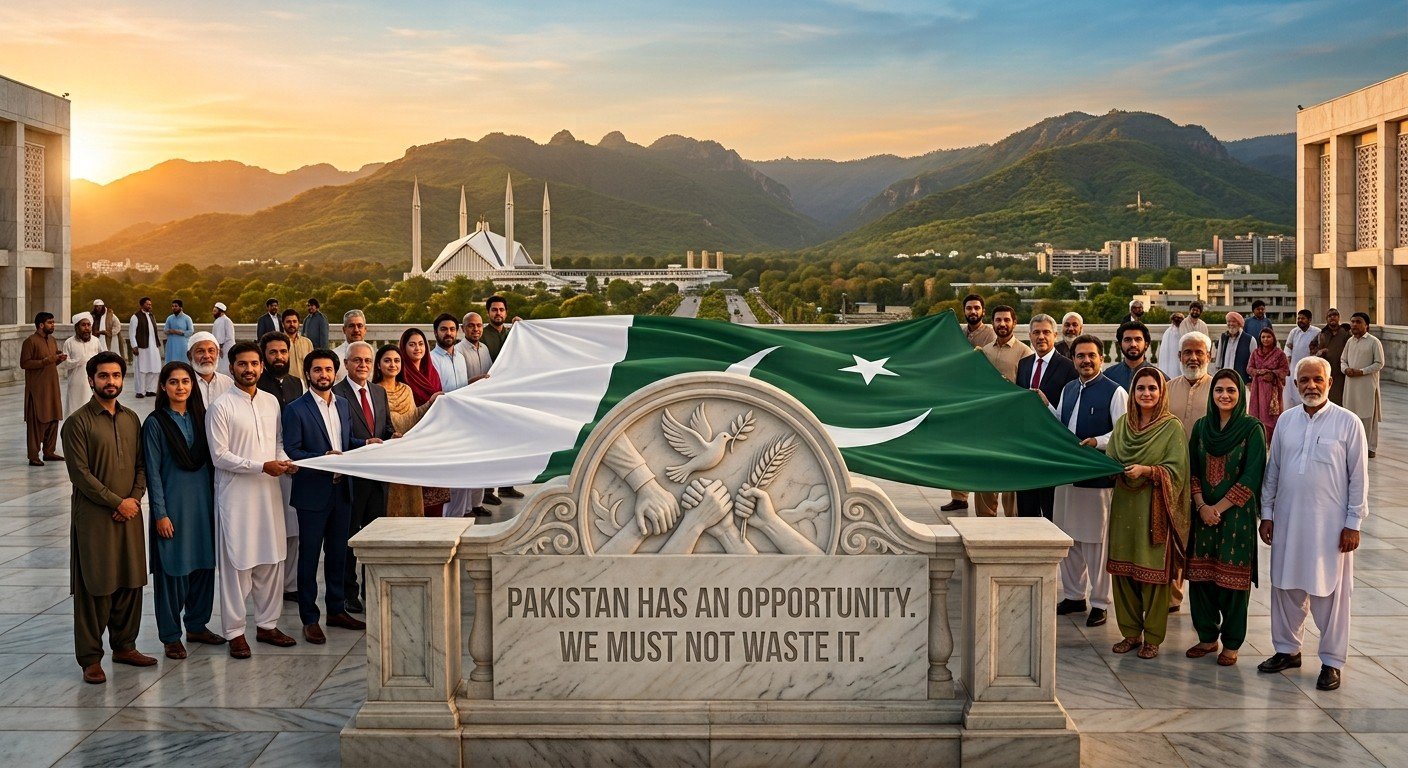
For some time now, Pakistan’s public conversation has once again been dominated by speculation. Every development produces a new prediction, every silence invites another interpretation, and every political possibility is discussed as though it were already a certainty. Much of the national conversation has become focused on what may happen next in the political arena, while a much more important question is gradually being pushed into the background: what should Pakistan itself be doing at this moment?
That question deserves our attention. Political circumstances change, governments change, leaders rise and fall, and political parties pass through periods of strength and weakness. None of these developments, however important in the short term, can become the measure of Pakistan’s future. The country is larger than any political personality and more permanent than any political contest. Whatever happens in the political arena, Pakistan will still have to face the same responsibilities the following morning.
The Larger Question
The timing could not be more important. Pakistan’s strategic and diplomatic environment is changing, and the recent agreement between Pakistan, Türkiye and Saudi Arabia is part of that changing environment. Such developments require prudence, confidence and careful attention to the country’s long-term interests. They also provide an opportunity for Pakistan to consolidate its position and devote greater attention to its own economic, institutional and national strength.
This opportunity should not be lost in another cycle of internal political confrontation.
Pakistan’s political parties have every right to compete. They have every right to disagree with one another, criticise governments, challenge policies and seek the support of the people. That is the nature of political life. But political competition becomes damaging when the success of one side is defined by the failure or humiliation of the country itself. No political victory can be meaningful if Pakistan becomes weaker in the process.
Politics Must Serve the Country
This is where the responsibility of political leadership becomes especially important. Every major political movement in Pakistan has followers who believe deeply in its cause. That commitment is part of democratic politics and should be respected. But political followers should also understand that political loyalty does not require hostility towards fellow citizens. A person who supports another party is not necessarily an opponent of Pakistan. A citizen may disagree strongly with a political position and remain completely committed to the country.
The same principle applies to those who lead these movements. Influence carries responsibility. The larger the following, the greater the responsibility to ensure that political mobilisation does not become social division. Pakistan has no shortage of political energy. What it needs now is to direct that energy towards constructive national objectives.
The country cannot afford a politics in which every development is treated as the beginning of another confrontation and every disagreement is presented as a struggle from which one side must emerge completely victorious. Such an approach keeps society divided and prevents attention from moving towards the matters that will determine Pakistan’s future.
The time has therefore come for political forces to sit together.
This does not mean that differences should disappear. It does not mean that accountability should be abandoned, that political parties should surrender their identities or that legitimate criticism should be discouraged. It means recognising that there are national matters greater than the immediate political contest. Economic stability, national security, institutional continuity, social harmony and the long-term interests of Pakistan cannot remain secondary to political rivalry.
The Responsibility of Influence
There is an important message here for every political worker and follower, regardless of party affiliation. Before accepting or forwarding a claim, it is worth asking whether it is true. Before reacting to a political statement, it is worth considering whether the reaction will improve the situation or make it worse. And before treating another Pakistani as an enemy because of his political preference, it is worth remembering that political affiliations may change, but the country remains shared by all of us.
The information environment has made this responsibility even greater. Speculation travels quickly, but its consequences can remain long after the original claim has disappeared. Political parties, media organisations, commentators and ordinary citizens all have a role in maintaining a national conversation based on responsibility rather than constant confrontation. There is a difference between keeping people politically informed and keeping society permanently agitated.
Criticism has its legitimate place. Debate has its legitimate place. Political opposition has its legitimate place. But all of these must operate within a larger commitment to national stability and constitutional order. Political disagreement should strengthen democratic culture, not weaken confidence in the country itself.
Respect for Institutions
Pakistan’s institutions have defined responsibilities, and the strength of the country depends upon those responsibilities being carried out effectively within the constitutional framework. The armed forces have their national and constitutional responsibilities in safeguarding the country’s sovereignty and security. Political institutions have their responsibilities in governance and representation. The judiciary, media and civil society have their respective roles. A stable Pakistan is one in which these responsibilities complement one another and contribute to the functioning, security and progress of the state.
This is why the present opportunity should be used to strengthen confidence in Pakistan’s institutions and to allow each institution to perform its responsibilities with the seriousness that the national interest requires.
The country does not become stronger when political disagreements are transformed into institutional confrontation. It becomes stronger when differences are managed through the established constitutional and democratic framework.
A Changing World
The international environment makes this even more important. Countries around the world are reassessing their security, economic priorities, strategic relationships and national resilience. Recent conflicts have demonstrated the enormous economic and human cost of prolonged instability. Nations that preserve internal cohesion and use periods of opportunity to strengthen their economic and institutional foundations will be better prepared for the future.
Pakistan should be one of them.
This is the time to look inward in the best possible sense-not to withdraw from the world, but to strengthen the foundations from which Pakistan engages with it. The country needs economic growth, investment, employment, education, technology, institutional capacity and better governance. None of these objectives belongs to one political party. They belong to the next generation of Pakistanis.
Pakistan Comes First
Perhaps that is the message that supporters of every political party need to consider. Whatever political cause one supports today, that cause cannot be greater than Pakistan itself. A political movement may have a legitimate grievance, a strong argument or a deeply committed following. But no grievance is resolved by weakening the country, and no political objective is ultimately served by creating conditions in which ordinary Pakistanis lose confidence in their future.
There will always be another political contest. There will always be another election. There will always be disagreement. Mature nations do not eliminate these differences; they learn how to manage them without allowing them to damage the foundations of the state.
Pakistan now has an opportunity to demonstrate precisely that maturity.
The country has endured difficult periods before and has repeatedly shown resilience. The present moment should therefore not be approached with unnecessary anxiety or political impatience. It should be approached with confidence, discipline and responsibility. The strategic space available to Pakistan should be used to strengthen the country, not consumed by internal division.
The political leadership of the country has an opportunity to begin a different kind of conversation-one in which competition remains, criticism remains and accountability remains, but the constant desire to defeat and discredit one another gives way to a greater concern for national stability and progress.
The past cannot be changed, but the political culture of the future can be.
Pakistan does not need all its citizens to agree with one another. It needs them to understand that disagreement does not make them enemies. It does not need political parties to abandon their identities. It needs them to recognise that every political identity ultimately exists within one national identity.
The opportunity before Pakistan is real, but opportunities do not remain available forever.
This is the time to use the space wisely, to reduce unnecessary confrontation, to bring political forces closer to a workable understanding and to concentrate on strengthening the country.
The world around Pakistan is changing. Pakistan must change with it-not by abandoning its principles, but by becoming more mature, more confident and more united in the pursuit of its national interests.
The political question of the day will eventually pass. The political personalities of today will eventually become part of history. What Pakistan does with this moment, however, will remain with the generation that follows.
The opportunity is before us. The responsibility is ours. Pakistan must not waste it.
Disclaimer: The views and opinions expressed in this article are solely those of the author and do not necessarily reflect the views, policies, or position of this website. The website does not endorse or oppose any opinion presented herein.