

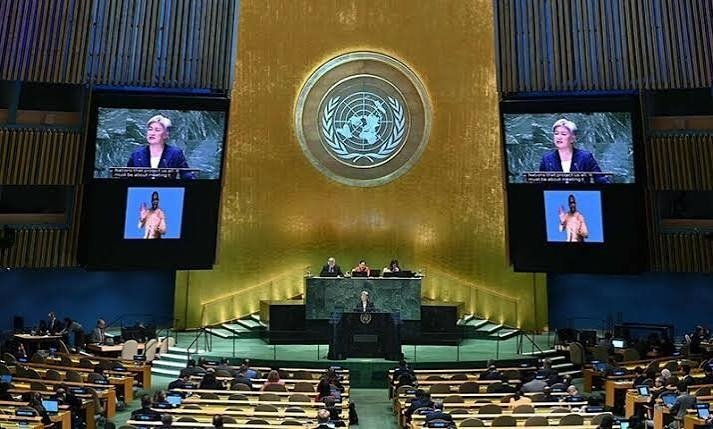
The United Nations still provides the world with an important diplomatic stage, but the stage should not be confused with the balance of power behind it. When major powers disagree, the institution can become a place where positions are declared rather than problems resolved. The recent General Assembly once again exposed the distance between international representation and the realities of power.
For Pakistan, however, the more important question is not whether the UN has lost some of its effectiveness. It is how a country should operate when the international environment itself is becoming less predictable.
Pakistan’s security challenges are no longer neatly separated. Militancy and border tensions can exist alongside conventional pressure. Drones, cyber activity and information warfare can accompany developments on the ground. A crisis that begins along a frontier can quickly acquire diplomatic, economic and technological dimensions.
The challenge, therefore, is not simply to prepare for more threats. It is to deal with several forms of pressure arriving at the same time.
Pakistan’s armed forces have considerable experience of adapting to this changing environment. Their responsibilities have expanded well beyond conventional battlefield preparedness to include counterterrorism, border security, air and maritime security, intelligence and increasingly complex forms of modern warfare.
This raises a different strategic question: how effectively can these capabilities be connected?
That may become more important than simply adding another capability.
A piece of intelligence is valuable when it reaches the right decision-maker in time. Technology matters when it can be incorporated into an operational system. Defence cooperation becomes meaningful when it produces practical capacity rather than remaining at the level of political declarations. Diplomacy is stronger when it operates with a clear understanding of the security environment.
The strategic requirement, in other words, is increasingly one of integration.
This is where the Makkah Joint Defence Agreement involving Pakistan, Saudi Arabia and Türkiye deserves attention. The three countries have begun developing institutional arrangements around the agreement, including mechanisms for defence cooperation, technology development and production. Their foreign ministers also met on the margins of the UN General Assembly on 25 September to review implementation and discuss further institutional steps.
The significance of this framework should not be measured simply by the fact that another defence arrangement now exists.
Its greater potential may lie in bringing together different national strengths.
Pakistan contributes extensive military experience and an established defence structure. Türkiye has developed substantial defence-industrial and technological capabilities. Saudi Arabia possesses major strategic, economic and geographic importance. If these strengths can be connected intelligently, the result could be more useful than a conventional partnership based largely on political statements.
The practical possibilities are broad: defence production, research and development, training, intelligence coordination, early warning, air and maritime awareness, cyber cooperation and mechanisms for consultation during a crisis.
Not all of these need to emerge at once. Nor does every area of cooperation need public disclosure. The important point is to create mechanisms that function before a crisis rather than attempting to build cooperation after one has already begun.
That would also be consistent with the professional mindset of Pakistan’s military institutions, where preparedness is ultimately about preserving options when circumstances change rapidly.
The same principle could be applied at the national level.
Pakistan already possesses several important instruments: an experienced military, strategic deterrence, intelligence institutions, diplomatic relationships, a growing defence-industrial base, technological expertise and access to significant regional partnerships. The strategic opportunity is to make these instruments complement one another more effectively.
This does not require Pakistan to turn away from multilateral institutions. The UN remains an important forum for diplomacy, international legitimacy and engagement, even when its limitations are visible. But no international institution can substitute for a country’s own ability to understand threats, make timely decisions and maintain sufficient room for strategic choice.
That is perhaps the more useful lesson from a changing international order.
Pakistan can continue to engage the world diplomatically while simultaneously strengthening the systems through which it protects its interests. The two are not contradictory. What matters is that external engagement rests on a capable and coordinated national foundation.
The Makkah framework offers a similar opportunity. Its ultimate value will not be determined by the language of communiques or the number of meetings held. It will be determined by whether Pakistan, Saudi Arabia and Turkiye can gradually turn political understanding into institutional capacity.
For Pakistan, this could become a strategic project worth developing carefully and patiently.
The country has spent decades learning how to respond to different forms of conflict. The next requirement may be learning how to connect those responses into a security architecture that is faster, more coordinated and adaptable to several pressures at once.
The question, therefore, is no longer simply how much capability Pakistan possesses.
It is how well those capabilities work together.
That may be the strategic advantage that matters most in the next decade: not necessarily more instruments, but better integration of the instruments Pakistan already possesses.
Disclaimer: The views and opinions expressed in this article are solely those of the author and do not necessarily reflect the views, policies, or position of this website. The website does not endorse or oppose any opinion presented herein.