

Modernity, national confidence and the value of freedom
There is a curious phenomenon in the life of nations: what the outside world recognises as an achievement, people at home can sometimes take for granted. We become so accustomed to what we possess that we forget how difficult it was to build, how much sacrifice it required, and how easily its value can be overlooked.
Pakistan deserves to be viewed through this wider perspective.
Across the Muslim world, Pakistan carries a distinct identity: a country with a modern state, a professional military, a strategic nuclear capability, scientific and technical talent, and a long history of participating in important international affairs. Its standing has been shaped not by a single achievement, but by generations of scientists, engineers, soldiers, diplomats, entrepreneurs, teachers and ordinary citizens who have contributed to the country’s development.
Yet the Pakistani citizen does not always recognise the full significance of this national inheritance. That is not a uniquely Pakistani tendency. People everywhere can undervalue what is familiar and admire what appears distant. We often notice the value of something only when we see it from another perspective.
The task before us is not to exaggerate Pakistan’s achievements or deny its difficulties. It is to understand what the country has accomplished, recognise what remains unfinished, and develop the confidence to build on its strengths.
Modernity Is More Than a Western Label
Pakistan’s modern outlook has been one of its important national assets. Its development of scientific institutions, universities, industrial capabilities, professional services and a sophisticated defence establishment reflects a sustained effort to participate in the modern world while retaining its own identity.
Modernity does not require a nation to abandon its faith, traditions or cultural inheritance. It requires the ability to apply knowledge, organise institutions, develop technology and respond intelligently to changing circumstances.
A society can remain deeply connected to its history while embracing scientific discovery. It can preserve its religious identity while investing in research. It can respect tradition while encouraging its young people to question, innovate and create.
This is the distinction Pakistan must continue to develop: confidence in its identity combined with openness to knowledge.
The achievements of Pakistani scientists and engineers, the development of the country’s nuclear programme, its professional military institutions and the contributions of its diaspora demonstrate that Pakistanis can operate at the highest levels of technical and professional competence.
These accomplishments should not become reasons for complacency. They should become reasons for greater ambition.
A country that has demonstrated the ability to develop complex capabilities should also aspire to expand its scientific research, improve its educational standards, strengthen its industries and create more opportunities for its young people.
National pride becomes meaningful when it encourages further achievement.
The Muslim World and Pakistan’s Distinctive Place
Pakistan occupies a distinctive place in the imagination of many people across the Muslim world. Its identity combines a Muslim national foundation with modern state institutions, an established defence capability, a large and youthful population, and experience in diplomacy and international engagement.
Its nuclear capability, in particular, established a significant position for Pakistan in the strategic affairs of the Muslim world. The achievement reflected decades of effort by scientists, engineers, political leadership and military professionals.
But a nation’s standing cannot be measured by military strength alone. It also depends on the quality of its education, the reliability of its institutions, its economic performance, the confidence of its people and the contribution it makes to international stability.
Pakistan’s potential is therefore much wider than its defence achievements. Its future influence can grow through scientific collaboration, trade, technological development, education, cultural exchange and constructive diplomacy.
The country should aspire to be recognised not only for the strength it possesses, but also for the knowledge it creates, the opportunities it provides and the solutions it contributes to shared challenges.
The Muslim world does not need another competition in slogans. It needs societies that can transform intellectual talent into scientific progress, economic opportunity and responsible leadership.
Pakistan has the foundations to contribute meaningfully to that future.
Europe Reminds Us That No Achievement Is Permanent
Consider Europe, and France in particular. These are societies with long histories of scientific discovery, industrial development, cultural influence and institutional achievement. They have built systems that many people around the world continue to study and admire.
Yet contemporary events remind us that no society is permanently protected from political disagreement, economic pressure or public dissatisfaction.
France has recently experienced serious unrest and political uncertainty, while concerns about public finances have placed additional pressure on its political leadership. These developments illustrate the difficult work required to sustain public confidence, manage competing expectations and preserve social stability.
This is not a reason to dismiss France or underestimate European achievements. Its scientific institutions, industries, universities and cultural influence remain important. Rather, the lesson is that even established societies must continually work to maintain the systems they have built.
The same principle applies to Pakistan.
We should not measure our progress solely by comparing ourselves with another country, nor should we assume that another country’s difficulties prove our own superiority. Every society has strengths, weaknesses and challenges that must be understood in context.
The more useful question is what we can learn from these experiences.
Institutions require maintenance. Public trust requires effort. Economic progress requires discipline. Freedom requires responsibility. And national achievements require continued investment if they are to endure.
No country can simply inherit success and expect it to last forever.
Freedom Is Not a Lollipop
Freedom is often discussed as though it were a gift that can be enjoyed without responsibility. In reality, freedom is one of the most demanding responsibilities a society can possess.
Freedom is not a lollipop that is handed to us merely because we wish to have it. It is a responsibility that must be protected, exercised wisely and passed on with care.
The freedom of a nation rests on more than declarations. It requires institutions capable of functioning, citizens willing to fulfil their responsibilities, leaders prepared to make difficult decisions, and a public that understands the difference between disagreement and destruction.
Freedom also requires the discipline to accept that other people may hold different opinions. It allows citizens to question, debate and seek improvement, but it does not remove the obligation to respect the rights and dignity of others.
A society that confuses freedom with the absence of responsibility risks weakening the very institutions that protect its freedoms.
Likewise, a society that treats every question as disloyalty risks losing the creativity and honest debate that help institutions improve.
The challenge is to preserve both freedom and responsibility: the freedom to think, learn and contribute, and the responsibility to ensure that our actions strengthen rather than damage the society we share.
For Pakistan, this is not an abstract philosophical concern. It is central to the future we wish to build for our children.
The Difference Between Possessing Strength and Using It Wisely
Pakistan has demonstrated important capabilities. The question now is how to convert those capabilities into broader and more lasting national progress.
Military professionalism must be accompanied by continuous learning. Scientific talent must find opportunities to contribute at home. Education must equip young people not merely with certificates but with practical knowledge. Industry must develop the ability to innovate and compete. Public institutions must continually improve their performance.
The same principle applies to leadership.
A strong leader does not need to pretend that every decision is perfect. Strength includes the ability to assess evidence, recognise changing circumstances and improve an approach when necessary.
A confident nation does not need to measure itself against others through resentment. It can study their achievements, understand their mistakes and use that knowledge to improve its own future.
Pakistan should approach the modern world with this combination of confidence and realism. Its identity is not a limitation on progress. Its achievements are not a reason to stop learning. And its difficulties should not become an excuse to abandon ambition.
The purpose of national confidence is to give people the courage to do more, not the permission to do less.
What Pakistanis Must Recognise
It is easy to take national achievements for granted when we encounter them every day. A professional institution, a scientific capability or an established national service may appear ordinary to those who have grown up with it.
Yet many such achievements are the result of decades of effort, difficult choices and contributions by people whose names are not widely known.
Our responsibility is to recognise that inheritance without becoming complacent about it.
We should honour the scientists who developed national capabilities, the teachers who educated generations, the professionals who built institutions, the soldiers who served their country, the entrepreneurs who created opportunities and the citizens who continued working through difficult circumstances.
But recognition must be accompanied by a question: what are we doing with what they left us?
Are we expanding educational opportunities? Are we creating an environment in which young people can use their talents? Are we strengthening research and industry? Are we making institutions more effective? Are we preparing our children to understand a world that will be very different from the one we inherited?
These questions are not expressions of pessimism. They are expressions of responsibility.
A nation that recognises its achievements honestly can build on them with greater confidence.
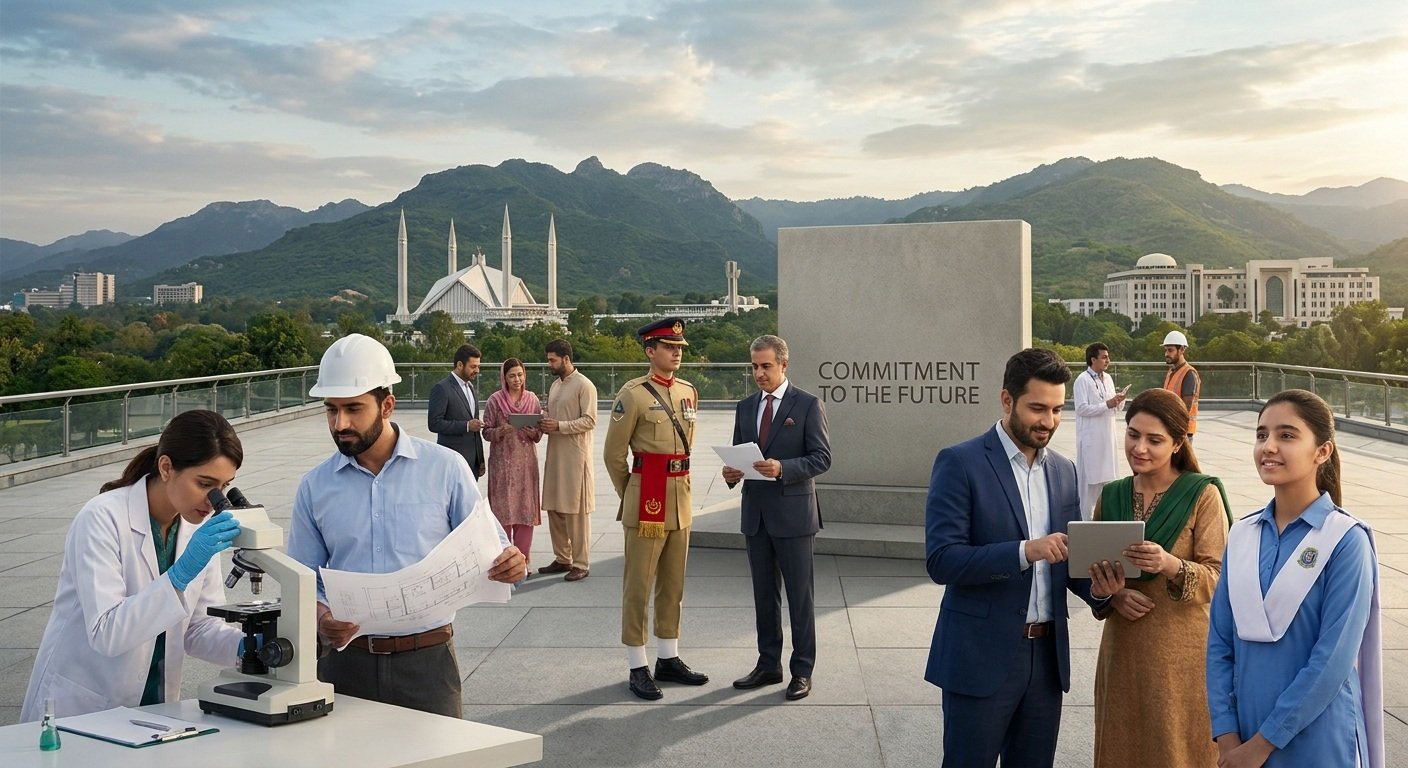
Patriotism as a Commitment to the Future
Patriotism should not be reduced to the repetition of national slogans. Nor should it depend on the denial of every difficulty.
Its deeper meaning lies in wanting the country to become stronger, more capable, more prosperous and better prepared for the next generation.
For one citizen, patriotism may mean developing a new technology. For another, it may mean teaching a child, running an honest business, improving a public service or helping a family become self-reliant.
For a professional who has completed a long career, it may mean sharing experience with younger people and helping them avoid mistakes that took years to understand.
For a student, it may mean acquiring a skill that contributes to the country’s future.
Every generation receives something from those who came before it. The question is whether it will preserve that inheritance, improve it and pass it on in better condition.
Pakistan’s modern achievements should inspire precisely this sense of obligation.
We should be proud of what our country has accomplished, confident in what its people can achieve, and honest about the work still required.
A Nation Must Believe in Its Own Potential
Pakistan does not need to spend its future proving that it is superior to every other country. It needs to demonstrate, through its achievements, that it can turn potential into progress.
Its scientific and technical talent must be developed. Its institutions must continue to learn. Its young people must be given opportunities to succeed. Its national strengths must be used to improve the lives of its citizens.
The world is changing, and the countries best prepared for the future will be those that combine knowledge with discipline, confidence with humility, and ambition with responsibility.
Pakistan has already demonstrated that it can achieve things that once appeared difficult. The next challenge is to make progress more widely felt in the daily lives of its people.
Let us appreciate our national inheritance without taking it for granted. Let us learn from the world without losing confidence in ourselves. Let us defend our freedoms while remembering the responsibilities that accompany them.
Above all, let us recognise that patriotism is not merely the celebration of what Pakistan has been. It is a commitment to what Pakistan can become.
A nation honours its past most meaningfully when it uses that inheritance to build a better future. Pakistan’s greatest achievement will not be that the world recognises its potential, but that its own people learn to fulfil it.
Disclaimer: The views and opinions expressed in this article are solely those of the author and do not necessarily reflect the views, policies, or position of this website. The website does not endorse or oppose any opinion presented herein.