

Sitting in the calm, orderly society of Norway, one cannot help but notice a striking contrast when observing the fires of the Middle East. Here, stability is considered success; there, conflict is still too often mistaken for strength.
And yet, the fundamental question remains unchanged:
Who is winning, and who is losing?
When we move beyond surface-level narratives and emotionally charged interpretations in the tensions between Iran and Israel, a more complex reality emerges. One side claims tactical superiority; the other speaks of long-term endurance.
But the truth is less dramatic and more sobering:
No one is decisively winning, and no one can afford to lose.
The real battlefield is not only physical-it is psychological.
One of the enduring dilemmas of our time is the elevation of religious emotion over strategic reasoning. History, however, teaches the opposite lesson.
When emotional narratives dominate, those who call for restraint are labeled weak, and those who question decisions are accused of lacking faith. Yet true courage lies in confronting reality-even when it challenges deeply held beliefs.
Religion, in such conflicts, often becomes a source of legitimacy and mobilization. But it should not replace sound judgment.
In such a volatile environment, if Pakistan advocates for restraint, dialogue, and mediation, it should not be misread as weakness.
Institutions such as Inter-Services Public Relations reflect a strategic understanding shaped by experience:
Not every war is meant to be fought-some are meant to be prevented.
This is not the logic of retreat, but of maturity.
A critical question arises: who should guide decisions of war and peace?
Should it be those driven by ideological or religious certainty?
Or those who evaluate consequences across society, across generations?
Modern statecraft demands leadership that thinks beyond immediate emotion, anticipates long-term repercussions, and understands the cost of escalation. The difference between reaction and strategy is often the difference between survival and collapse.
An old strategic question persists:
Is attacking the path to victory?
Or does restraint invite defeat?
Neither is universally true.
An unprepared attack leads to destruction.
A passive defense invites erosion.
The real principle is this:
The greatest threat today is not always the external enemy, but internal illusion.
When nations begin to believe their own constructed narratives unquestioningly, they lose the ability to assess reality. And when that happens, defeat begins not on the battlefield, but in the mind.
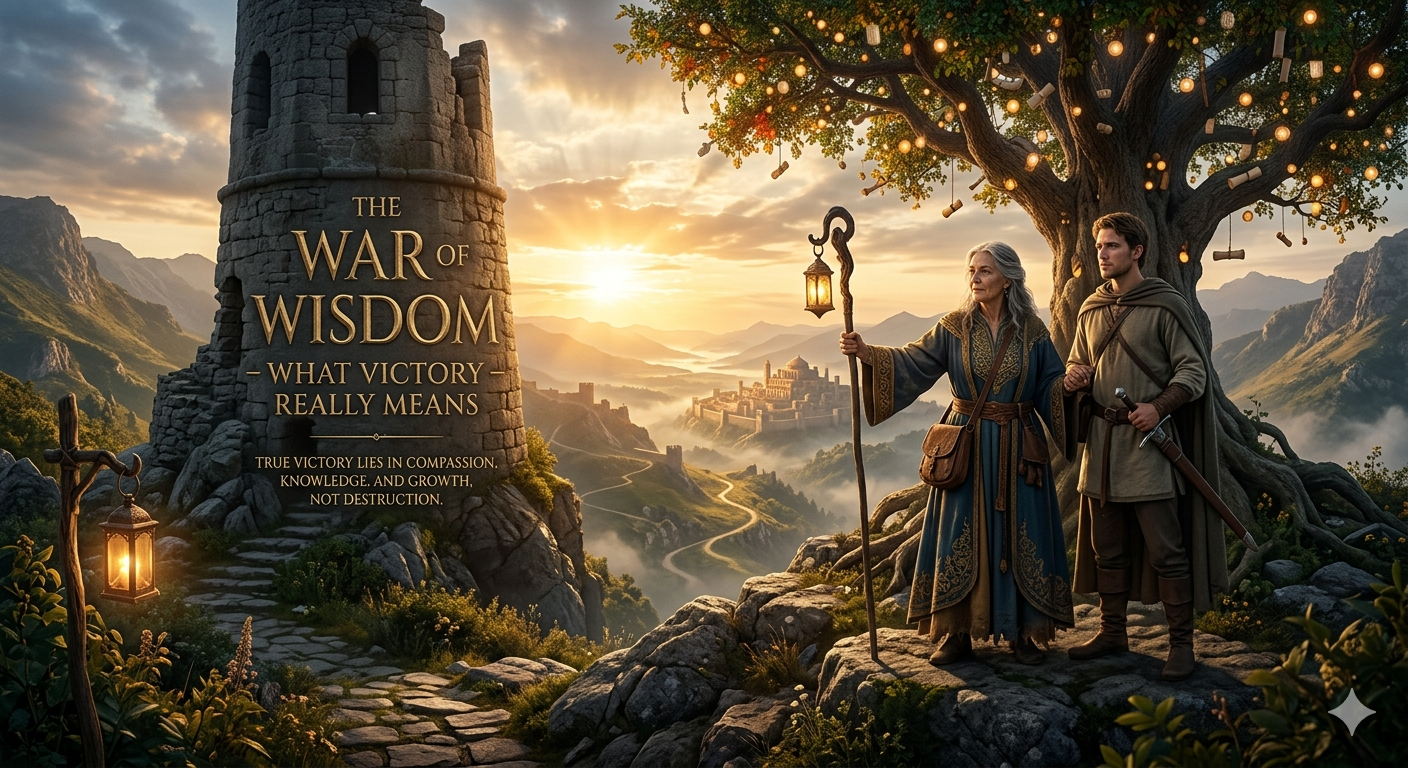
Victory is not merely territorial gain, nor is it the ability to inflict damage. It lies in preserving one’s people, strengthening institutions, and making decisions that can withstand the judgment of history. A decision taken with clarity and restraint often carries greater weight than actions driven by impulse or perception.
And above all, sanity must prevail. When wisdom is sidelined and thoughtful voices are dismissed under the pressure of emotional or ideological influence, the balance of judgment begins to erode. There is an old lesson in the story of a creature turned into something greater than its nature-it gains the form of strength but not its understanding. When those who are truly capable begin to act under the manipulation of the unwise, the natural order itself is disturbed. Power without preparedness breeds fear, and fear, in turn, breeds instability. If such a cycle is not checked, it does not merely harm one nation or one conflict-it unsettles the wider balance upon which all societies depend.
Disclaimer: The views and opinions expressed in this article are solely those of the author and do not necessarily reflect the views, policies, or position of this website. The website does not endorse or oppose any opinion presented herein.