

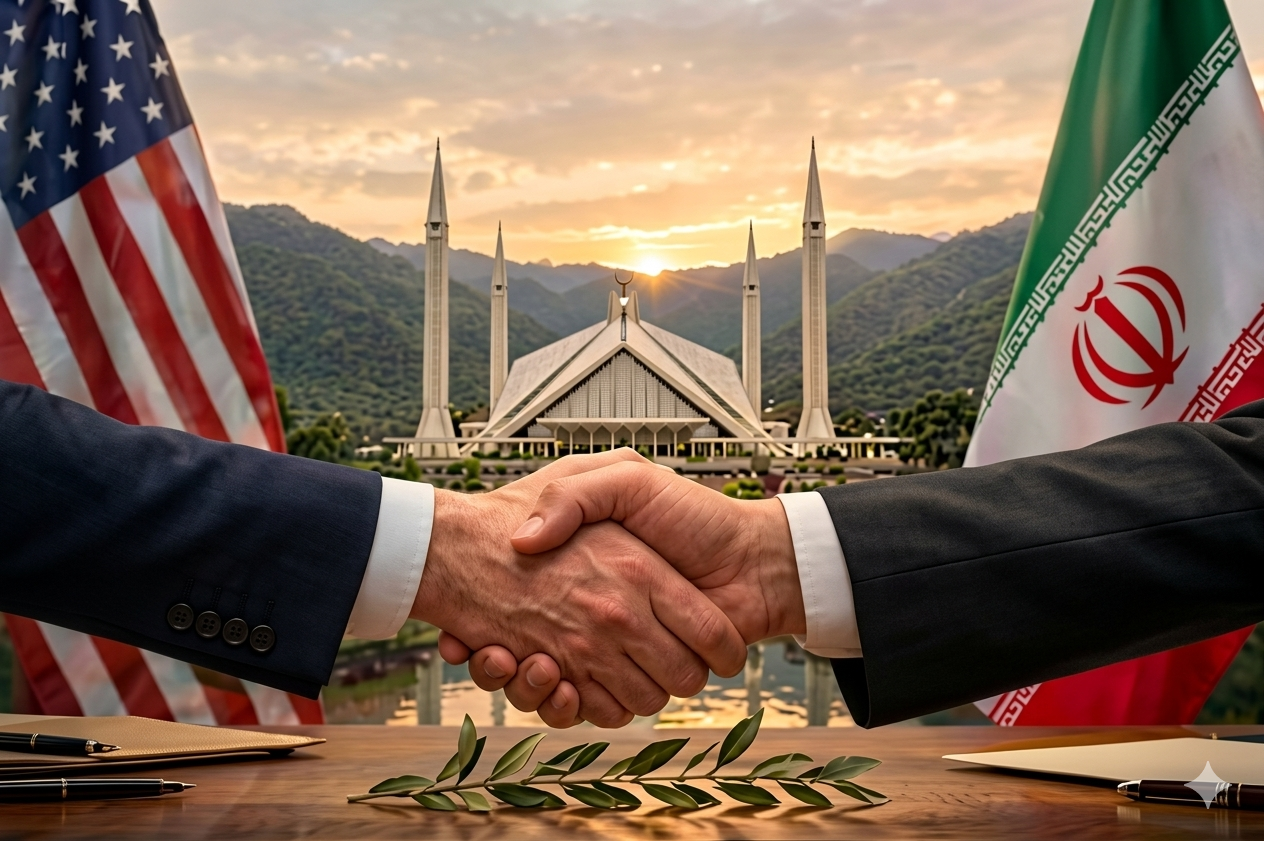
Islamabad and the Renaissance of Global Diplomacy
Imagine a world where tomorrow any nation is asked to bring peace between two powerful rivals -whether it is Russia and Ukraine, or any other divided front. In such moments, success does not come from distraction or power alone. It comes from the quiet discipline of patience, structured understanding, and what can be called the art of the accord -the ability to hold opposing realities together until a workable path forward emerges, beyond distraction and political turbulence.
Congratulations to Islamabad and its diplomatic team for contributing to a renewed phase of engagement in an era marked by structural tensions and fragmented global alignments.
If this moment in international diplomacy continues on its current trajectory, it may later be understood as the emergence of a new diplomatic phase associated with the Islamabad process.
What is unfolding reflects a broader recalibration in global affairs, where prolonged confrontation is increasingly being challenged by structured engagement and managed dialogue. In such an environment, diplomacy is no longer limited to formal negotiations between adversaries; it increasingly depends on systems that can sustain communication when direct political space becomes constrained.
Within this evolving architecture, Pakistan’s position is increasingly understood as one of functional connectivity -a role defined not by visibility alone, but by the continuity it enables across divided strategic environments.
In an era where global alignments are fragmented and trust between major actors remains limited, the ability to maintain channels of communication becomes a form of strategic relevance in itself. The value of such positioning lies in preventing dialogue breakdown at moments when geopolitical pressure is at its peak.
Modern geopolitics is no longer shaped solely at negotiation tables. It is shaped by the stability of the systems that surround those tables. Energy corridors, maritime routes, financial flows, and political signaling now operate as interconnected layers. Disruption in one layer quickly transmits pressure across the rest.
The Strait of Hormuz stands as one of the clearest examples of this interdependence -where geography, energy security, and global economic stability converge. In such environments, diplomacy increasingly functions as system maintenance rather than ceremonial engagement. Its purpose is not only to reach agreement, but to prevent collapse in communication itself.
Pakistan’s relevance in this context is best understood through its ability to operate across multiple diplomatic channels without being fully absorbed into any single strategic bloc. This creates utility in environments where direct engagement between principal actors is limited, sensitive, or politically constrained.
Such intermediary roles are often less visible in public narratives, yet they remain structurally important in sustaining continuity during periods of geopolitical tension. Their significance is measured less by declarations and more by the stability they enable in fragmented environments.
At the same time, the current international landscape remains shaped by uncertainty. Regional tensions, differing security perspectives, and overlapping crises continue to influence decision-making among key actors. As a result, many diplomatic processes remain conditional and reversible, progressing through cautious and layered engagement rather than linear resolution.
Within this setting, connectivity between states increasingly carries economic consequences. Access, dialogue, and diplomatic continuity are closely linked with trade routes, investment confidence, and long-term regional stability. Where communication weakens, economic uncertainty tends to increase; where it is sustained, opportunities for stability expand.
This reflects a broader transformation in global affairs: intermediary actors and facilitating states are becoming increasingly important in ensuring that international systems do not fragment under pressure. They do not replace major powers, but they help ensure that engagement between them remains possible.
In this evolving framework, Pakistan’s engagement is situated within the category of system-sustaining diplomacy -where influence is expressed through continuity, access, and the maintenance of dialogue under strain. The importance of such positioning lies in its contribution to keeping diplomatic pathways open when direct channels are under pressure.
Looking ahead, the deeper challenge for all states engaged in such environments is not only external positioning, but internal capacity. Diplomatic relevance must be supported by institutional depth, analytical strength, and the ability to translate access into long-term strategic and economic benefit.
Modern state capability increasingly depends on knowledge systems -the ability to integrate external experience, comparative learning, and structured analysis into decision-making frameworks. In this sense, diplomacy becomes not only a tool of engagement, but also a mechanism for learning and adaptation.
From this perspective, the current phase of global diplomacy is characterized by fragmentation, conditional cooperation, and distributed influence. No single actor determines outcomes independently; rather, outcomes emerge through interaction between multiple layers of engagement operating simultaneously.
Within this structure, Pakistan’s presence reflects a form of functional connectivity that contributes to continuity in complex and sensitive environments. Its significance lies not in isolated moments, but in the broader system stability it supports.
If this trajectory continues, what is currently unfolding may later be understood as part of a wider structural shift in how international engagement is sustained.
Beyond institutional frameworks, there is also a deeper responsibility emerging from such moments -a responsibility to strengthen the intellectual and philosophical foundations of peace itself. The international system cannot remain dependent on repeated cycles of escalation followed by negotiated recovery. Stability requires a more consistent commitment to dialogue as a principle, not only as a reaction to crisis.
In this sense, diplomacy must increasingly be understood as a discipline of restraint -one that discourages the normalization of conflict as a policy tool and encourages structured engagement even under pressure. The true measure of progress is not the management of crisis alone, but the reduction of its repetition.
The Islamabad Accord, viewed through this lens, becomes more than a diplomatic reference point. It becomes a reminder that the future of international relations will depend on whether states prioritize continuity over disruption, engagement over isolation, and structured dialogue over escalation.
In a divided and uncertain world, such approaches represent not idealism, but strategic necessity -and it is within this space that Pakistan’s diplomatic relevance continues to find expression
Disclaimer: The views and opinions expressed in this article are solely those of the author and do not necessarily reflect the views, policies, or position of this website. The website does not endorse or oppose any opinion presented herein.
2 Comments
Echo from Oslo
Brighter vision n beautiful approach on our international Diplomatic victory
Many thanks. A brighter vision and a peaceful approach are often the strongest tools of diplomacy.