

There is a point at which propaganda stops being a battle of narratives and begins to affect real human lives. A photograph, a television headline, a social-media post or an allegation repeated often enough can turn an ordinary person into a terrorist in the public imagination before the facts have been independently established. By the time the truth is examined, a reputation may already have been destroyed, a family humiliated and an entire community pushed further into suspicion.
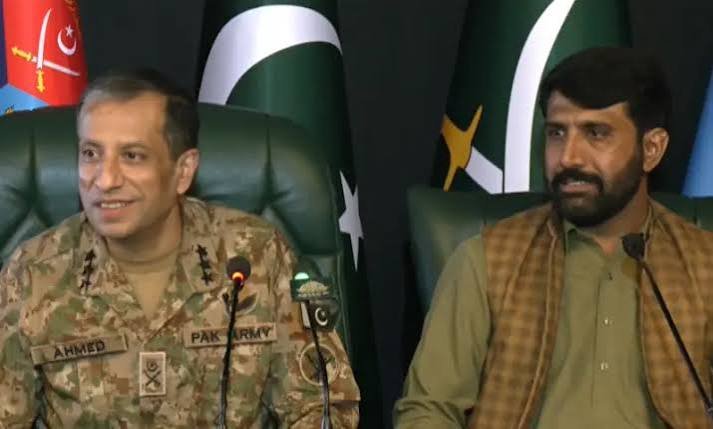
The recent episode involving Muhammad Asif, presented alive at a Pakistani military press conference on October 1, 2026, is a striking example. Indian authorities and media had reported that a man identified as Mohammad Asif, also known as Hashim Musa or Asif Fauji, had been killed in Indian-administered Kashmir and associated him with Lashkar-e-Taiba. Pakistan’s military disputed that identification and presented a former Pakistani soldier, Muhammad Asif, before journalists. Asif said he was alive, living with his family, and had learned through social media that he had supposedly been killed. The Associated Press reported the competing accounts and noted that India had not immediately responded to Pakistan’s presentation of Asif alive.
The Pakistani military spokesperson, Lt Gen Ahmed Sharif Chaudhry, sarcastically described the alleged figure as a “Superman” who appeared to have been credited with an extraordinary list of activities before the living Asif was brought before the cameras. Whatever the eventual independent determination of the identity and circumstances, the episode should remind us of a fundamental principle: an allegation is not evidence, and repetition does not turn an allegation into fact.
That principle cannot belong to one side alone. It must apply to governments, militaries, intelligence agencies, media organisations and armed groups alike. If we demand evidence from our opponents but accept every claim made by our own side, we are not defending truth. We are simply choosing which propaganda we prefer.
The BLA and the distinction between a group and a people
The Balochistan Liberation Army is an armed separatist organisation with a documented record of violence. The United States designated the BLA in 2019 and described it as an armed separatist group that had targeted security forces and civilians, citing attacks including the 2018 suicide attack against Chinese engineers in Balochistan, the 2018 attack on the Chinese consulate in Karachi and the 2019 attack on a hotel in Gwadar.
The United Kingdom has also proscribed the BLA. In 2025, British legislation specified that the Majeed Brigade should be treated as an alternative name for the already-proscribed organisation.
These facts matter because the BLA cannot responsibly be dismissed simply as a label invented by Pakistan. But recognising the record of an armed organisation must never become an excuse to label an entire population by that organisation.
A Baloch civilian is not the BLA. A political activist is not automatically a militant. A critic of the Pakistani state is not automatically an enemy of Pakistan. Equally, acknowledging the grievances of Baloch citizens does not require anyone to endorse violence. Allegations of abuses by state authorities also deserve credible investigation and accountability.
The distinction is simple but essential: an armed organisation must answer for its own actions, while civilians must retain their individual identity and rights.
When grievance becomes an ideology of violence
The BLA is part of a wider problem that exists far beyond South Asia. Across the world, armed organisations and ideological movements have mobilised people around religion, ethnicity, nationalism, separatism or political revolution. Their histories and causes differ, but violence becomes particularly dangerous when a movement persuades its followers that the people on the other side are somehow less deserving of dignity.
The process often begins with identity and grievance. A community is told that its suffering has a single cause and that another group is responsible. History becomes simplified, opponents are collectively blamed, and eventually violence is presented as necessary, heroic or morally justified.
No religion, ethnicity or culture has a monopoly on this phenomenon. Human beings have used many different ideologies to justify violence, just as people from those same traditions have also built movements for peace and reconciliation.
The line Europe and the wider world should draw is therefore not between cultures. It should be between an ideology that recognises the humanity of others and one that permits violence against them.
A legitimate grievance does not automatically legitimise an armed organisation. Political change does not require hatred. Justice does not require dehumanisation.
The new battlefield is the human mind
The modern information battlefield has made this problem more complicated. A video can reach millions before its origin is established. A photograph can be presented without context. An allegation can be repeated across hundreds of accounts until familiarity begins to resemble proof.
For young people growing up in Europe, the consequences can be profound. A young Pakistani, Indian, Baloch, Kashmiri or Afghan who was born in Norway, Britain, Belgium, Germany or elsewhere may have little direct experience of the conflicts that dominate social media. Yet those conflicts can still become part of his or her identity.
One online narrative may portray Pakistan as nothing but oppression. Another may portray India as nothing but aggression. Another may present Balochistan exclusively through the language of resistance. Elsewhere, young people may encounter material portraying every Baloch activist as a terrorist or every critic of the Pakistani state as an enemy.
Each version can remove history, context and individual human experience.
Young Europeans of South Asian heritage should not have to inherit somebody else’s political hatred simply because of their ancestry. They should be taught how propaganda works, how to examine evidence and how to distinguish a government from a population, a political movement from an armed organisation and a genuine grievance from an act of violence.
Their cultural identity should not become a prison built from somebody else’s conflict.
Europe and Norway must raise the voice of humanity
This is where Europe, and particularly Norway, has an important responsibility. European societies have invested heavily in human rights, democratic institutions, the rule of law and peaceful political disagreement. Those principles should not become weaker when conflicts from other parts of the world enter European communities through diaspora politics and social media.
Europe should therefore raise its voice when ideologies begin to draw a line between human beings and cultures. It should reject the idea that taking up weapons is the natural expression of political identity, while still allowing genuine political grievances to be heard.
This is not a plea for Europe to take one side in every dispute. It is a plea for Europe to stand for a principle above competing political narratives: the dignity of human life.
Norway and other European countries can tell young people that they may care deeply about Pakistan, India, Balochistan, Kashmir or any other homeland issue without hating another community. They can teach that supporting the rights of a people does not require supporting an armed organisation, just as opposing an armed organisation does not require denying the suffering or grievances of the community from which it claims to emerge.
Europe should stand with the ideology of humanity and peace.
That means supporting peaceful political expression rather than glorifying violence; defending the rights of civilians regardless of nationality; investigating serious allegations rather than simply repeating them; and giving young people the intellectual tools to question narratives coming from every direction.
Europe does not need to become an extension of somebody else’s information war.
Pakistan’s position and the responsibility of scrutiny
As a Pakistani writer living in Europe, I also believe that Pakistan’s own stated position deserves to be understood accurately. Pakistan’s Foreign Ministry describes its foreign policy as seeking peace and stability through international cooperation and identifies sovereignty, non-aggression and the peaceful settlement of disputes among its guiding principles. In 2026, Pakistani officials have repeatedly described dialogue and diplomacy as the preferred means of resolving disputes and have publicly advocated restraint, negotiation and peaceful settlement.
That policy should be taken seriously without placing the Pakistani state beyond scrutiny. Pakistan has legitimate security concerns arising from militant violence, including attacks attributed to the BLA and other armed groups. But security claims, intelligence allegations and accusations of foreign involvement should still be examined through evidence and law.
That is not anti-Pakistan. It is a standard that ultimately protects Pakistan as well.
A country does not demonstrate confidence in its position by asking the world to believe every claim it makes. It demonstrates confidence by allowing its claims to withstand scrutiny.
The same standard must apply to India and to every other state.
A Pakistani voice for peace in Europe
I write this as a Pakistani writer living in Europe. I am not writing as a government spokesperson, nor am I asking Europeans to accept Pakistan’s narrative simply because I am Pakistani.
I am asking for something more fundamental: that Europe listen to every genuine grievance while refusing to glorify violence; that it defend the security of states without abandoning accountability; and that it protect communities from being turned against one another by narratives created far from the people who must live with their consequences.
Pakistan has a right to security. Baloch citizens have a right to dignity and justice. Indians have a right to live without collective blame. Kashmiris have a right to have their political concerns heard. And civilians everywhere have the right not to become targets because of an ideology, nationality or political dispute.
These principles can coexist.
Peace does not require us to pretend that conflicts do not exist. It requires us to find ways of confronting them without destroying the humanity of the people involved.
That is why I ask Norway and Europe to raise their voices—not for Pakistan against India, not for India against Pakistan, not for one ethnic group against another, and not for one political movement against another, but for humanity itself.
Let young people inherit knowledge rather than hatred, history rather than propaganda, and dialogue rather than somebody else’s war.
The final lesson
The most dangerous consequence of information warfare is not that governments accuse one another. Governments have always done that. The greater danger comes when ordinary people begin to carry those conflicts inside their own communities and start seeing neighbours, classmates or fellow citizens through the lens of distant political battles.
Once a human being is reduced to a label, it becomes easier to deny that person’s individuality. Once a community is reduced to a political symbol, it becomes easier to justify hostility towards everyone within it.
That is why the lesson of the BLA, of violent non-state actors elsewhere, and of the controversy surrounding the “Asif Superman” episode reaches beyond Pakistan, India or Balochistan. It concerns the way modern societies decide what to believe about one another.
Governments must provide evidence. Media organisations must correct mistakes. Armed groups must be judged by their actions. Genuine grievances must be heard without romanticising violence. States must protect their citizens without treating accountability as an enemy. And European societies must ensure that the conflicts of distant homelands do not become permanent divisions among the people who now call Europe home.
As a Pakistani writer in Europe, that is the message I want to leave behind: I do not ask anyone to choose Pakistan over another country. I ask people to choose humanity over hatred, peace over glorified violence, and evidence over propaganda.
Because propaganda can manufacture an enemy in an afternoon.
But the consequences can last for generations.
Disclaimer: The views and opinions expressed in this article are solely those of the author and do not necessarily reflect the views, policies, or position of this website. The website does not endorse or oppose any opinion presented herein.