

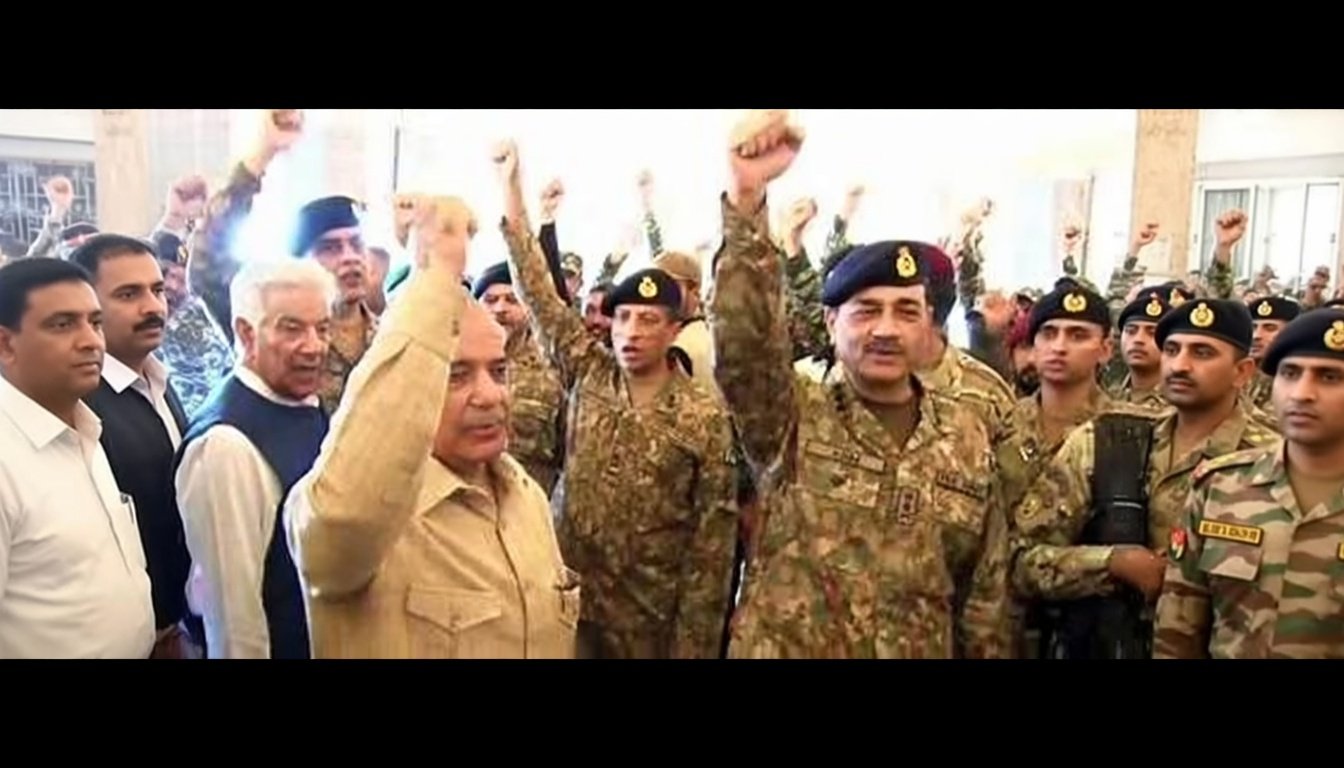
In the opening days of April 2026, the Middle East teetered on the brink of a far wider conflict. Direct US-Iran clashes had shut the Strait of Hormuz, sent oil prices soaring past $110 a barrel, and threatened global supply chains. Then, on 8 April, a two-week ceasefire was announced. The breakthrough was not crafted solely in Washington or Tehran, it was shaped in Islamabad. Pakistan’s “Islamabad Accord” offered both sides a practical off-ramp: an immediate halt to fighting, reopening of the Strait of Hormuz, and structured follow-up talks hosted in Pakistan. This was no accidental diplomacy. It was the result of deliberate, back-channel work by Prime Minister Shehbaz Sharif and Field Marshal Asim Munir.
Inside Pakistan, the moment is being framed as Marka-e-Haq 2.0, the sequel to last year’s India-Pakistan crisis that earned Field Marshal Asim Munir widespread recognition for his leadership and crisis management. But this chapter is different. It is not about military victory on the battlefield; it is about quiet, calculated mediation under intense pressure and the practical difference it is already delivering is measurable.
How the Mediation Worked
Pakistan did not simply volunteer, it earned the role through its unique relationships. Field Marshal Asim Munir and Prime Minister Shehbaz Sharif ran a tightly coordinated civil-military channel. Over 48 critical hours, FM Asim Munir personally engaged with US Vice President JD Vance and special envoy Steve Witkoff, while Shehbaz Sharif maintained direct lines to Tehran. The two-phase Islamabad Accord was straightforward: Phase One delivered the ceasefire and reopened the strait within days; Phase Two set the stage for substantive talks in Islamabad.
World leaders have been unusually direct in crediting both men. US President Donald Trump publicly stated that his administration’s conversations with “Prime Minister Shehbaz Sharif and Field Marshal Asim Munir of Pakistan” were decisive in reaching the pause. Iranian Foreign Minister Abbas Araghchi went further, expressing “deep gratitude to his dear brothers HE Prime Minister Sharif and HE Field Marshal Munir for their tireless efforts” that prevented a larger war. Saudi Arabia’s Ministry of Foreign Affairs praised the “fruitful efforts made by Pakistan and Field Marshal Munir” in de-escalating the crisis. Even Kazakhstan’s President Kassym-Jomart Tokayev lauded the Pakistani leadership’s role in stabilising energy markets that affect landlocked economies across Central Asia.
This was not symbolic praise. Pakistan’s credibility, built on long-standing ties with Saudi Arabia and the Gulf, historical relations with Iran, and renewed working channels with the current US administration, gave it leverage no other mediator possessed at that moment. The 274th Corps Commanders’ Conference, chaired by Field Marshal Munir on 7 April, sent a clear signal: Pakistan would back de-escalation but would not tolerate actions that endangered the process.
Managing Multiple Fronts
While steering the Middle East file, Pakistan was simultaneously executing Operation Ghazab lil Haq inside Afghanistan. Launched in late February 2026 after deadly cross-border attacks by TTP and Afghan Taliban elements, the operation combined precision strikes on terror infrastructure in Nangarhar, Kandahar, and Paktia. Official tallies report over 700+ militants neutralised; independent monitoring shows a sharp decline in terrorist incidents inside Pakistan since then. Handling a high-stakes diplomatic mediation abroad and a decisive counter-terrorism campaign at home at the same time is rare, and it reinforced Pakistan’s image as a state that can deliver results on multiple fronts.
Tangible Gains and the Road Ahead
The immediate economic payoff is already visible. Global oil prices eased sharply within hours of the ceasefire announcement. For Pakistan, a net energy importer still working through IMF benchmarks and debt obligations, even a short period of stability means lower import bills, reduced pressure on the rupee, and breathing space for industrial recovery. Renewed credibility with Gulf partners and Western capitals is also opening doors for fresh investment commitments and smoother rollover of bilateral loans.
Yet the hard reality remains: this is a temporary ceasefire. It buys 14 days of calm, not permanent peace. Iran seeks a comprehensive deal; the United States wants verifiable restraints on Tehran’s nuclear and missile programmes. Converting the pause into a durable regional framework will demand the same patient, low-drama approach that produced the initial breakthrough. Pakistan must now host the follow-up talks without letting them become mere photo opportunities.
There is also the information battle. Some voices, both inside and outside the region, are already trying to downplay Pakistan’s contribution or paint it as proxy work. The practical response must stay factual: highlight verifiable outcomes (Hormuz reopened, no new strikes) and let the public statements from Trump, Araghchi, Saudi Arabia, and others speak for themselves.
For ordinary Pakistanis, the families whose monthly budgets are hit by fuel and food prices, the real victory lies in stability. Lower energy costs flow directly into transport fares, electricity bills, and kitchen expenses. Reduced regional tension also protects remittance flows and creates space for tourism and investment interest to grow.
Marka-e-Haq 2.0 is therefore less about grand declarations and more about competence under pressure. Pakistan showed it could mediate, deter, and deliver simultaneously. Field Marshal Asim Munir and Prime Minister Shehbaz Sharif have earned rare public praise from major capitals for doing exactly that.
The true test now begins in the coming weeks in Islamabad. If Pakistan sustains the same focused, results-oriented style, the dividends, diplomatic, economic, and strategic, will compound. If it slips into over-claiming or loses momentum, the window will close quickly. For now, the region and Pakistan’s own people have reason to watch the next round of talks with cautious optimism.
Disclaimer: The views and opinions expressed in this article are solely those of the author and do not necessarily reflect the views, policies, or position of this website. The website does not endorse or oppose any opinion presented herein.