

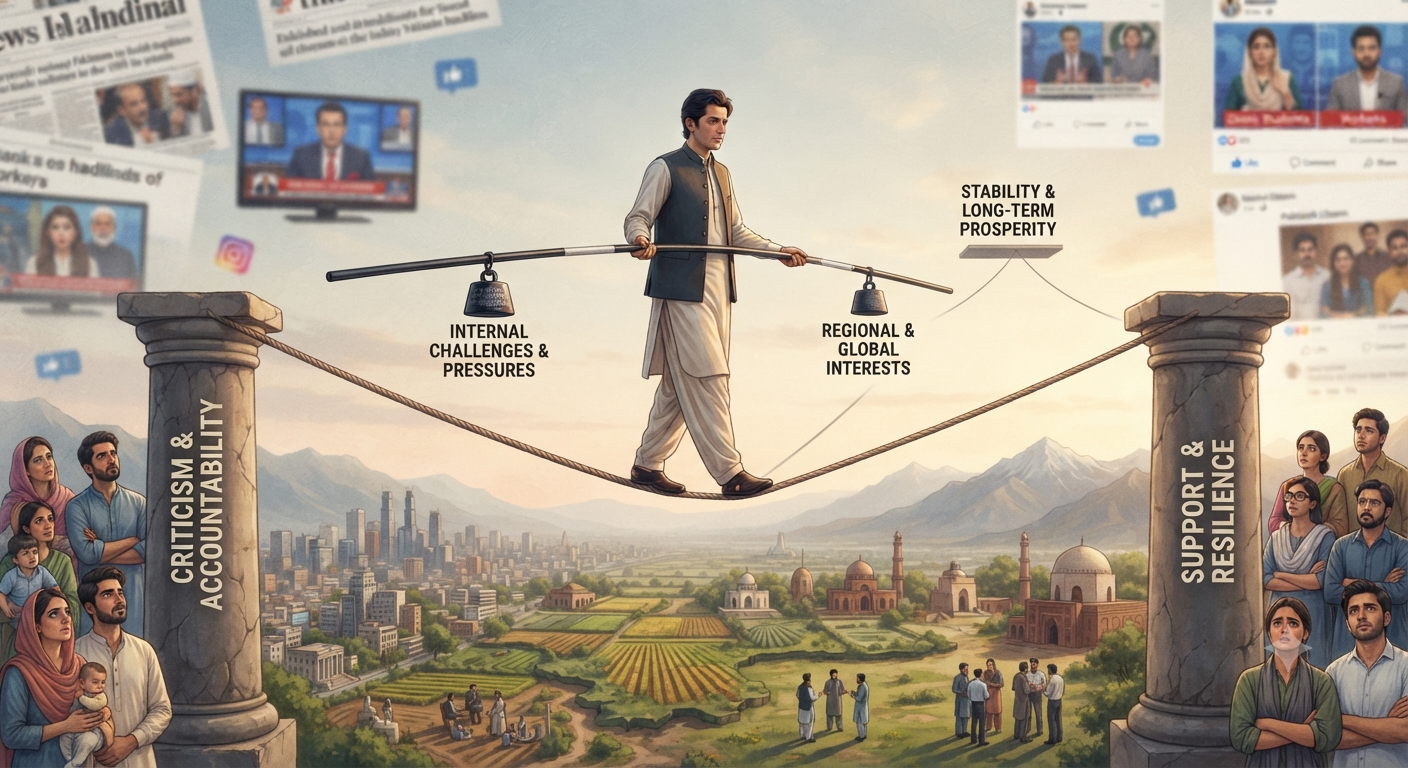
Imagine a person walking on a tightrope, carefully watching both sides, aware that even a small loss of balance could have serious consequences. That image, to me, reflects something of Pakistan’s position today.
Pakistan operates in a difficult environment, surrounded by competing interests, regional pressures, internal challenges, and narratives that often pull public opinion in different directions. The challenge is not simply to choose one side and reject the other. It is to maintain balance, understand the realities around us, and move forward without losing sight of the country’s long-term interests.
That is why I believe Pakistan’s stability matters.
To say this is not to suggest that Pakistan is perfect, or that every government decision, institutional policy, or national choice should go unquestioned. A healthy society must allow room for criticism. Institutions should be accountable, policies should be debated, and mistakes should be acknowledged.
But there is an important distinction between criticism intended to improve a country and criticism that gradually erodes confidence in the country itself.
That distinction deserves some thought.
When we form strong opinions about Pakistan, how much of our thinking comes from our own experience, and how much comes from the information environment around us?
What role do television channels, social media platforms, commentators, political movements, and the communities we associate with play in shaping our understanding?
These are questions that apply to everyone, regardless of political position.
In an age of information overload, it is easy to remain within a single information circle. We may repeatedly hear the same interpretation of events until it becomes the only interpretation we recognize. The challenge, therefore, is not simply to have convictions, but to examine where those convictions come from.
That is particularly important when discussing a country as complex as Pakistan.
A nation cannot be understood through a single television programme, a social-media feed, a political slogan, or one particular narrative. Its reality is far more complicated. Pakistan is a country of more than its political disputes and institutional disagreements. It is also the daily life of millions of people who work, study, raise families, serve their communities, and hope for a better future.
For that reason, I believe criticism should be grounded in reality and directed toward improvement.
I can disagree with a policy without rejecting my country.
I can question an institution without wishing to see it weakened.
I can acknowledge serious problems without concluding that Pakistan itself is beyond hope.
These positions are not contradictory.
In fact, they may be necessary for a mature national conversation.
Pakistan’s future will not be secured by blind praise, but neither will it be secured by permanent pessimism. It requires a balance between accountability and responsibility, criticism and constructive engagement, national interest and individual opinion.
This is where I believe the tightrope metaphor becomes relevant.
A country facing difficult circumstances cannot afford to lose its balance. It must be able to recognize threats without becoming consumed by fear, acknowledge weaknesses without surrendering hope, and pursue reform without creating unnecessary instability.
That requires judgment.
It also requires perspective.
When I speak about Pakistan’s safety and stability, I am not speaking only about governments or institutions. I am thinking about ordinary people. I am thinking about children growing up in the country, families planning their futures, young people seeking opportunities, and generations yet to come.
For them, stability is not an abstract political concept.
It is the foundation upon which everyday life is built.
This is why I believe that supporting Pakistan should not be interpreted as an inability to criticize it. A person can love a country and still want it to improve. In fact, genuine concern for a country often includes the desire to see its weaknesses addressed honestly.
The question is what comes after the criticism.
Does it lead toward reform, understanding, and progress?
Or does it simply deepen division and distrust?
That is a question worth asking ourselves.
We should also be careful about the narratives we adopt. Not every criticism of Pakistan is unfair, and not every criticism is accurate. Not every supporter is blind, and not every critic is an enemy. Reality is rarely so simple.
The responsibility of a citizen is to look beyond labels and examine the substance.
Where does the information come from?
What evidence supports it?
What interests might shape the narrative?
Are we considering more than one perspective?
And, perhaps most importantly, does our position ultimately contribute to a stronger and more stable society?
These questions are not directed at any one group. They are questions for all of us.
Pakistan has serious challenges. It also has considerable strengths. Its future will depend on whether it can recognize both.
My support for Pakistan comes from a simple conviction: a country should be judged by its problems, but not defined by them.
There is nothing contradictory about wanting Pakistan to become more secure, more prosperous, more accountable, and more united while also recognizing the progress that has been made and the resilience of its people.
The goal should not be to deny reality.
The goal should be to face reality without losing perspective.
Perhaps that is what balance truly means.
It means being able to criticize without destroying.
To question without abandoning.
To reform without destabilizing.
And to disagree without forgetting that, ultimately, we share a common future.
Pakistan is not perfect. No country is.
But it is home to millions of people whose hopes and aspirations deserve to be protected. Whatever our political views or differences of opinion, we should be able to agree on the importance of their safety, their dignity, and their future.
That is why I support Pakistan.
Not because I believe every decision is correct.
Not because I believe every institution is beyond criticism.
And not because I think difficult questions should be avoided.
I support Pakistan because I believe that criticism should ultimately serve the country, not weaken it; that reform should strengthen stability, not destroy it; and that, in difficult times, balance is not weaknessit is wisdom.
Pakistan is walking a difficult path. The task before all of us is to help it maintain its balance and move forward.
Disclaimer: The views and opinions expressed in this article are solely those of the author and do not necessarily reflect the views, policies, or position of this website. The website does not endorse or oppose any opinion presented herein.