

Close Menu

    Subscribe to Updates

    Get the latest creative news from FooBar about art, design and business.

    What's Hot

    Pakistan Moves to Accelerate Privatisation of Electricity Distribution Companies, PM Shehbaz Says

    June 9, 2026

    Global Nuclear Weapons Spending Hits Record 119 Billion Dollars, ICAN Report Says

    June 9, 2026

    Police fire tear gas at Nanyuki protests over US Ebola quarantine facility amid court orders

    June 9, 2026
    Facebook X (Twitter) Instagram
    Trending
    • Pakistan Moves to Accelerate Privatisation of Electricity Distribution Companies, PM Shehbaz Says
    • Global Nuclear Weapons Spending Hits Record 119 Billion Dollars, ICAN Report Says
    • Police fire tear gas at Nanyuki protests over US Ebola quarantine facility amid court orders
    • Palestinian Detainees Allege Systematic Sexual Violence in Israeli Detention Facilities
    • Iran Accuses US of Revoking World Cup Ticket Allocation Amid Visa and Travel Disputes
    • Democracy beyond Protest: The Constitutional Meaning of the AJK Refugee Seats Case
    •   Is Russia Planning Something Big With Pakistan?
    • Pentagon Moves to Restrict China Biotech Access Amid Security Concerns
    Facebook X (Twitter) Instagram
    echoasianews.com
    • Home
      • Fact Check
      • War Updates
    • World News
    • Local News
    • Opinion
    • Business
    • Entertainment
    • Sports
    • Politics
    • Technology
    echoasianews.com
    Home»Opinion»A New Dawn for Pakistan
    Opinion

    A New Dawn for Pakistan

    Shakeel AkhtarBy Shakeel AkhtarFebruary 19, 2026No Comments4 Mins Read
    Facebook Twitter Pinterest LinkedIn WhatsApp Reddit Tumblr Email
    Share
    Facebook Twitter LinkedIn Pinterest Email

    Not a cosmetic adjustment, not another temporary political understanding, but a structural recalibration of how politics, protest, policy, and national stability interact. Can we begin from a more honest premise? The state is only part of the solution. The responsibility extends far beyond one institution. Political actors, media platforms, economic stakeholders, civil society, and citizens all shape the climate in which stability either survives or erodes. A functioning country is not sustained by authority alone; it is sustained by collective discipline.

    Stability is not suppression. It is infrastructure.

    Across much of the modern world, organized agitation as a recurring pressure mechanism against the state has largely gone out of fashion. Mature political systems do not negotiate under prolonged disruption. They do not treat cyclical confrontation as a legitimate instrument of leverage. They understand that continuity protects economic growth, investment confidence, and international credibility.

    Yet in Pakistan, agitation remains a recurring feature of political engagement. Political competition is natural and necessary in a democracy. Peaceful dissent is a constitutional right. But there is an important distinction between democratic opposition within a framework and strategies that rely primarily on disruption to compel outcomes.

    When confrontation becomes cyclical, governance becomes reactive.

    Administrative focus shifts from planning to crisis management. Energy that should advance reform is spent containing turbulence. Investor confidence weakens. Economic hesitation follows. The cost accumulates quietly but persistently.

    The deeper question is not who mobilizes. The deeper question is why agitation continues to be treated as an effective negotiating instrument. Once disruption yields structural concessions, the method tends to repeat itself. Future actors absorb the lesson: pressure produces results.

    And when pressure becomes precedent, predictability declines.

    Over time, authority fragments, polarization deepens, and institutions grow fatigued. No modern state seeking long-term stability can afford that pattern.

    There is also a recurring narrative that Pakistan’s strategic position or external relationships can compensate for internal instability. Some argue that Pakistan uniquely understands major global actors, or that international stakeholders closely monitor and calibrate every development within the country. While international relationships matter and geopolitical relevance is real, no external understanding can substitute for internal coherence.

    No foreign engagement can replace domestic stability.

    A country that seeks respect abroad must first demonstrate discipline at home.

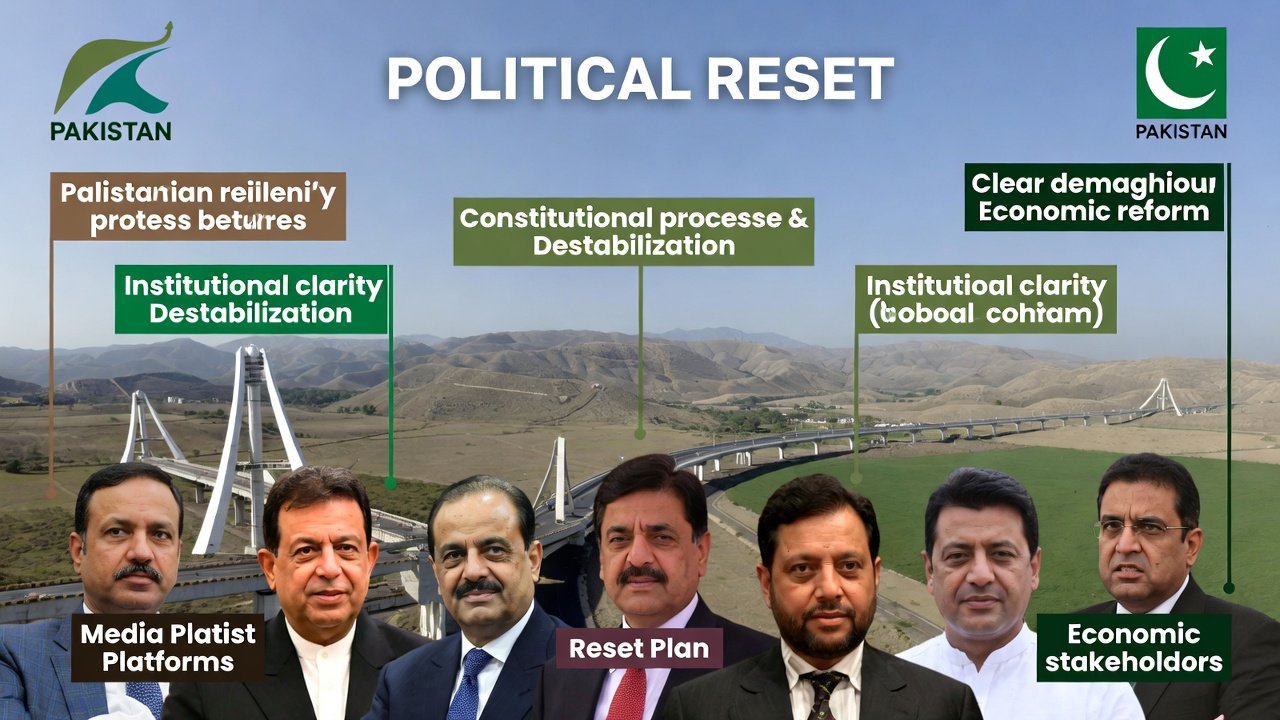
    A grand RESET does not mean limiting politics; it means professionalizing it. It requires clearer boundaries between protest and destabilization, stronger adherence to constitutional processes, policy continuity beyond electoral cycles, and media responsibility in shaping public discourse. Economic reform must be treated not as a partisan project but as a national priority. Institutional balance must be maintained through law, not through personality-driven adjustments.

    Correction must be calm, structured, and lawful  never reactive.

    High stakeholders carry particular responsibility in this process, not because they are the source of instability, but because they are custodians of continuity. Their role is to reinforce institutional clarity, encourage responsible political conduct, and prioritize long-term national cohesion over short-term tactical advantage. Stability cannot be delegated; it must be jointly protected.

    Pakistan does not need another cycle of elevation followed by estrangement; it needs continuity, predictability, and strategic maturity. A modern state cannot revolve around personalities, however influential they may be, but must instead rely on systems resilient enough to withstand individual ambitions and political fluctuations.

    The issue is not opposition. The issue is method.

    The issue is not dissent. The issue is durability.

    If Pakistan seeks lasting economic strength, institutional credibility, and global respect, it must consciously outgrow confrontation politics while safeguarding constitutional freedoms. A grand RESET begins not with reaction, but with clarity of purpose, institutional balance, and disciplined governance.

    And clarity, once firmly established, restores national equilibrium without unnecessary turbulence

    Disclaimer: The views and opinions expressed in this article are solely those of the author and do not necessarily reflect the views, policies, or position of this website. The website does not endorse or oppose any opinion presented herein.

    Share this:

    • Share on Facebook (Opens in new window) Facebook
    • Share on X (Opens in new window) X

    Like this:

    Like Loading…
    Democratic Process Governance Institutional Reform National Reset Pakistan Political Stability Public Policy Rule of Law Statecraft
    Share. Facebook Twitter Pinterest LinkedIn Tumblr Telegram Email
    Shakeel Akhtar
    Shakeel Akhtar

    Shakeel Akhtar is a geopolitical analyst and writer based in Oslo, Norway. His work focuses on global power shifts, strategic behavior of states, and their implications for regional security, with particular emphasis on Pakistan’s defence posture and strategic maturity.

    Related Posts

    Global Nuclear Weapons Spending Hits Record 119 Billion Dollars, ICAN Report Says

    June 9, 2026

    Democracy beyond Protest: The Constitutional Meaning of the AJK Refugee Seats Case

    June 9, 2026

      Is Russia Planning Something Big With Pakistan?

    June 9, 2026
    Leave A Reply Cancel Reply

    Don't Miss
    Local News
    Local News

    Pakistan Moves to Accelerate Privatisation of Electricity Distribution Companies, PM Shehbaz Says

    By EchoAsiaNewsJune 9, 202602 Mins Read

    Islamabad: Prime Minister Shehbaz Sharif has directed authorities to expand and accelerate the privatisation of…

    Share this:

    • Share on Facebook (Opens in new window) Facebook
    • Share on X (Opens in new window) X

    Like this:

    Like Loading…

    Global Nuclear Weapons Spending Hits Record 119 Billion Dollars, ICAN Report Says

    June 9, 2026

    Police fire tear gas at Nanyuki protests over US Ebola quarantine facility amid court orders

    June 9, 2026

    Palestinian Detainees Allege Systematic Sexual Violence in Israeli Detention Facilities

    June 9, 2026

    Subscribe to Updates

    Get the latest news from echoasianews.

    Stay In Touch
    • Facebook
    • Twitter
    • Instagram
    • WhatsApp
    About Us
    About Us

    We cover a wide range of topics including World News, Business & Economy, Crypto, Entertainment, Politics, Sports, and Technology, ensuring our audience stays informed about both regional and international developments.
    We're accepting new partnerships right now.

    Email Us: social@echoasianews.com

    Facebook X (Twitter) Pinterest YouTube WhatsApp
    Our Picks

    Pakistan Moves to Accelerate Privatisation of Electricity Distribution Companies, PM Shehbaz Says

    June 9, 2026

    Global Nuclear Weapons Spending Hits Record 119 Billion Dollars, ICAN Report Says

    June 9, 2026

    Police fire tear gas at Nanyuki protests over US Ebola quarantine facility amid court orders

    June 9, 2026
    Categories
    • Blog
    • Business & Economy
    • Entertainment
    • Fact Check
    • Local News
    • Opinion
    • Politics
    • Sports
    • Technology
    • War Updates
    • World News
    Meet Our Team
    • Editorial Board
    © 2026 . All Rights Reserved EchoAsiaNews.

    Type above and press Enter to search. Press Esc to cancel.

    %d