

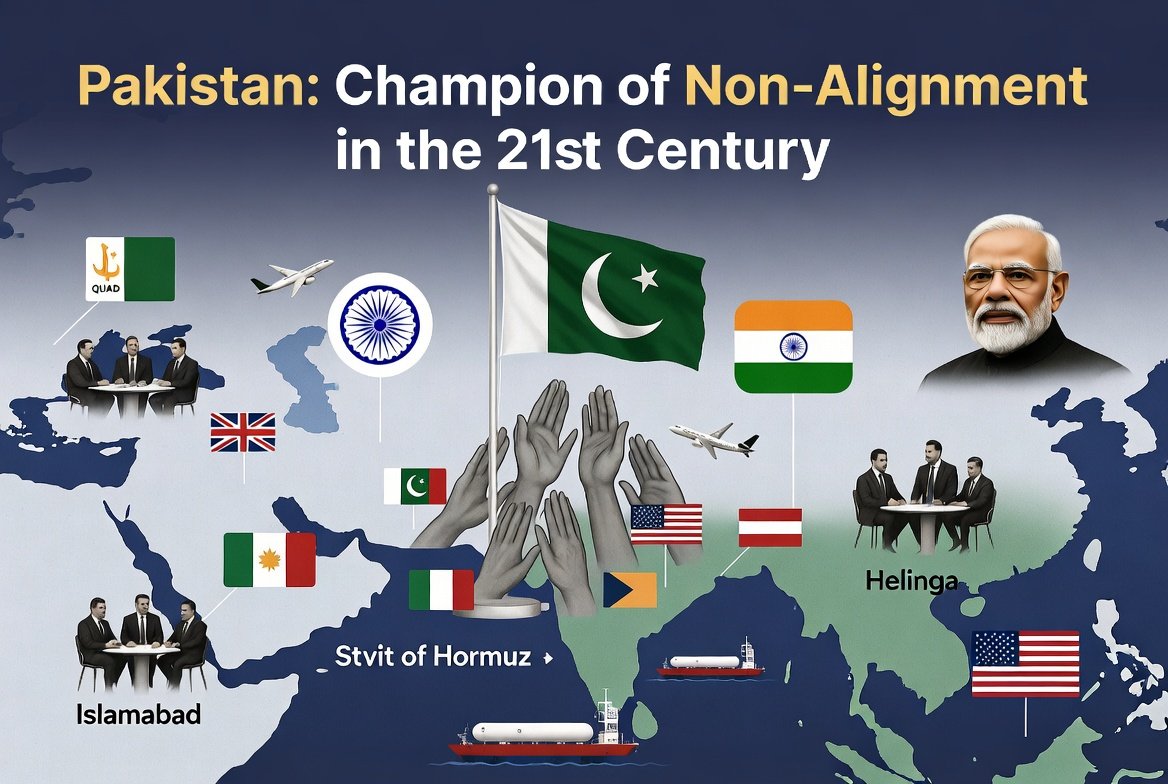
In the 1970s, Pakistan was firmly aligned with the West through its memberships in SEATO and CENTO, playing a vital role in the US-led strategy to contain communism in Asia and beyond. On the other hand, India took pride in its nonaligned status, leading the Non-Aligned Movement (NAM) and representing itself as a voice for the Global South, refusing to take sides with either the US-led capitalist bloc or the Soviet-led socialist bloc. Today, however, the scenario has strikingly reversed itself, with Pakistan playing the new role of a champion for non-alignment and a multi-aligned foreign policy, and India, under Modi, moving closer to Western and Indo-Pacific alliances, yet finding itself increasingly on the sidelines in critical regional and global diplomacy.
This evolution is a reflection of the strategic maturation of Pakistan over the decades. After having gone through some challenges during the war of 1971, Pakistan set out to diversify its relations and strengthen its ties with the Muslim world, Gulf countries, and China. The end of the Cold War and changing global realities have further encouraged this approach of balanced engagement rather than alignment. The Economic Corridor with China was an important part of this strategy, giving an economic dimension to its traditional strategic ties with China, while at the same time maintaining cordial relations with all others. This is how its foreign policy remains pragmatic, enabling it to act as an honest broker in global conflicts without being beholden to either side.
Pakistan’s commitment to non-alignment and principled foreign policy can be seen most vividly in its current attempts to ease tensions in the Middle East. Instead of taking sides, Pakistan has emerged as a neutral mediator and facilitator of dialogue between the warring parties.
On the 29th of March, 2026, the foreign ministers of Pakistan, Saudi Arabia, Turkey, and Egypt met in Islamabad and gave full support to Pakistan’s initiative to arrange direct peace talks between the US and Iran. They stated that “dialogue and diplomacy remain the only viable path to achieving lasting peace.” A coordination committee of senior officials was established to boost cooperation between the countries. Pakistan’s Deputy Prime Minister and Foreign Minister, Mr. Mohammad Ishaq Dar, pointed out the confidence shown by the US and Iran in Pakistan’s ability to arrange the talks between the two countries. Iranian President Masoud Pezeshkian thanked Pakistan during a telephone conversation with Prime Minister Shehbaz Sharif for its positive role and sincere efforts in promoting the idea of dialogue and even serving as a messenger between the US and Iran while involving Gulf countries in the process.
As a result of these efforts, Iran has agreed to allow the safe passage of 20 more Pakistani-flagged vessels through the Strait of Hormuz, with the number of vessels passing on a daily basis being two. This was welcomed by Pakistan’s Foreign Minister Dar as “a welcome and constructive step towards peace,” which would help ease the world’s energy supply concerns because the strait facilitates 25% of the world’s oil trade.
Just two days later, on the 31st of March 2026, Pakistan’s Foreign Minister Dar met with the Chinese Foreign Minister Wang Yi in Beijing. China’s foreign ministry spokeswoman Mao Ning said that China and Pakistan, who are referred to as the ‘all-weather’ strategic partners, would “strengthen strategic communication and coordination on the Iran situation” and “make new efforts toward advocating for peace.” China welcomed Pakistan’s efforts at mediation on the situation.
These efforts demonstrate the unique position of Pakistan as a responsible middle power. With strong cultural, religious, and historical ties to both Iran and the Arab world through shared Islamic affinities, and with good relations with the West, Pakistan has been able to play the role of a bridge well. Unlike the distant rhetoric-based strategy, Pakistan has actively engaged in shuttle diplomacy, facilitating crucial meetings, and providing space for dialogue. The strong backing of regional powers such as Saudi Arabia, Egypt, and Türkiye speaks to the genuine nature of the strategy pursued by Islamabad.
On the other hand, the Modi regime, despite its previous position as the leader in the Non-Aligned Movement, is moving closer to the United States, the Quad, and Israel. The move has affected its position as an unbiased mediator in critical regions, especially the Middle East, where the relationship is largely influenced by culture and religion. In the end, India is being edged out of the diplomatic efforts, especially in the Middle East, as Pakistan is showing more proactive leadership based on the Non-Aligned Movement principles.
The development in the foreign policy of Pakistan is based on pragmatism and the need to ensure stability in the region as well as the world at large. While the country has its own set of challenges, it continues to support mediation processes that do not only benefit the country but the world as a whole, from the acquisition of energy routes to the avoidance of conflict, which would otherwise affect the world’s economies.
The world is witnessing the leadership of Pakistan in the true sense, as the country has emerged as the champion of non-alignment in the 21st century. Trust-building, shuttle diplomacy, and the establishment of coordination committees, such as the four-nation committee, are all demonstrating the capabilities of middle powers in bridging the gap in times of trouble, especially when the great powers are facing challenges of their own. As long as Pakistan continues to lead in an effective, balanced, and principled manner, the country will continue to be an integral part of the global peace process.
Disclaimer: The views and opinions expressed in this article are solely those of the author and do not necessarily reflect the views, policies, or position of this website. The website does not endorse or oppose any opinion presented herein.