

Close Menu

    Subscribe to Updates

    Get the latest creative news from FooBar about art, design and business.

    What's Hot

    Civilian Posthumously Awarded Sitara-e-Shujaat for Stopping Suicide Bomber Near Kohat

    May 13, 2026

    Karachi Court Grants Three-Day Physical Remand of Alleged Drug Network Operator Anmol alias “Pinky”

    May 13, 2026

    India Raises Gold and Silver Import Tariffs to Support Rupee and Foreign Reserves

    May 13, 2026
    Facebook X (Twitter) Instagram
    Trending
    • Civilian Posthumously Awarded Sitara-e-Shujaat for Stopping Suicide Bomber Near Kohat
    • Karachi Court Grants Three-Day Physical Remand of Alleged Drug Network Operator Anmol alias “Pinky”
    • India Raises Gold and Silver Import Tariffs to Support Rupee and Foreign Reserves
    • Russia and Ukraine Resume Drone Strikes After Short-Lived Truce Ends, Casualties Reported
    • Demi Moore Urges Film Industry to Embrace AI Ahead of Cannes Festival
    • China Urges Pakistan to Expand Mediation Role in Iran-US Tensions and Hormuz Strait Issue
    • SBP Warns Middle East Conflict Could Threaten Pakistan’s Economic Outlook
    • Trump, Xi Set for High-Stakes Summit at Beijing’s Temple of Heaven
    Facebook X (Twitter) Instagram
    echoasianews.com
    • Home
      • Fact Check
      • War Updates
    • World News
    • Local News
    • Opinion
    • Business
    • Entertainment
    • Sports
    • Politics
    • Technology
    echoasianews.com
    Home»Opinion»Out of the Nest: Wheel-and-Deal Alliances and the Illusion of Power
    Opinion

    Out of the Nest: Wheel-and-Deal Alliances and the Illusion of Power

    Shakeel AkhtarBy Shakeel AkhtarJanuary 31, 2026No Comments4 Mins Read
    Facebook Twitter Pinterest LinkedIn WhatsApp Reddit Tumblr Email
    Share
    Facebook Twitter LinkedIn Pinterest Email

    Once, a primary school teacher entered his classroom in an unusually cheerful mood. Hoping to spark imagination, he asked his students a playful question:
    “If God were to grant you one wish right now-here and now-what would you ask for?”
    Hands shot up instantly.
    One child wanted money.
    Another dreamed of a car.
    Someone whispered about a big house.
    Each wish reflected something missing, something desired.
    Smiling wisely, the teacher intervened.
    “Instead of all these things,” he said, “you should ask for wisdom.”
    The class fell quiet-until one witty, mischievous boy stood up.
    “Sir,” he said innocently, “everyone asks for what they lack in life.”
    The class laughed. The teacher paused.
    The joke was subtle, but the message was devastatingly clear: desire reveals deficiency. We do not ask for what we possess. We ask for what we fear losing-or never had.
    That classroom moment explains today’s global politics better than a shelf of strategic doctrines.
    States, like children, are revealing their insecurities through their wishes. The louder the demand, the deeper the absence. The more dramatic the alliance, the greater the underlying uncertainty. Power, it turns out, speaks least when it is secure.
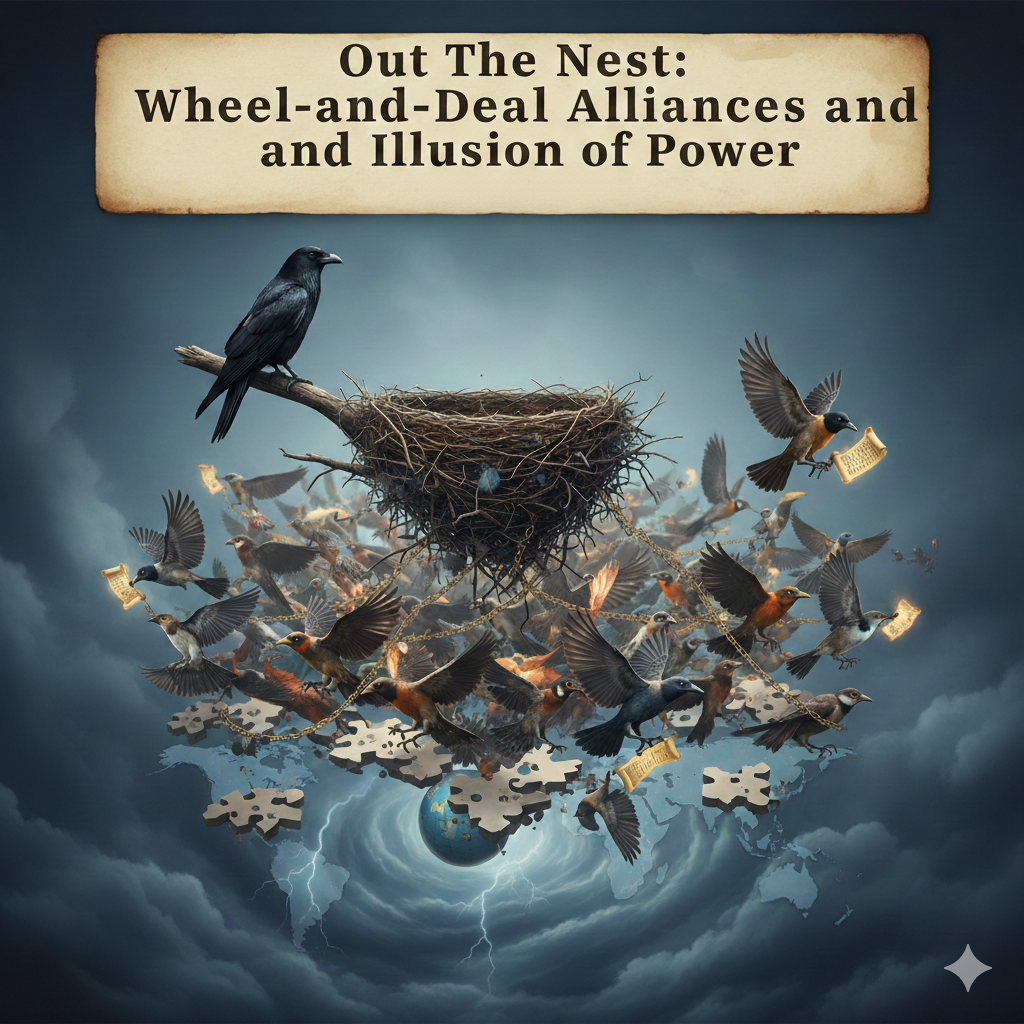
    The world today is full of noise because the nest has cracked.
    Countries no longer feel sheltered by stable rules, predictable alliances, or durable balances. So they flap. They announce. They threaten. They sign agreements with ceremonial enthusiasm and strategic impatience. What is marketed as strength is often fear dressed in confidence.
    This is the wheel-and-deal world order.
    Europe’s renewed courtship of India is a textbook example. Presented as a landmark partnership, it is less a civilizational alignment and more a mutual reassurance pact. Europe seeks relevance and market security; India seeks strategic validation amid regional pressure. Values are spoken of, interests are prioritized, and contradictions are politely ignored. Such arrangements look solid on podiums-but history suggests they age quickly.
    India’s broader diplomatic behavior follows the same pattern. Rapid accumulation of partnerships, constant signaling, and high-decibel narratives point not to strategic comfort, but to strategic unease. When a state feels secure, it consolidates. When it feels exposed, it multiplies options-often at the cost of coherence.
    The United States remains the most capable power, yet even it is not immune to this syndrome. Its expanding web of commitments reflects careful calculation, but also an unspoken recognition: dominance today requires constant reinforcement. Alliances are renewed not out of romance, but necessity. The announcements are loud because reassurance is expensive.

    China and Russia, often described as a unified counterweight, are bound less by trust than by timing. Their convergence is practical, conditional, and reversible-held together by shared pressure rather than shared destiny. History has seen many such alignments; few survive shifts in circumstance.
    Canada and other middle powers navigate this landscape cautiously, choosing selective engagement over permanent attachment. Their restraint is often misread as hesitation. In reality, it is strategic literacy.
    Against this backdrop, Pakistan’s posture deserves careful attention-not emotional commentary.
    While others advertise partnerships, Pakistan practices strategic economy. Its state and military policies do not confuse visibility with effectiveness. Deterrence is maintained without spectacle. Partnerships are cultivated without dependency. Red lines are drawn clearly-but not theatrically.
    Pakistan understands a lesson many seem to have forgotten: interest-based agreements have short lives. They flourish in headlines and expire in footnotes. Power that survives is not the power that announces most-but the power that adapts best.
    This is not passivity. It is discipline.
    Where others appear like birds newly out of the nest-flapping loudly to convince the world of their weight-Pakistan conserves energy, balances its wings, and studies the air. In a system crowded with short-term deals and conflicting loyalties, maneuverability becomes strength.
    The irony of our time is simple. Those who claim to offer long-term visions often operate with short-term patience. Those who shout about permanence quietly prepare exits.
    History does not reward noise. It rewards judgment.
    And just like that child in the classroom, the world today is asking for what it lacks. The loudest wishes reveal the deepest fears. The quietest actors, meanwhile, already understand what they possess.

    Share this:

    • Share on Facebook (Opens in new window) Facebook
    • Share on X (Opens in new window) X

    Like this:

    Like Loading…
    Diplomacy Foreign Policy Geopolitics Global Affairs Global Politics International Relations International Strategy Modern Diplomacy Political Commentary Power Balance Strategic Alliances US China Russia Relations World Order
    Share. Facebook Twitter Pinterest LinkedIn Tumblr Telegram Email
    Shakeel Akhtar
    Shakeel Akhtar

    Shakeel Akhtar is a geopolitical analyst and writer based in Oslo, Norway. His work focuses on global power shifts, strategic behavior of states, and their implications for regional security, with particular emphasis on Pakistan’s defence posture and strategic maturity.

    Related Posts

    Israel’s Secret Base in Iraq Was a Dangerous Act of Rogue Militarism

    May 13, 2026

    Cross-Border Terrorism and Pakistan’s Legitimate Security Concerns

    May 13, 2026

    Global eyes on South Asian “Energy City”

    May 12, 2026
    Leave A Reply Cancel Reply

    Don't Miss
    Local News
    Local News

    Civilian Posthumously Awarded Sitara-e-Shujaat for Stopping Suicide Bomber Near Kohat

    By EchoAsiaNewsMay 13, 202601 Min Read

    A civilian who was killed while stopping a suicide bomber near Kohat has been posthumously…

    Share this:

    • Share on Facebook (Opens in new window) Facebook
    • Share on X (Opens in new window) X

    Like this:

    Like Loading…

    Karachi Court Grants Three-Day Physical Remand of Alleged Drug Network Operator Anmol alias “Pinky”

    May 13, 2026

    India Raises Gold and Silver Import Tariffs to Support Rupee and Foreign Reserves

    May 13, 2026

    Russia and Ukraine Resume Drone Strikes After Short-Lived Truce Ends, Casualties Reported

    May 13, 2026

    Subscribe to Updates

    Get the latest news from echoasianews.

    Stay In Touch
    • Facebook
    • Twitter
    • Instagram
    • WhatsApp
    About Us
    About Us

    We cover a wide range of topics including World News, Business & Economy, Crypto, Entertainment, Politics, Sports, and Technology, ensuring our audience stays informed about both regional and international developments.
    We're accepting new partnerships right now.

    Email Us: social@echoasianews.com

    Facebook X (Twitter) Pinterest YouTube WhatsApp
    Our Picks

    Civilian Posthumously Awarded Sitara-e-Shujaat for Stopping Suicide Bomber Near Kohat

    May 13, 2026

    Karachi Court Grants Three-Day Physical Remand of Alleged Drug Network Operator Anmol alias “Pinky”

    May 13, 2026

    India Raises Gold and Silver Import Tariffs to Support Rupee and Foreign Reserves

    May 13, 2026
    Categories
    • Blog
    • Business & Economy
    • Entertainment
    • Fact Check
    • Local News
    • Opinion
    • Politics
    • Sports
    • Technology
    • War Updates
    • World News
    Meet Our Team
    • Editorial Board
    © 2026 . All Rights Reserved EchoAsiaNews.

    Type above and press Enter to search. Press Esc to cancel.

    %d