

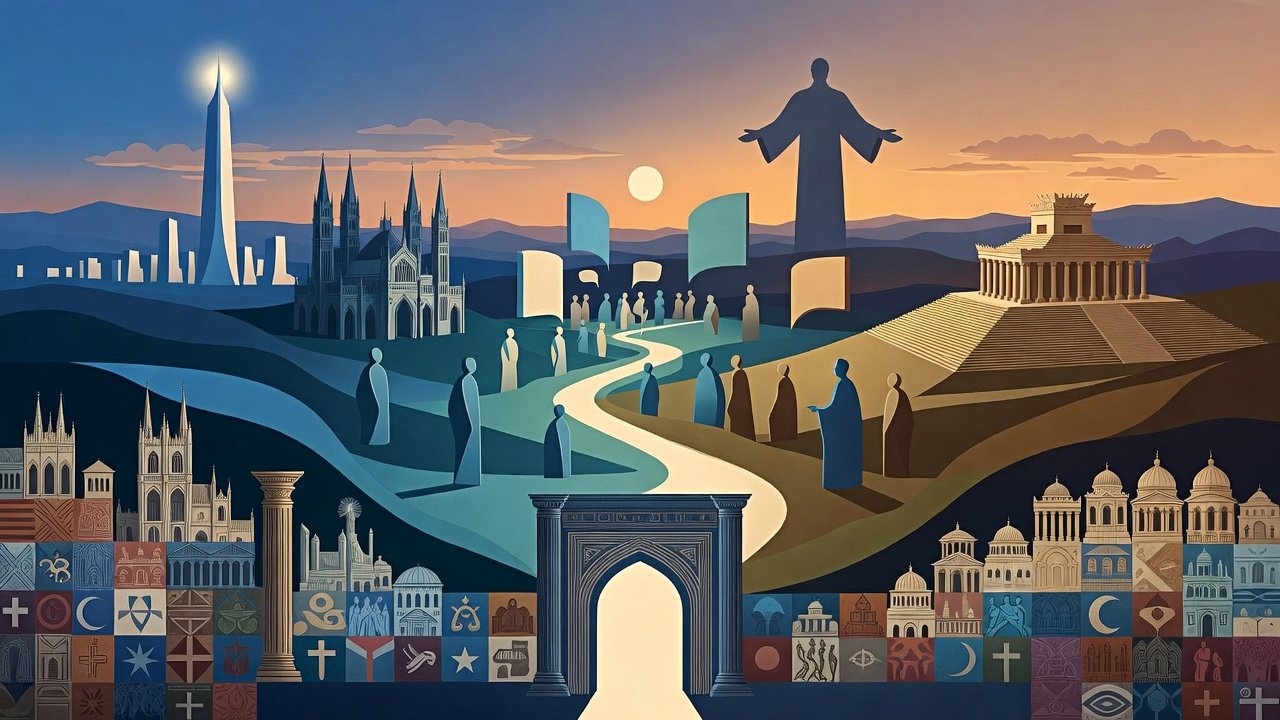
No religion teaches terrorism.
Not the Qur’an.
Not the Bible.
Not the sacred traditions of any major faith.
Yet violence is committed in their names.
The contradiction does not lie in revelation. It lies in interpretation – and in who controls it.
Terrorism is not born in scripture. It is manufactured through selective reading, political manipulation, grievance amplification, and identity engineering. A verse detached from context becomes a slogan. A slogan repeated becomes ideology. An ideology weaponized becomes extremism.
The central question is not whether religion is peaceful.
The central question is Who interprets religion in our time? Under what authority? And for what objective?
Interpretation and the Problem of Supremacy
When faith transforms from moral discipline into identity supremacy, danger begins. The claim “we are right” shifts into “only we are right.” From there, exclusion follows. Then hostility. Then justification of force.
In Islamic intellectual history, multiple juristic schools emerged – each offering structured interpretation. Diversity of thought was acknowledged. Debate was rigorous. Authority required scholarship.
But in modern times, interpretation often escapes scholarship and enters populism. Every sect produces its own voice. Every preacher claims authenticity. Every political faction injects its preference into theology.
Discussion becomes circular.
Accusation replaces argument.
“Not from us” becomes a verdict.
And when religious identity merges with political authority, interpretation risks becoming a tool of control.
In several states, religious authority aligns with state authority. The ruler’s direction shapes the sermon. The sermon shapes the public mood. The public mood defines loyalty. Interpretation flows downward.
This is not unique to one country or one region. Influence everywhere shapes narrative.
The Democratic Contrast: Accountability of Authority
Modern democracies demonstrate another principle: authority is not absolute.
In the United Kingdom, even members of the royal family have faced public legal scrutiny. Prince Andrew was not shielded by status when allegations surfaced. Legal process prevailed.
In Norway, Mette-Marit publicly acknowledged poor judgment regarding past associations. Public accountability did not weaken the state; it strengthened institutional credibility.
In the United States, the Supreme Court of the United States has demonstrated that executive authority can be challenged – including policy actions such as tariff measures under Donald Trump. The principle is clear law stands above personality.
This is the discipline of systems.
Authority is respected – but it is reviewable.
Freedom of Speech and Exposure of Extremism
A difficult question confronts modern societies:
Should harmful interpretations be suppressed – or exposed?
If criticism of one religion is permitted, criticism of another must also be permitted. Intellectual confidence cannot demand protection from scrutiny.
Freedom of speech is not an attack on faith. It is a safeguard against monopolized interpretation. It does not include incitement to violence; where harm begins, law must intervene.
If someone distorts Islam to justify violence, that distortion must be challenged openly – not whispered about privately. Silence allows manipulation to grow.
Protection from prejudice is necessary.
Protection from debate is dangerous.
Europe’s legal frameworks aim to prevent hate crimes and discrimination. But legal restraint alone does not produce intellectual maturity. Immigrant communities, like host societies, must engage in self-discipline. Victimhood narratives cannot substitute for civic responsibility.
The same applies everywhere – including Pakistan.
The Pakistan Question
In Pakistan, public opinion has often recalibrated in response to shifts in state posture toward global powers.
At one time, anti-American rhetoric defined national emotion. Later, diplomatic recalibration altered tone. Public sentiment adjusted accordingly.
This reveals something important:
Narratives shape sentiment.
But mature states do not swing between emotional extremes. They operate through calibrated policy.
If rulers influence interpretation, then rulers also carry responsibility. Religious clarity cannot be imposed by decree. Nor can it be left to unregulated populism.
A sustainable framework requires:
Scholarly credibility
Institutional transparency
Open but disciplined debate
Clear separation between theological discourse and political mobilization
The objective is not uniformity of thought.
The objective is prevention of weaponized interpretation.
Living in a Different Age
We do not live in tribal empires or medieval kingdoms.
We live in nuclear states.
In digitized societies.
In interconnected economies.
In media ecosystems that amplify outrage within seconds.
Interpretations formed in older geopolitical realities cannot be applied mechanically without contextual understanding.
Timeless moral principles remain intact:
Justice. Mercy. Protection of life. Human dignity.
But application requires intellectual responsibility.
The Strategic Dimension
Extremism weakens states internally before any external adversary acts.
For Pakistan – a nuclear power positioned in a volatile region – internal ideological discipline is a strategic necessity.
The armed forces defend territorial sovereignty.
But intellectual sovereignty must also be guarded.
No external actor can destabilize a nation whose interpretive authority is credible, accountable, and aligned with constitutional order.
The Way Forward
Encourage qualified scholarship – not populist rhetoric.
Allow structured debate- not chaotic agitation.
Protect freedom of speech – while enforcing law against incitement to violence.
Ensure rulers do not manipulate theology for temporary political gain.
Build public resilience against emotional mobilization.
If sensible voices speak, some will accuse them of bias. That is inevitable in polarized environments. Silence, however, strengthens extremism.
Strong states do not fear discussion.
Weak confidence hides behind slogans.
Religion does not produce terrorists.
Distorted authority does.
The real test for Pakistan – and for all modern states – is whether interpretation will be disciplined by law, scholarship, and accountability, or driven by impulse and political expediency.
Faith is not the battlefield.
Control over its meaning is.
Disclaimer: The views and opinions expressed in this article are solely those of the author and do not necessarily reflect the views, policies, or position of this website. The website does not endorse or oppose any opinion presented herein.