

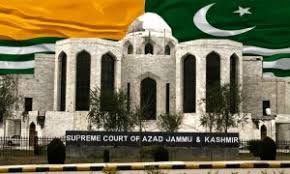
The recently delivered advisory opinion of the Supreme Court of Azad Jammu and Kashmir regarding the dispute over the refugee seats issue has been largely examined in terms of constitutionalism and politics. Several issues have been discussed extensively including the constitutionality of refugees’ seats, claims of the Joint Awami Action Committee (JAAC) and the government’s reaction to the protests. Nevertheless, there is something else that should be highlighted about the Court’s opinion, something more general and fundamental. In essence, it reminds us of the most basic feature of any constitutional democracy: protest is an indispensable aspect of democracy, yet it is not a substitute for it.
In modern democracies, the citizens are provided with various ways of pursuing political change. They can vote for their elected representatives. They can debate and amend the laws in parliaments. They can petition the courts over the interpretation of constitutional provisions. They can form political parties supporting different ideologies. They can advocate for political change through NGOs. However, peaceful protests constitute just another way of doing so.
The conflict of refugee seats exposed two conflicting approaches regarding what constitutes a functioning democratic system. One approach called for changing a certain constitutional structure, while the other emphasized that any changes must be made using the processes outlined by the constitution for making amendments to it. In its advisory opinion, the Supreme Court made the important distinction between making a request and implementing it. Individuals and organizations can request changes to the constitutional arrangement but cannot insist on constitutional amendments by pressuring, disrupting, and coercing. According to the Supreme Court, constitutional amendments are serious constitutional acts that can only be initiated by the elected representatives.
Such an approach is necessary because constitutional democracies rely more on the process of handling requests than the force of their requests. Forcing changes to the constitution regardless of whether enough pressure is applied to make such changes would slowly erode the democratic principles of constitutional government. Pressure would gradually take over the process of amending a constitutional arrangement, thereby diminishing the power of elected institutions and marginalizing the role of legislation in shaping public policies.
The ruling of the Court thus has wider implications beyond the controversy surrounding refugee seats. The decision responds to the dilemma that confronts many young democracies: the tendency to view protests as the most important means of conferring political legitimacy. In South Asia, the public discourse regularly portrays any public demonstrations as the highest form of democracy at work. Even as public engagement is crucial, it is imperative that political conflicts not be settled through actions outside the purview of the institutional processes. Elections, parliamentary discussion, and constitutional processes have been developed in order to translate political demand into legal outcomes.
Just as vital is the focus of the Supreme Court on the democratic rights of individuals who are not part of the protesting crowd. Democratic rights are for those who participate in public protests, but equally for those who wish to vote, work, go to school, seek health care services, travel freely, and pursue their everyday activities. The constitution ensures the right to assemble, yet at the same time, the constitution guarantees an array of other rights which might get affected as a result of disruptions in public affairs.
The reaffirmation by the Court of the compulsory aspect of elections under Article 22(4) highlights yet another aspect of this matter. After the announcement of elections, the democratic avenue of constitutional change became wide open. Change agents could still seek to compete in the elections, win popular backing, and seek reforms through the Legislative Assembly. The avenue for constitutional change existed. The question that had to be answered was not if change could happen, but how.
This may be the most significant lesson that emerges from the opinion. Democracy is about more than allowing demonstrations; it involves strong institutions that resolve political differences. Demonstrations can serve to heighten awareness of problems, energize public debate, and influence policy discussion. They can highlight concerns and inspire change. But constitutional change necessitates much more than that. It requires the enactment of law, representation, and adherence to constitutional process.
It is through this decision of the Supreme Court that the basic democratic principle has been affirmed once again; it is the nature of the process by which demands have been dealt with rather than the number of such demands that legitimized the constitutional amendment. Through the affirmation of the power of elected bodies, the need for a constitutional process, and the role of the government in protecting public order and ensuring proper elections, the court has made a clear point. In the context of a constitutional democracy, while the act of protest can be the start of a discussion, the institution must be the one to make it an end.
The issue of refugees having their own seats remains highly debatable, and there may very well be citizens who think the present arrangements are inappropriate. It must also be said that this debate may remain ongoing. It is, however, through a clearly defined constitutional route that any changes have to be made, and this cannot be considered a negation of democratic practice.
Disclaimer: The views and opinions expressed in this article are solely those of the author and do not necessarily reflect the views, policies, or position of this website. The website does not endorse or oppose any opinion presented herein.
