

Beyond the Asian Century: Why the Future Is Interdependent
A World at a Turning Point
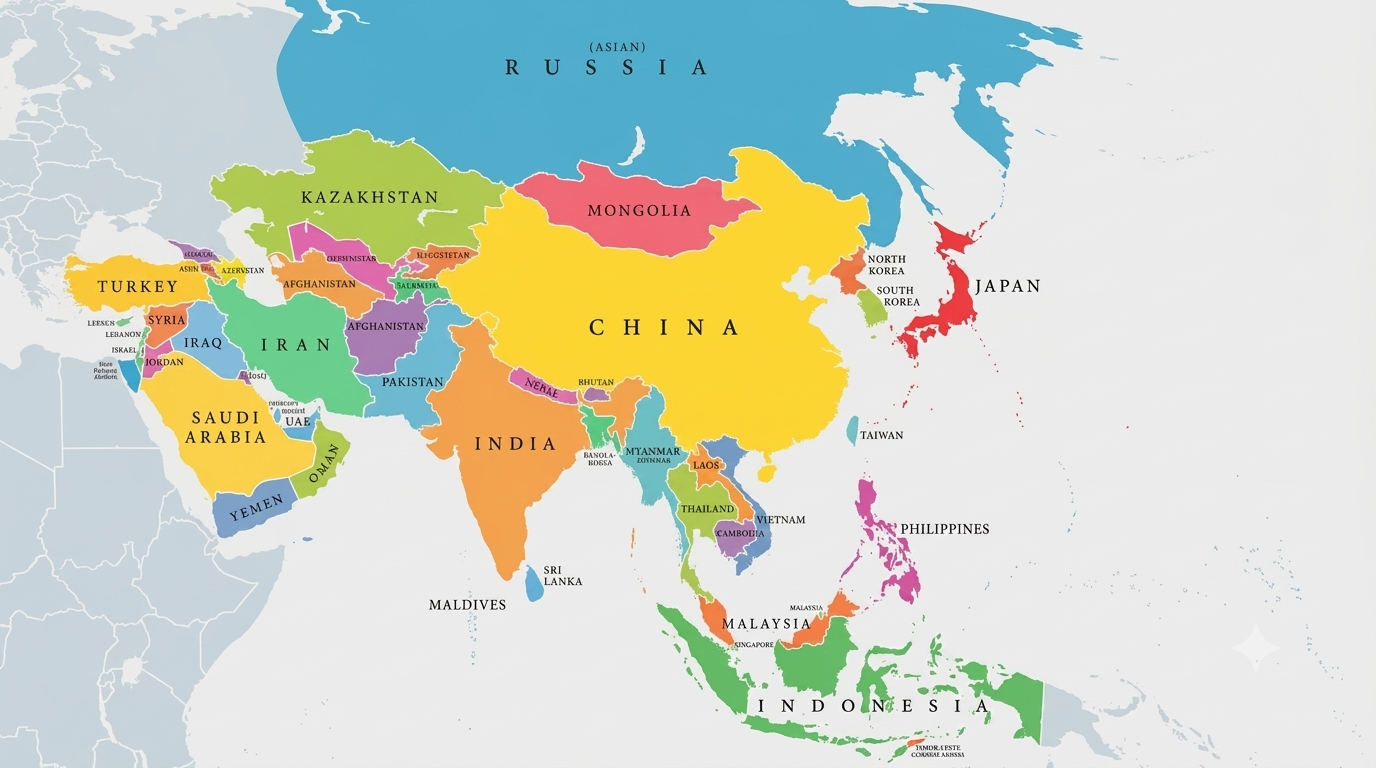
For much of the past decade, one phrase has dominated discussions of geopolitics: “The Future Is Asian.” It reflects the remarkable economic growth, technological advancement, demographic weight, and expanding influence of Asia. Manufacturing has shifted eastward, supply chains increasingly depend upon Asian economies, innovation is flourishing across the continent, and Asia has become central to global commerce, finance, and technology.
The deeper reality, however, is not that one civilization is replacing another. The defining story of the twenty-first century is that humanity is becoming more interconnected than at any previous point in history. The future is not about Asia replacing the world; it is about the world becoming increasingly connected with Asiaand Asia becoming increasingly connected with the world. This is not the story of a new empire. It is the story of a new relationship built upon interdependence rather than dominance.
The New Silk Roads
Civilizations have always advanced through connection rather than isolation. The ancient Silk Road carried far more than silk. It transported mathematics, astronomy, medicine, commerce, architecture, languages, philosophy, and culture across continents. Long before globalization became a modern expression, civilizations were already learning from one another through exchange rather than conquest.
Today’s digital networks, shipping routes, research laboratories, universities, innovation centers, and global supply chains have become the new Silk Roads of our age. Knowledge now travels faster than caravans ever could, while ideas cross borders more easily than armies. Nations continue to compete, but they also rely upon one another for prosperity, innovation, and resilience. The strongest societies of tomorrow will therefore not be those that isolate themselves from the world, but those that learn how to engage with it wisely.
Migration: Civilization’s Silent Architect
Migration is often discussed primarily in terms of borders, labor markets, or demographic pressures. While these considerations are important, they overlook migration’s greatest contribution to civilization.
Migration is, above all, the movement of knowledge, experience, ambition, and opportunity. Throughout history, civilizations have been enriched by people who crossed borders carrying new skills, fresh ideas, entrepreneurial spirit, and cultural confidence. Human progress has rarely remained confined by geography; instead, it has flourished wherever people have exchanged ideas and experiences across cultures.
My own observations in Norway have reinforced this understanding. During international gatherings and civic events, I have repeatedly witnessed recognition of the valuable contribution made by immigrant communities to national development. Among them, Pakistanis have earned respect through education, entrepreneurship, healthcare, public service, business, and civic engagement. Their success demonstrates that disciplined communities can contribute meaningfully to societies far beyond the lands of their birth. Migration, therefore, should not be viewed merely as the movement of workers, but as one of civilization’s greatest instruments for exchanging knowledge and strengthening mutual understanding.
Geography Opens Doors
Many nations proudly describe their geography as their greatest strategic advantage. Geography undoubtedly matters. It shapes trade routes, influences diplomacy, affects security, and determines access to markets. Yet geography alone has never made a nation great.
Geography opens doors, but institutions determine whether those doors remain open. History offers countless examples of countries blessed with extraordinary locations that failed to realize their potential because institutions remained weak. Conversely, nations with relatively modest natural advantages transformed themselves through education, innovation, accountable governance, reliable public institutions, and the rule of law. Opportunity may be inherited, but greatness never is.
Trust: The New Strategic Currency
Every era has possessed its defining strategic resource. The Industrial Revolution rewarded coal. The twentieth century rewarded oil. The digital age rewarded information. The coming decades, however, may reward something even more valuable: trust.
Trust encourages investment because it reduces uncertainty. It attracts talent because it rewards merit, strengthens institutions because citizens believe fairness is possible, and encourages innovation because people are willing to invest their ideas where they expect stability and opportunity. In the twenty-first century, nations will increasingly compete not only through economic output or technological capability, but also through the confidence they inspire among investors, researchers, entrepreneurs, students, and ordinary citizens. Trust is steadily becoming one of the world’s most valuable strategic assets.
The Next Global Competition
The nature of international competition is evolving rapidly. Countries now compete for researchers before they compete for resources, for innovators before they compete for industries, for universities before they compete for markets, and for credibility before they compete for influence.
Human capital is steadily becoming more valuable than natural capital. Societies that invest in education, scientific research, ethical leadership, technological creativity, and institutional excellence will enjoy advantages that cannot easily be measured by military strength or economic statistics alone. The future therefore belongs not merely to powerful nations, but to capable societies that cultivate knowledge, innovation, and public trust.
Pakistan’s Moment
Pakistan stands at one of the world’s most significant geographical crossroads, linking South Asia, Central Asia, the Middle East, and the Arabian Sea. Few nations occupy such an important meeting point of regions, cultures, and commercial possibilities. This location presents both extraordinary opportunities and considerable responsibilities.
The more important question, however, is not whether Pakistan occupies an important place on the map. The real question is whether it can become a country that attracts confidence through capable institutions, quality education, scientific research, innovation, responsible governance, constructive diplomacy, and meaningful engagement with the wider world. A nation’s reputation is ultimately built not by its geography but by the quality of its institutions and the confidence of its people. History does not reward geography alone; it rewards those who know how to use it wisely.
The State Is Not an Emotion
In every society, people often expect the state to think and feel as individuals do. They hope it will reward good intentions, overlook repeated failures, or rescue every citizen from the consequences of poor choices. Yet history suggests that enduring states operate differently.
The state is not an emotion; it is an institution. Like a well-designed machine, it functions through laws, incentives, and systems rather than personal affection. It neither loves nor hates. Its enduring purpose is to preserve social order, protect national stability, and create conditions in which society can prosper across generations. In doing so, it naturally encourages what strengthens the nationeducation, innovation, productive enterprise, responsible citizenship, and respect for the rule of lawwhile discouraging practices that weaken public trust, economic resilience, or institutional integrity.
This principle extends beyond government itself. Markets reward competence. Universities reward learning. Scientific communities reward discovery. Healthy institutions, whether public or private, tend to recognize contribution more than intention. They cannot permanently compensate for indiscipline, nor can they sustain societies that neglect responsibility while expecting continuous progress.
For this reason, the relationship between citizens and the state should not be understood merely as one of entitlement, but of mutual responsibility. Strong institutions require responsible citizens, just as responsible citizens depend upon strong institutions. Neither can flourish for long without the other.
The Choice Before Us
The future will not be shaped by geography alone, nor by economic statistics, military strength, or even the rise of Asia as a region. It will ultimately be shaped by peopleby their ability to learn, adapt, innovate, cooperate, and earn the trust of others. Interdependence creates opportunity. Trust creates prosperity. Migration carries knowledge. Geography opens doors. Institutions determine whether those doors remain open. None of these forces, powerful as they are, can build a future for those who refuse to build it for themselves.
No nation, no government, no institution, and no visionary leader can permanently substitute for personal responsibility. History has never rewarded societies that waited endlessly for a savior; it has rewarded societies whose ordinary citizens chose extraordinary discipline. The most valuable passport is not merely the one carried in a pocket, but the reputation earned through honesty, competence, perseverance, and integrity. The strongest bridge between nations is not made of steel or concrete; it is built upon confidence in human character. Migration may open new horizons, but only knowledge, discipline, and ethical conduct can sustain success. Geography may offer opportunities, but only capable institutions and responsible citizens can transform opportunity into lasting prosperity.
The question before every young person is therefore not, “Who will build my future?” Rather, it is, “What am I doing today that makes me worthy of the future I hope to inherit?” The twenty-first century will not belong to those who wait. It will belong to those who preparenot to those who complain, but to those who create; not to those who spend their lives searching for a messiah, but to those who become responsible architects of their own destiny.
Perhaps that is the greatest lesson of all.
The future is not something we inherit. It is something we earn.
Disclaimer: The views and opinions expressed in this article are solely those of the author and do not necessarily reflect the views, policies, or position of this website. The website does not endorse or oppose any opinion presented herein.