

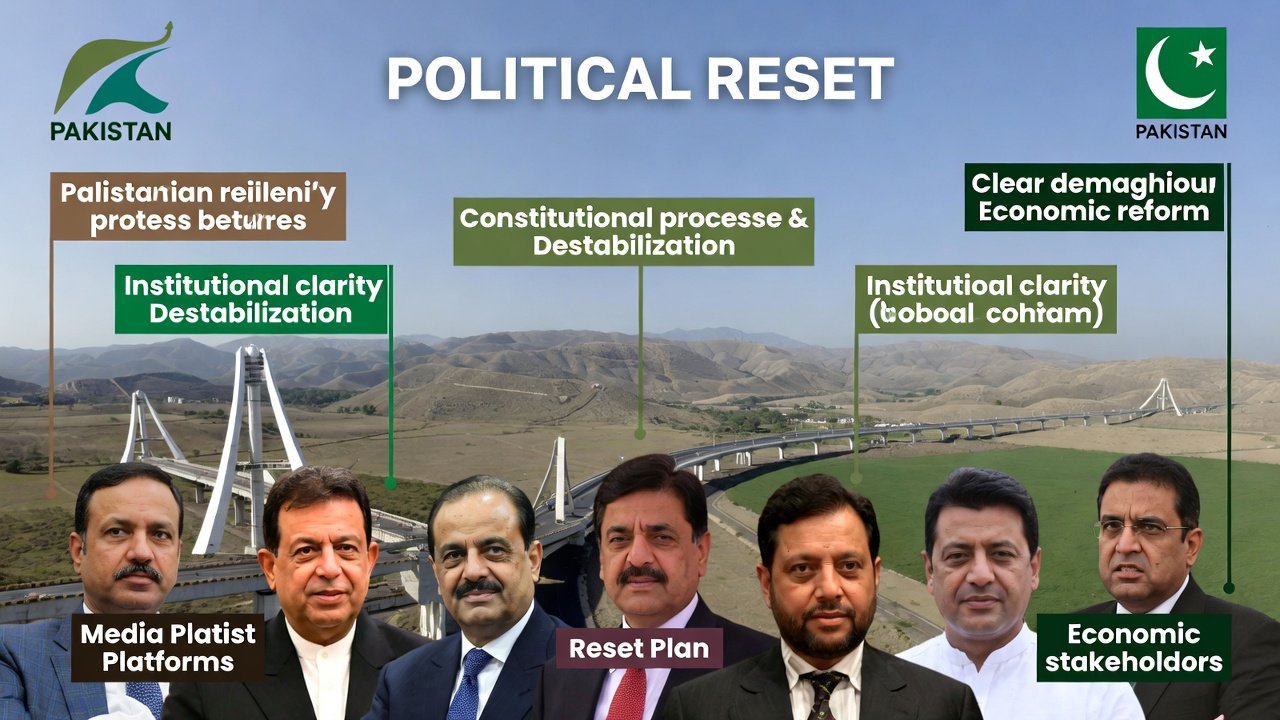
Not a cosmetic adjustment, not another temporary political understanding, but a structural recalibration of how politics, protest, policy, and national stability interact. Can we begin from a more honest premise? The state is only part of the solution. The responsibility extends far beyond one institution. Political actors, media platforms, economic stakeholders, civil society, and citizens all shape the climate in which stability either survives or erodes. A functioning country is not sustained by authority alone; it is sustained by collective discipline.
Stability is not suppression. It is infrastructure.
Across much of the modern world, organized agitation as a recurring pressure mechanism against the state has largely gone out of fashion. Mature political systems do not negotiate under prolonged disruption. They do not treat cyclical confrontation as a legitimate instrument of leverage. They understand that continuity protects economic growth, investment confidence, and international credibility.
Yet in Pakistan, agitation remains a recurring feature of political engagement. Political competition is natural and necessary in a democracy. Peaceful dissent is a constitutional right. But there is an important distinction between democratic opposition within a framework and strategies that rely primarily on disruption to compel outcomes.
When confrontation becomes cyclical, governance becomes reactive.
Administrative focus shifts from planning to crisis management. Energy that should advance reform is spent containing turbulence. Investor confidence weakens. Economic hesitation follows. The cost accumulates quietly but persistently.
The deeper question is not who mobilizes. The deeper question is why agitation continues to be treated as an effective negotiating instrument. Once disruption yields structural concessions, the method tends to repeat itself. Future actors absorb the lesson: pressure produces results.
And when pressure becomes precedent, predictability declines.
Over time, authority fragments, polarization deepens, and institutions grow fatigued. No modern state seeking long-term stability can afford that pattern.
There is also a recurring narrative that Pakistan’s strategic position or external relationships can compensate for internal instability. Some argue that Pakistan uniquely understands major global actors, or that international stakeholders closely monitor and calibrate every development within the country. While international relationships matter and geopolitical relevance is real, no external understanding can substitute for internal coherence.
No foreign engagement can replace domestic stability.
A country that seeks respect abroad must first demonstrate discipline at home.
A grand RESET does not mean limiting politics; it means professionalizing it. It requires clearer boundaries between protest and destabilization, stronger adherence to constitutional processes, policy continuity beyond electoral cycles, and media responsibility in shaping public discourse. Economic reform must be treated not as a partisan project but as a national priority. Institutional balance must be maintained through law, not through personality-driven adjustments.
Correction must be calm, structured, and lawful never reactive.
High stakeholders carry particular responsibility in this process, not because they are the source of instability, but because they are custodians of continuity. Their role is to reinforce institutional clarity, encourage responsible political conduct, and prioritize long-term national cohesion over short-term tactical advantage. Stability cannot be delegated; it must be jointly protected.
Pakistan does not need another cycle of elevation followed by estrangement; it needs continuity, predictability, and strategic maturity. A modern state cannot revolve around personalities, however influential they may be, but must instead rely on systems resilient enough to withstand individual ambitions and political fluctuations.
The issue is not opposition. The issue is method.
The issue is not dissent. The issue is durability.
If Pakistan seeks lasting economic strength, institutional credibility, and global respect, it must consciously outgrow confrontation politics while safeguarding constitutional freedoms. A grand RESET begins not with reaction, but with clarity of purpose, institutional balance, and disciplined governance.
And clarity, once firmly established, restores national equilibrium without unnecessary turbulence
Disclaimer: The views and opinions expressed in this article are solely those of the author and do not necessarily reflect the views, policies, or position of this website. The website does not endorse or oppose any opinion presented herein.