

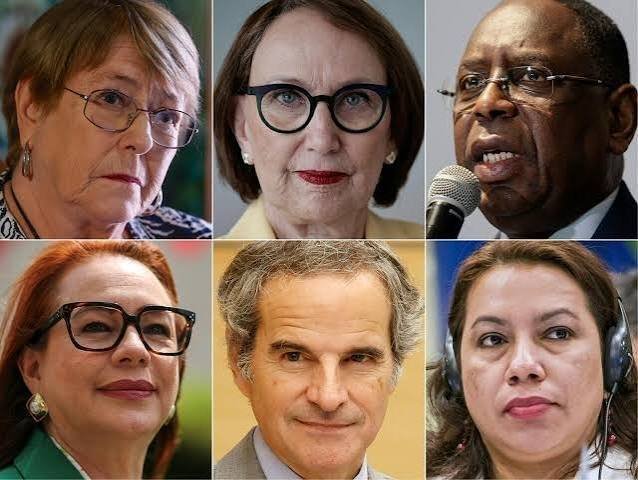
United Nations: The six candidates seeking to become the next United Nations secretary-general are set to participate in a televised debate on Thursday, one week before the formal selection process begins for the organization’s top post.
Who Are the Candidates?
The 90-minute debate will take place in the UN General Assembly Hall and feature questions from diplomats, UN staff, and civil society representatives. The event will be broadcast by Bloomberg.
The candidates vying to succeed Secretary-General António Guterres, whose term ends on December 31, 2026, are:
- Michelle Bachelet of Chile
- María Fernanda Espinosa of Ecuador
- Rafael Grossi of Argentina
- Rebeca Grynspan of Costa Rica
- Carolyn Rodrigues-Birkett of Guyana
- Macky Sall of Senegal
General Assembly President Annalena Baerbock said the debate offers an opportunity for member states and the public to assess the candidates’ leadership priorities at a time when the United Nations faces significant global challenges.
The UN is currently grappling with a financial shortfall and growing scrutiny from several member states, including the United States, which has called for reforms aimed at improving the organization’s efficiency and focus on its core responsibilities.
How Will the Next UN Chief Be Chosen?
The formal selection process begins on July 30, when the 15-member UN Security Council will hold its first confidential straw poll to assess support for the candidates.
Additional rounds of voting will continue until one candidate secures at least nine votes without a veto from any of the Security Council’s five permanent members — China, France, Russia, the United Kingdom, and the United States.
The Security Council will then recommend its preferred candidate to the 193-member UN General Assembly, which will formally appoint the next secretary-general.
The successful candidate will assume office on January 1, 2027.
Diplomats told AFP that the contest remains open, with Rafael Grossi widely viewed as an early front-runner, while Rebeca Grynspan and Carolyn Rodrigues-Birkett are also considered strong contenders.
Several member states have also expressed support for appointing the first woman to lead the United Nations, while Latin American countries have argued that the post should rotate to their region under the organization’s informal geographic rotation practice.