

Close Menu

    Subscribe to Updates

    Get the latest creative news from FooBar about art, design and business.

    What's Hot

    Civilian Posthumously Awarded Sitara-e-Shujaat for Stopping Suicide Bomber Near Kohat

    May 13, 2026

    Karachi Court Grants Three-Day Physical Remand of Alleged Drug Network Operator Anmol alias “Pinky”

    May 13, 2026

    India Raises Gold and Silver Import Tariffs to Support Rupee and Foreign Reserves

    May 13, 2026
    Facebook X (Twitter) Instagram
    Trending
    • Civilian Posthumously Awarded Sitara-e-Shujaat for Stopping Suicide Bomber Near Kohat
    • Karachi Court Grants Three-Day Physical Remand of Alleged Drug Network Operator Anmol alias “Pinky”
    • India Raises Gold and Silver Import Tariffs to Support Rupee and Foreign Reserves
    • Russia and Ukraine Resume Drone Strikes After Short-Lived Truce Ends, Casualties Reported
    • Demi Moore Urges Film Industry to Embrace AI Ahead of Cannes Festival
    • China Urges Pakistan to Expand Mediation Role in Iran-US Tensions and Hormuz Strait Issue
    • SBP Warns Middle East Conflict Could Threaten Pakistan’s Economic Outlook
    • Trump, Xi Set for High-Stakes Summit at Beijing’s Temple of Heaven
    Facebook X (Twitter) Instagram
    echoasianews.com
    • Home
      • Fact Check
      • War Updates
    • World News
    • Local News
    • Opinion
    • Business
    • Entertainment
    • Sports
    • Politics
    • Technology
    echoasianews.com
    Home»Opinion»When Missiles Fall, Markets Bleed: How the West Asian War Is Shaking the Global Economy
    Opinion

    When Missiles Fall, Markets Bleed: How the West Asian War Is Shaking the Global Economy

    Muhammad Anwar Saleem Hashmi AzadBy Muhammad Anwar Saleem Hashmi AzadMarch 6, 2026No Comments4 Mins Read
    Facebook Twitter Pinterest LinkedIn WhatsApp Reddit Tumblr Email
    Share
    Facebook Twitter LinkedIn Pinterest Email

    “War Destroys, Peace Builds: A Call for Economic and Social Harmony”

    The bombs and missiles may be falling in West Asia, but the tremors are being felt far beyond the battlefield. From Mumbai to Seoul, from Tokyo to Dubai, financial markets are reacting with a mix of fear, uncertainty, and rapid capital flight. The current conflict is not merely a geopolitical crisis; it is rapidly evolving into a global economic stress test.

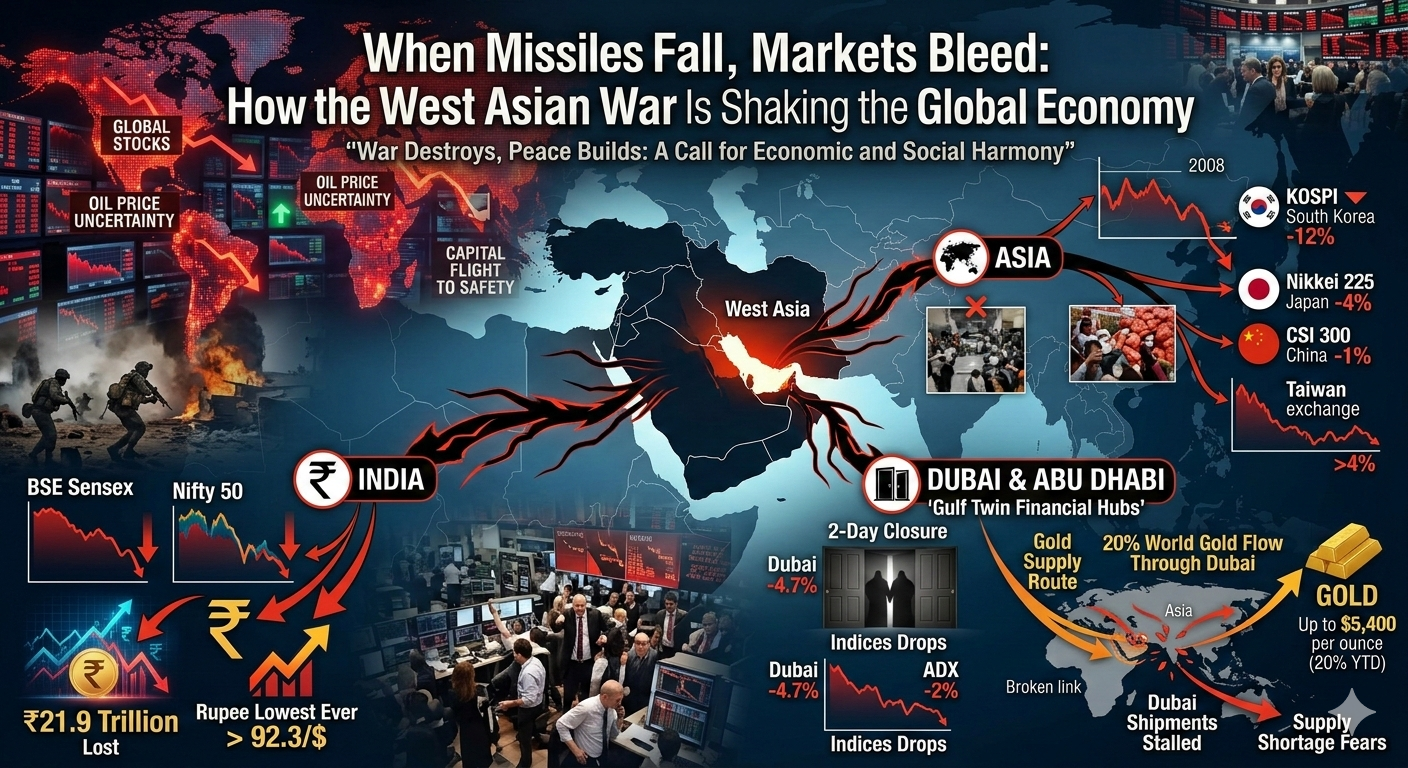
    Within just three days, investors in India have witnessed a staggering loss of nearly ₹21.9 trillion in market value. The damage has been swift and severe. The country’s flagship stock index, the BSE Sensex, plunged another 1,100 points in a single trading session. Meanwhile, the broader benchmark, the Nifty 50, dropped 385 points, reflecting widespread panic among investors.

    The currency market has not been spared either. The Indian Rupee has slipped past 92 to the U.S. dollar, touching 92.3, its lowest level on record. Currency depreciation of this magnitude reflects deep investor anxiety and capital outflows, especially during times of geopolitical instability.

    Yet the financial contagion is not limited to India.

    Across Asia, markets are flashing warning signs. In South Korea, the benchmark KOSPI collapsed by 12% in a single day, marking its steepest drop since the global financial crisis of 2008, triggered by the Global Financial Crisis. That year saw the unraveling of the international banking system following massive turmoil in U.S. markets.

    Other major Asian markets also recorded sharp declines. In Japan, the Nikkei 225 fell nearly 4%. In China, the CSI 300 Index dropped about 1%. Meanwhile, the stock exchange in Taiwan slid more than 4%, highlighting the region-wide nervousness gripping investors.

    Ironically, the financial epicenter of the shock lies closer to the conflict itself. The Gulf’s twin financial hubs, Dubai and Abu Dhabi, were closed for two days due to the escalating situation. When trading resumed, markets immediately plunged. Dubai’s main index dropped 4.7%, while the ADX General Index in Abu Dhabi fell 2%.

    These movements are not routine market corrections. They represent the financial system absorbing the shock of a widening regional war.

    West Asia remains one of the most critical nodes in the global economy. Much of the world’s energy supply and trade routes pass through this region. Cities like Dubai, Abu Dhabi, Riyadh, and Doha serve as major financial gateways that attract global capital. When instability erupts in these hubs, the ripple effects quickly spread across continents.

    The reaction of global investors follows a familiar pattern during times of crisis: they abandon risk and rush toward safety.

    This explains the sudden surge in the price of Gold. At the start of the conflict, gold prices skyrocketed to $5,400 per ounce, roughly 30 grams, as investors scrambled for safe-haven assets. Although prices have since eased slightly to around $5,100, they remain 20% higher than at the start of the year, an extraordinary rise within just a few months.

    Even more worrying is the emerging disruption in global gold supply chains.

    The city of Dubai plays a crucial role in the physical gold trade. Approximately 20% of the world’s gold flows pass through the emirate each year. Gold from Africa and Europe is often routed through Dubai before reaching major consumer markets in Asia, particularly India.

    Since the conflict began, however, gold shipments through Dubai have stalled. Cargo movement has slowed dramatically, creating fears of a potential supply shortage. If these disruptions persist, prices could climb even higher in the coming weeks.

    This is the defining nature of modern warfare: the battlefield no longer contains the damage. Conflict now travels through supply chains, financial markets, currencies, and commodities. What begins as a regional confrontation quickly becomes a global economic disturbance.

    For now, the signals from the markets are unmistakable. Equity indices are falling, currencies are weakening, and safe-haven assets are surging. The red flashing across trading screens worldwide is not just a financial warning, it is a reflection of geopolitical uncertainty spreading through the arteries of the global economy.

    In today’s interconnected world, when missiles fly in one region, the economic shockwaves circle the globe within hours. The war in West Asia is proving that once again.

    Disclaimer: The views and opinions expressed in this article are solely those of the author and do not necessarily reflect the views, policies, or position of this website. The website does not endorse or oppose any opinion presented herein.

    Share this:

    • Share on Facebook (Opens in new window) Facebook
    • Share on X (Opens in new window) X

    Like this:

    Like Loading…
    Financial Markets geopolitical crisis global economy stock market crash west asia war
    Share. Facebook Twitter Pinterest LinkedIn Tumblr Telegram Email
    Muhammad Anwar Saleem Hashmi Azad
    Muhammad Anwar Saleem Hashmi Azad

    Muhammad Anwar Saleem Hashmi Azad is a student of Peace and Conflict Studies at the National Defence University. He is associated with International Peace and Security Studies (CIPS), and has also pursued academic engagement at the National University of Sciences and Technology (NUST). His work focuses on strategic affairs, energy security, hybrid conflict, and Open-Source Intelligence (OSINT), examining the intersection of geopolitics, economic stability, and modern warfare in an increasingly volatile global order.

    Related Posts

    Israel’s Secret Base in Iraq Was a Dangerous Act of Rogue Militarism

    May 13, 2026

    Cross-Border Terrorism and Pakistan’s Legitimate Security Concerns

    May 13, 2026

    Global eyes on South Asian “Energy City”

    May 12, 2026
    Leave A Reply Cancel Reply

    Don't Miss
    Local News
    Local News

    Civilian Posthumously Awarded Sitara-e-Shujaat for Stopping Suicide Bomber Near Kohat

    By EchoAsiaNewsMay 13, 202601 Min Read

    A civilian who was killed while stopping a suicide bomber near Kohat has been posthumously…

    Share this:

    • Share on Facebook (Opens in new window) Facebook
    • Share on X (Opens in new window) X

    Like this:

    Like Loading…

    Karachi Court Grants Three-Day Physical Remand of Alleged Drug Network Operator Anmol alias “Pinky”

    May 13, 2026

    India Raises Gold and Silver Import Tariffs to Support Rupee and Foreign Reserves

    May 13, 2026

    Russia and Ukraine Resume Drone Strikes After Short-Lived Truce Ends, Casualties Reported

    May 13, 2026

    Subscribe to Updates

    Get the latest news from echoasianews.

    Stay In Touch
    • Facebook
    • Twitter
    • Instagram
    • WhatsApp
    About Us
    About Us

    We cover a wide range of topics including World News, Business & Economy, Crypto, Entertainment, Politics, Sports, and Technology, ensuring our audience stays informed about both regional and international developments.
    We're accepting new partnerships right now.

    Email Us: social@echoasianews.com

    Facebook X (Twitter) Pinterest YouTube WhatsApp
    Our Picks

    Civilian Posthumously Awarded Sitara-e-Shujaat for Stopping Suicide Bomber Near Kohat

    May 13, 2026

    Karachi Court Grants Three-Day Physical Remand of Alleged Drug Network Operator Anmol alias “Pinky”

    May 13, 2026

    India Raises Gold and Silver Import Tariffs to Support Rupee and Foreign Reserves

    May 13, 2026
    Categories
    • Blog
    • Business & Economy
    • Entertainment
    • Fact Check
    • Local News
    • Opinion
    • Politics
    • Sports
    • Technology
    • War Updates
    • World News
    Meet Our Team
    • Editorial Board
    © 2026 . All Rights Reserved EchoAsiaNews.

    Type above and press Enter to search. Press Esc to cancel.

    %d