
Close Menu

    Subscribe to Updates

    Get the latest creative news from FooBar about art, design and business.

    What's Hot

    OLIVE POTENTIALS  IN PAKISTAN

    October 27, 2026

    Kashmir After Commemoration: Pakistan Must Turn Diplomacy into Strategy

    October 27, 2026

    CPEC, Gwadar and Balochistan: Why Indian-Sponsored Terrorism Must Fail

    October 26, 2026
    Facebook X (Twitter) Instagram
    Trending
    • OLIVE POTENTIALS  IN PAKISTAN
    • Kashmir After Commemoration: Pakistan Must Turn Diplomacy into Strategy
    • CPEC, Gwadar and Balochistan: Why Indian-Sponsored Terrorism Must Fail
    • STRATAVERSE
    • Serbia’s Vučić Concedes Election Defeat as Student-Led Opposition Celebrates
    • Shadab Khan’s Maiden ODI Century Leads Pakistan to Thrilling Win Over England
    • Trump Compares Muslim Senate Candidate Abdul El-Sayed to 9/11 Hijackers
    • Beyond the Threat of Force: Can the Makkah Accord Make Deterrence Work?
    Facebook X (Twitter) Instagram
    echoasianews.com
    • Home
      • Fact Check
      • War Updates
    • World News
    • Local News
    • Opinion
    • Business
    • Entertainment
    • Sports
    • Politics
    • Technology
    echoasianews.com
    Home»Opinion»When Laws Failed, Deals Succeeded: How Indian Farmers Became Collateral in a Political Vendetta
    Opinion

    When Laws Failed, Deals Succeeded: How Indian Farmers Became Collateral in a Political Vendetta

    Aarav SharmaBy Aarav SharmaFebruary 11, 2026No Comments4 Mins Read
    Facebook Twitter Pinterest LinkedIn WhatsApp Reddit Tumblr Email
    When Laws Failed, Deals Succeeded: How Indian Farmers Became Collateral in a Political Vendetta
    Share
    Facebook Twitter LinkedIn Pinterest Email

    Couldn’t break them with laws, so he sold them out with deals to the Americans.

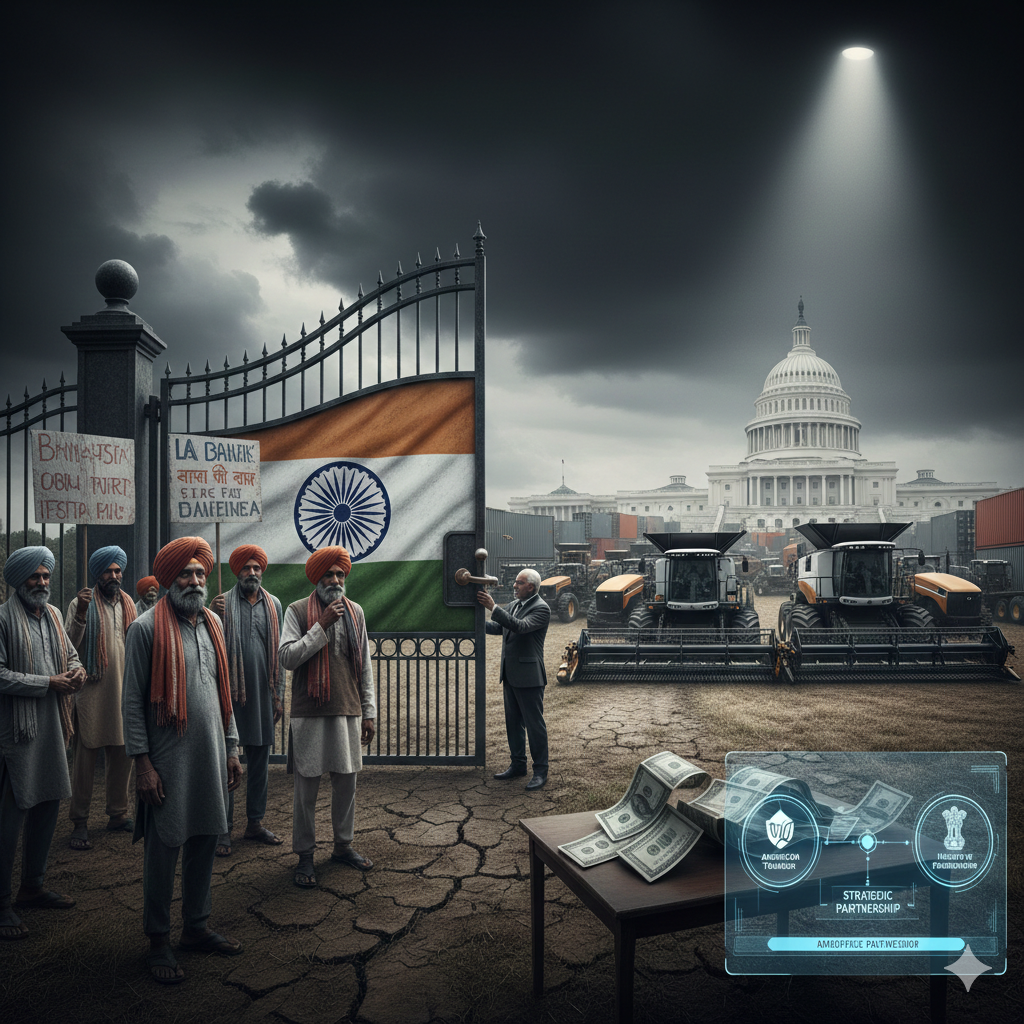
    That single line captures the uneasy continuity in India’s agricultural policy over the last few years. When Indian farmers rose up against the three farm laws, they weren’t merely resisting technical reforms. They were blocking what they understood, correctly, as a structural corporate takeover of Indian agriculture. The laws were pushed with unprecedented urgency, defended with open hostility toward dissent, and finally repealed not out of conviction, but exhaustion, after a year-long agitation that shook the country and embarrassed the government globally. That defeat clearly rankled.

    Today, under the language of “trade frameworks” and “strategic partnerships,” India’s agricultural markets are being opened to heavily subsidised U.S. farm products. No mass debate. No parliamentary upheaval. No nationwide consultation with those whose lives depend on agriculture. What could not be achieved through domestic law is now being routed through international agreements, quietly, contractually, and with smiles for foreign cameras.

    Cheap Imports, Crushing Consequences

    This is not a level playing field. American agriculture is industrial-scale, capital-intensive, and backed by massive state subsidies. Indian agriculture, on the other hand, survives on small and marginal farmers, fragmented landholdings, and minimal state support that often arrives late or not at all. Cheap imports don’t merely compete; they crush.

    For a farmer cultivating two acres in Punjab, Maharashtra, or Bihar, there is no way to “innovate” fast enough to survive a flood of subsidised foreign produce. The market doesn’t reward patriotism or resilience. It rewards scale and state-backed power. Once prices collapse, the farmer absorbs the shock, not the corporation, not the foreign exporter, and certainly not the policymakers signing the deals.

    From Reform to Retribution

    Seen together, a troubling pattern emerges. First, attempt control through domestic laws. Fail. Then, reroute the same outcome through an international backdoor.

    This is where the issue moves beyond economics and into politics, specifically political retribution. The message to farmers is chillingly clear. Resist once, and policy will remember.

    Political scientists call this policy bypassing, when elected governments circumvent domestic resistance by shifting decision-making to arenas where opposition is weaker. Robert Putnam’s Two-Level Game Theory explains this well. Leaders negotiate internationally not just with foreign states, but against their own domestic constraints. When domestic opposition is strong, leaders may deliberately use international agreements to lock in outcomes they could not secure at home.

    In simpler terms, if the people say no, sign a deal that makes their consent irrelevant.

    Neoliberalism With a Nationalist Mask

    This also exposes the contradiction at the heart of the Modi project. On the surface, it speaks the language of nationalism, self-reliance and civilizational pride. In practice, it follows a textbook neoliberal script. Privatise risk, socialise loss, and open domestic markets to global capital while calling it reform.

    Dependency theorists warned decades ago that such arrangements turn developing economies into markets rather than producers, locking them into asymmetric trade relationships. India risks becoming exactly that in agriculture. A consumption base for foreign agribusiness, while its own farmers are slowly pushed out of viability.

    The Opposition’s Failure and Responsibility

    Yet this is not a one-man story. The opposition, too, bears responsibility. Beyond episodic outrage and press conferences, there has been little sustained effort to build a coherent alternative vision for Indian agriculture. One that combines reform with protection, productivity with dignity.

    Farmers cannot be remembered only when they are on highways or during elections. If the opposition truly sees this as betrayal, it must articulate why, clearly, economically, and politically, and take that argument back to Parliament, to states, and to the streets.

    Not Reform. Not Globalisation. Something Darker.

    This isn’t reform. This isn’t globalisation in any honest sense. This looks like revenge, delivered quietly, contractually, and dressed up as diplomacy.

    When a government cannot defeat protest, but can outwait it and outmaneuver it through trade deals, democracy itself is diminished. And when the cost of that maneuvering is borne by those who feed the nation, the betrayal is not abstract. It is deeply, materially Indian.

    The farmers resisted once. The policy, it seems, has not forgiven them.

    Disclaimer: The views and opinions expressed in this article are solely those of the author and do not necessarily reflect the views, policies, or position of this website. The website does not endorse or oppose any opinion presented herein.

    Author

    • Aarav Sharma
      Aarav Sharma

      Aarav Sharma is a young political analyst and columnist with a deep interest in South Asian geopolitics, international diplomacy, and policy reform. He graduated from King's College London with a focus in global governance and gives a comprehensive understanding of the relationship between home politics and foreign affairs. His work has appeared in youth-led political events and think tank publications. Aarav is passionate about narrowing the disparity among academia and policy making.

    Share this:

    • Share on Facebook (Opens in new window) Facebook
    • Share on X (Opens in new window) X

    Like this:

    Like Loading…
    Agricultural Policy Farm Laws Farmers Protest Indian Politics Trade Policy US India Relations
    Share. Facebook Twitter Pinterest LinkedIn Tumblr Telegram Email
    Aarav Sharma

    Aarav Sharma is a young political analyst and columnist with a deep interest in South Asian geopolitics, international diplomacy, and policy reform. He graduated from King's College London with a focus in global governance and gives a comprehensive understanding of the relationship between home politics and foreign affairs. His work has appeared in youth-led political events and think tank publications. Aarav is passionate about narrowing the disparity among academia and policy making.

    Related Posts

    OLIVE POTENTIALS  IN PAKISTAN

    October 27, 2026

    Kashmir After Commemoration: Pakistan Must Turn Diplomacy into Strategy

    October 27, 2026

    CPEC, Gwadar and Balochistan: Why Indian-Sponsored Terrorism Must Fail

    October 26, 2026
    Leave A Reply Cancel Reply

    Don't Miss
    Opinion
    Opinion

    OLIVE POTENTIALS  IN PAKISTAN

    By Dr. Rana Muhammad Amir and Dr. Tahir MehmoodOctober 27, 202605 Mins Read

    Pakistan is a country which is blessed with all types of soils and seasons. Be…

    Share this:

    • Share on Facebook (Opens in new window) Facebook
    • Share on X (Opens in new window) X

    Like this:

    Like Loading…

    Kashmir After Commemoration: Pakistan Must Turn Diplomacy into Strategy

    October 27, 2026

    CPEC, Gwadar and Balochistan: Why Indian-Sponsored Terrorism Must Fail

    October 26, 2026

    STRATAVERSE

    October 26, 2026

    Subscribe to Updates

    Get the latest news from echoasianews.

    Stay In Touch
    • Facebook
    • Twitter
    • Instagram
    • WhatsApp
    Recent Posts
    • OLIVE POTENTIALS  IN PAKISTAN
    • Kashmir After Commemoration: Pakistan Must Turn Diplomacy into Strategy
    • CPEC, Gwadar and Balochistan: Why Indian-Sponsored Terrorism Must Fail
    • STRATAVERSE
    • Serbia’s Vučić Concedes Election Defeat as Student-Led Opposition Celebrates

    Archives

    • October 2026
    • September 2026
    • August 2026
    • July 2026
    • June 2026
    • May 2026
    • April 2026
    • March 2026
    • February 2026
    • January 2026
    • March 2021
    • January 2021
    • January 2020

    Categories

    • Blog
    • Business & Economy
    • Entertainment
    • Fact Check
    • Local News
    • Opinion
    • Politics
    • Sports
    • Technology
    • War Updates
    • World News
    About Us
    About Us

    We cover a wide range of topics including World News, Business & Economy, Crypto, Entertainment, Politics, Sports, and Technology, ensuring our audience stays informed about both regional and international developments.
    We're accepting new partnerships right now.

    Email Us: social@echoasianews.com

    Facebook X (Twitter) Pinterest YouTube WhatsApp
    Our Picks

    OLIVE POTENTIALS  IN PAKISTAN

    October 27, 2026

    Kashmir After Commemoration: Pakistan Must Turn Diplomacy into Strategy

    October 27, 2026

    CPEC, Gwadar and Balochistan: Why Indian-Sponsored Terrorism Must Fail

    October 26, 2026
    Categories
    • Blog
    • Business & Economy
    • Entertainment
    • Fact Check
    • Local News
    • Opinion
    • Politics
    • Sports
    • Technology
    • War Updates
    • World News
    Meet Our Team
    • Editorial Board
    © 2026 . All Rights Reserved EchoAsiaNews.

    Type above and press Enter to search. Press Esc to cancel.

    %d