

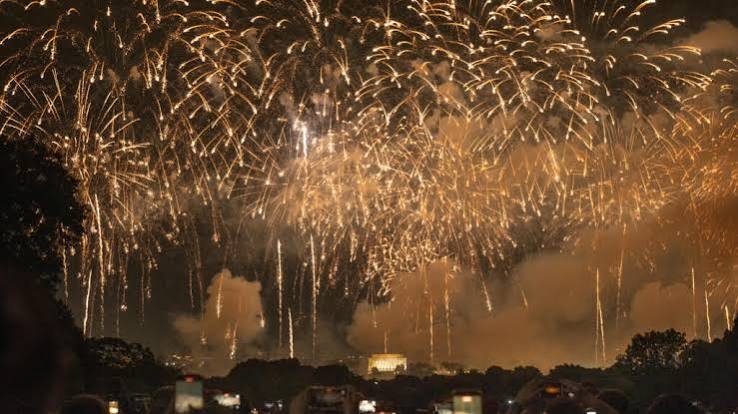
WASHINGTON: The United States capital briefly became the world’s most polluted major city after an unprecedented Independence Day fireworks display sent dangerous levels of smoke and fine particulate matter into the air, according to air quality data from Swiss monitoring company IQAir.
The large-scale fireworks event, organized as part of the White House-backed Freedom 250 celebrations, aimed to set a new Guinness World Record by launching approximately 850,000 fireworks within 40 minutes. Experts had warned beforehand that such an intense display could pose significant public health risks due to the massive release of airborne pollutants.
How Severe Did Air Pollution Become?
Air quality monitoring stations across Washington began recording rising pollution levels from local fireworks displays during the evening. However, pollution surged dramatically during the main midnight fireworks show.
Fine particulate matter (PM2.5)—microscopic particles capable of penetrating deep into the lungs and bloodstream—peaked at more than 200 micrograms per cubic meter at one monitoring station. The U.S. Environmental Protection Agency (EPA) sets a 24-hour exposure standard of 35 micrograms per cubic meter, making the recorded levels nearly six times higher than the recommended limit.
Authorities issued “Code Purple” air quality alerts across Washington and surrounding areas of Virginia and Maryland, indicating air pollution had reached levels considered unhealthy for the entire population, not only vulnerable groups.
When Did Washington Become the World’s Most Polluted City?
According to IQAir’s global air quality rankings, Washington ranked as the world’s most polluted major city between approximately 3:00 a.m. and 5:00 a.m. following the Independence Day celebrations.
The city’s ranking later improved as rainfall dispersed the smoke. By Sunday afternoon, pollution levels had largely returned to normal.
What Health Risks Did Scientists Highlight?
Atmospheric scientists warned that the exceptionally high concentration of PM2.5 particles posed immediate respiratory risks while also contributing to long-term health problems.
Russell Dickerson, an atmospheric scientist at the University of Maryland, said heavy rainfall prevented the situation from becoming significantly worse.
“We dodged a bullet. It was very bad, but it could have been substantially worse.”
Scientists noted that weather conditions played a critical role in dispersing the smoke before prolonged exposure could occur.
How Did the EPA Respond?
Responding to criticism, EPA Press Secretary Brigit Hirsch defended the celebrations, stating:
“Fireworks are awesome and we hope everyone enjoyed the incredible shows in and around our nation’s capital to celebrate 250 years of America.”
The remarks came as the Trump administration continues promoting deregulatory environmental policies while defending large-scale public celebrations.
Was the World Record Actually Broken?
The fireworks contractor, Pyrotecnico, had announced its intention to surpass the previous Guinness World Record of approximately 811,000 fireworks, set in the Philippines on New Year’s Day in 2016.
However, Guinness World Records has confirmed only that an application has been received. The organization said it cannot verify whether the record has been achieved until all evidence has been reviewed.
Why Was the Event Delayed?
The fireworks display was originally scheduled as the climax of Independence Day celebrations but was delayed by more than an hour due to thunderstorms during a record-breaking heatwave affecting much of the United States.
The show eventually began shortly before midnight, producing dense smoke that significantly reduced visibility for spectators and triggered the sharp deterioration in air quality.