

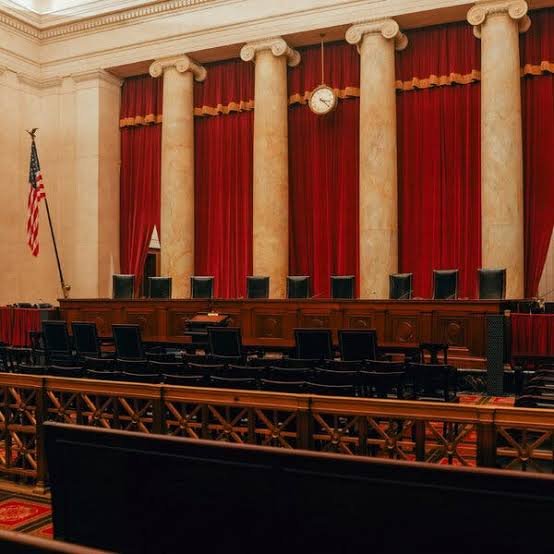
WASHINGTON: The US Supreme Court on Tuesday struck down President Donald Trump’s executive order seeking to end automatic birthright citizenship for children born in the United States to parents without permanent legal status, ruling that the measure violates the US Constitution.
In a 6-3 decision, the court upheld lower court rulings that found the executive order unconstitutional, dealing a major setback to the Trump administration’s immigration agenda.
Why did the Supreme Court reject the order?
Writing for the majority, Chief Justice John Roberts said the administration had failed to provide sufficient legal and historical grounds to overturn more than a century of constitutional interpretation.
Roberts traced the principle of birthright citizenship from English common law through the adoption of the Fourteenth Amendment in 1868 and the Supreme Court’s landmark 1898 ruling in United States v. Wong Kim Ark, which established that most individuals born on US soil are entitled to citizenship.
“The Framers of the Fourteenth Amendment extended that promise to every free-born person in this land. We keep that promise today,” Roberts wrote.
He was joined by Justices Amy Coney Barrett, Brett Kavanaugh, Sonia Sotomayor, Elena Kagan and Ketanji Brown Jackson.
What did Trump’s executive order seek to do?
Signed on January 20, 2025, shortly after Trump returned to office, the executive order sought to deny automatic US citizenship to children born in the country whose parents were in the United States temporarily or without legal immigration status.
The administration argued that the Fourteenth Amendment’s Citizenship Clause applies only to children whose parents are US citizens or lawful permanent residents, contending that the provision was originally intended to protect formerly enslaved people rather than all children born on US soil.
How did the court respond to those arguments?
The majority rejected the administration’s interpretation, stating that neither the Constitution nor federal immigration law supports limiting birthright citizenship based on the immigration status of parents.
Justice Jackson, in a concurring opinion, said the Fourteenth Amendment reflects broader constitutional principles that extend beyond the post-Civil War context.
Meanwhile, Justice Clarence Thomas, joined in dissent by Justices Samuel Alito and Neil Gorsuch, argued that the majority had misinterpreted the original meaning of the Citizenship Clause.
Although joining the majority, Kavanaugh wrote separately that Congress could legislate exceptions to birthright citizenship if it chose to do so, but noted that no such law currently exists.
How did Trump respond?
Trump criticised the ruling, calling it “too bad for our country,” and urged Republicans in Congress to introduce legislation restricting birthright citizenship.
He said lawmakers would have his “complete and total support” in pursuing changes to existing immigration laws.
What are the broader implications?
The ruling preserves the long-established interpretation of the Fourteenth Amendment and prevents the administration from implementing one of its most significant proposed immigration reforms.
Civil rights organisations, including the American Civil Liberties Union, welcomed the decision, describing it as a reaffirmation of constitutional protections.
Previous studies have warned that ending birthright citizenship could leave hundreds of thousands of children born annually in the United States without citizenship and significantly increase the country’s undocumented population over time.