

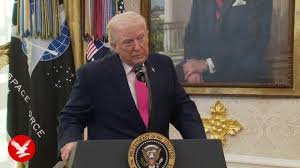
Washington reportedly sent a peace plan to Iran as US President Donald Trump expressed optimism on Tuesday over ending nearly a month of warfare, while Tehran announced it would allow “non-hostile” vessels safe passage through the Strait of Hormuz, the critical oil shipping route. The developments came amid continuing violence in the region. (Source: Dawn)
Trump told reporters at the White House that the United States was “in negotiations right now” with Iran. He described a recent Iranian gesture related to the strait as a “very big present worth a tremendous amount of money,” signaling tentative progress in diplomacy. Iran, in a message circulated by the International Maritime Organisation, confirmed that non-hostile oil vessels could pass through the strait, which channels nearly one-fifth of global crude exports.
The announcement led to a sharp drop in oil prices, with benchmark crude falling close to six per cent. Prices at the pump in the United States had surged in recent weeks due to the conflict, adding political pressure on the president. Trump indicated that the peace plan, reportedly sent via Pakistan, involved high-level US officials including Vice President JD Vance, and centered on preventing Iran from acquiring nuclear weapons.
Israeli media reported that the plan could include a one-month ceasefire, the transfer of Iran’s enriched uranium, and a ban on further enrichment, in exchange for the lifting of sanctions and support for civilian nuclear energy projects at Bushehr. Tehran accused Israel of carrying out a second strike on the Bushehr site, located near Gulf population centers, while residents reported daily missile alerts and fears of attacks on critical energy infrastructure.
Despite the signs of diplomacy, Washington continues military preparations. The Wall Street Journal reported that 3,000 troops from the 82nd Airborne Division are being deployed to the Middle East. Iranian missiles have reportedly breached Israeli defenses, causing injuries and damage in Tel Aviv, while Israel conducted extensive airstrikes across Iran and intensified operations in southern Lebanon. At least 1,072 people have been killed in the region due to the ongoing conflict, with more than one million displaced, according to Lebanese authorities.
Gulf states, including Bahrain, Kuwait, the United Arab Emirates, and Saudi Arabia, have reported intercepting renewed missile and drone attacks from Iran. Kuwait confirmed a fire at its main airport following drone strikes on a fuel facility. Pakistan’s prime minister has offered to host US-Iran talks, underlining Islamabad’s role in ongoing diplomatic efforts.