

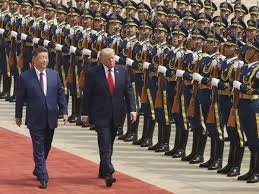
US President Donald Trump and Chinese President Xi Jinping held high-level talks in Beijing during a two-day summit focused on trade, geopolitical tensions, and regional security issues, including Iran and Taiwan. The meeting marked the first visit by a US president to China since Trump’s previous trip in 2017 and comes amid heightened global tensions linked to the ongoing Iran conflict and strained US domestic political conditions.
At the opening of the summit held at Beijing’s Great Hall of the People, Xi Jinping stated that US–China trade negotiations were making progress, noting that recent economic discussions in South Korea had produced what he described as “overall balanced and positive outcomes.” Xi emphasized that stable relations between the world’s two largest economies benefit global stability, stating: “When we cooperate, both sides benefit; when we confront each other, both sides suffer.”
Trump described the summit as potentially the “biggest summit ever,” following a formal welcome ceremony that included a military honor guard and large public participation. He praised Xi, stating: “You’re a great leader… there are those who say this may be the biggest summit ever.”
Both leaders reviewed ongoing trade arrangements aimed at sustaining a tariff truce reached in the previous year, under which the United States suspended high tariffs on Chinese imports while China eased restrictions on key exports, including rare earth materials. Officials said the talks also focused on establishing long-term mechanisms for trade and investment stability.
Economic discussions included US efforts to expand exports to China, particularly in aircraft (Boeing), agricultural goods, and energy products, as part of Washington’s strategy to reduce its trade deficit. China, meanwhile, pressed for easing US restrictions on advanced semiconductor technology and chipmaking equipment.
US and Chinese business executives attended parts of the engagement, including Elon Musk and Nvidia CEO Jensen Huang, who were introduced to Xi Jinping during the talks. Xi reportedly stated that US companies remain deeply integrated in China’s reform and opening-up process and that China’s “door of openness will only open wider.”
A key point of tension during the summit was Taiwan. Xi Jinping warned that Taiwan remains the most sensitive issue in US–China relations and stated that mishandling it could lead to severe consequences and heightened conflict risk. According to Chinese readouts, Xi told Trump that Taiwan-related issues could push bilateral relations into a “dangerous path.”
The United States reiterated its continued policy obligations regarding Taiwan’s defense capabilities, including ongoing arms sales commitments, despite the absence of formal diplomatic ties. China strongly opposed recent US arms packages to Taiwan, valued at approximately $14 billion, which remain under consideration.
Trump did not publicly respond to shouted questions regarding Taiwan during a photo session with Xi at the Temple of Heaven, where both leaders later appeared together.
The leaders also exchanged views on major international crises, including the ongoing US–Iran conflict. US officials have sought greater Chinese involvement in encouraging Iran toward a settlement framework, particularly regarding nuclear restrictions and maritime security in the Strait of Hormuz. However, analysts note China’s reluctance to apply strong pressure on Tehran due to its strategic and energy interests.
US Secretary of State Marco Rubio stated that China has an interest in stabilizing the situation, citing disruptions to shipping and broader global economic risks affecting Chinese exports.
The summit took place amid shifting geopolitical and domestic conditions. Analysts noted that Trump’s political position has been weakened by economic pressures linked to the Iran conflict, including inflationary effects and domestic political uncertainty ahead of upcoming US elections.
In contrast, Xi Jinping entered the talks from a position of relative domestic stability, with no comparable internal political pressure. Despite China’s slowing economy, Beijing has maintained strategic leverage through trade policy and critical supply chains, including rare earth exports.
Experts cited in reporting described the evolving US–China dynamic as increasingly balanced, with some referencing a “G2” framework reflecting a duopoly of global influence.
Both sides agreed to continue dialogue on trade mechanisms, artificial intelligence cooperation frameworks, and broader economic coordination. A Chinese state visit to the United States by Xi Jinping is tentatively planned for later in the year, which would mark his first visit since Trump’s second term began.
The summit concluded with a state banquet and further scheduled informal engagements between the two leaders, including discussions over tea and lunch on the following day.