

A river system which transcends nationals’ borders is one of the most delicate resources in international politics. The value of rivers is not limited to supplying drinking water, rivers are also responsible to sustain agriculture, electricity production, supporting ecosystems and ensuring economic stability. A river that passes more than one state becomes a common resource of nature which should be ruled by law, collaboration, and mutual respect. Indus River system between India and Pakistan is a prime example. Throughout, there have been sensitivities in Pakistan whenever developments in the upstream are thought to have an impact on downstream flows under the protection of international agreements and legal principles.
River network system comprises a major river, its tributaries, distributaries, lakes, wetlands and the overall drainage basin. The world shows huge river basins like Nile, Mekong, Danube and the Indus which have proven rivers to be not only features of the environment, but were life lines as well. In any given such system, an inevitable association exists between upper riparian states (where the river originates or flows first) and lower riparian states (that are the recipients of water which flows down the river). This structural fact poses both accountability on behalf of the upstream states and susceptibility on behalf of the downstream states.
This dynamic is evident in the Nile River. As a lower riparian state, Egypt relies extensively on water emitted by other upstream states like Ethiopia and Sudan. On the same note, The Grand Ethiopian Renaissance Dam in Ethiopia has caused schedule filling and down water security. The development of upstream dams has raised concerns in countries such as Cambodia and Vietnam within the Mekong Basin, that could potentially modify the fish population, sediment transport and seasonal crops. These examples demonstrate that downstream issues are the regular aspect of global water governance. The concerns that Pakistan expresses are therefore more in line with the international realities that are widely acknowledged to be faced by the lower riparian states around the globe.
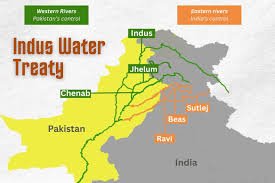
There are six rivers in the Indus River system which include; Indus, Jhelum, Chenab, Ravi, Beas, and Sutlej. These are Rivers that are located in the high areas, which feed Pakistan, providing the source of agriculture and foods as well as the means of livelihood of the rural population. The Indus Basin is vital to Pakistan because it supplies a significant part of national food security and economic stability as a significant part of the irrigation system.
Transformational Water law has been founded on principles that are aimed at meeting equal interests of all the riparian states. The principle of equitable reasonable use has it that each country having common river has a right to the water and should be able to use it without causing problems to the other countries. The other principle is the no significant harm rule, which limits the activities of an upstream state that may inflict serious harm on downstream users. These principles are massively incorporated in customary international law and endorsed by conventions like the United Nations Watercourses Convention. They also demand transparency, giving notice, and interstate collaboration of waters.
One of the most intricate water-sharing treaties of the world is the Indus Waters Treaty of 1960, which was facilitated by the World Bank. It gave the six rivers to the two nations: the eastern rivers (Ravi, Beas and Sutlej) to India with the western rivers (Indus, Jhelum and Chenab) mostly going to Pakistan. The western rivers enjoyed only partial compensation with India being granted non-consumptive uses like run-of-the-river hydropower but limited irrigation with extreme conditions. This is well understood in this arrangement which acknowledges the fact that Pakistan is the main lower riparian state of the western rivers.
Even though the treaty has still been found to be very functional in the decades, Pakistan has questioned some of the upstream hydropower and infrastructure projects. Although the dam storage along with the reservoir filling patterns and controlled releases may not cause any violation of total water limits, an effect on downstream flow timing may occur. In a nation that relies on the irrigation cycles, seasonality may matter more as well as the amount of water. The change in the timing of releases during either sowing time or drought will cause severe agricultural effects.
Other river systems are similar in that they have the same problems. In the Mekong Basin, downstream states are concerned with changing flow regimes which have an impact on fisheries and agriculture. Operations of the dam in Nile Basin have raised issues of availability of water in dry seasons. These international examples demonstrate that the conflicts between water are often related to not just quantity but also to timing and control. Consequently, the anxieties of Pakistan are in line with the proven lower riparian issues experienced at the global level.
Pakistan also has a case to assert that it has already made considerable structural trade-offs due to the treaty structure and has ceded rights to the eastern rivers at a time when it highly depends on the western rivers. This adds to the national stability of having agreed western river flows which is all the more important now.
In the modern times water stress in South Asia is being exacerbated by climate change, melting glaciers, and changes in rainfall distribution. Such changes render cooperation, trust and sharing of data more crucial than ever before. Improving joint monitoring and technical consultation mechanisms and scheduling communication should contribute to the decrease in case of misunderstanding and increase in stability of the treaty.
Finally, transboundary rivers should have a balanced approach between rights and responsibilities. It is always accepted by international law that upstream states have a right to develop but that the development should not result to serious harm to downstream population. The Indus Waters Treaty is the passion of the regional water governance. The location of Pakistan is not only indicative of a legal doctrine, but also of the realities of the location in that the country would be a lower riparian country reliant on predictable and secure river flows in order to live and prosper.
Disclaimer: The views and opinions expressed in this article are solely those of the author and do not necessarily reflect the views, policies, or position of this website. The website does not endorse or oppose any opinion presented herein.
