

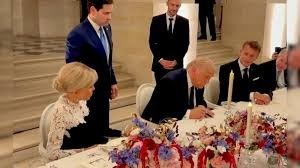
VERSAILLES: United States President Donald Trump and Iranian President Masoud Pezeshkian signed a landmark agreement aimed at ending months of conflict in the Middle East, with Tehran agreeing to dilute its enriched uranium stockpiles in exchange for sweeping economic relief and sanctions easing.
The memorandum of understanding was signed during a formal dinner at the Palace of Versailles following the G7 summit. Video footage released by a Trump aide showed the US president signing the document as world leaders, including French President Emmanuel Macron, applauded.
“Just signed it,” Trump told reporters as he left the palace.
Iranian Foreign Ministry spokesman Esmaeil Baqaei confirmed that the agreement had been finalized with the signatures of both presidents, according to state news agency IRNA.
Pakistan’s Prime Minister Shehbaz Sharif announced that the agreement would take effect immediately, describing it as a major step toward restoring stability in the region.
The deal seeks to formally end the conflict that began on February 28, when the United States and Israel launched military operations against Iran. Tehran responded with extensive missile and drone attacks across the region, while the Strait of Hormuz—one of the world’s most important energy transit routes—was effectively shut down. The United States subsequently imposed a naval blockade on Iranian ports.
Under the agreement, Iran will immediately reopen the Strait of Hormuz, while Washington will lift its naval restrictions on Iranian shipping. The United States has also committed to waiving oil sanctions that have severely impacted Iran’s economy.
The framework further outlines plans for a $300 billion reconstruction fund backed by regional states once a comprehensive agreement on Iran’s nuclear program is achieved.
Iranian officials nevertheless portrayed the deal as a strategic victory. Parliament Speaker Mohammad Bagher Ghalibaf argued that the agreement demonstrated Washington’s inability to achieve its objectives through military pressure.
China welcomed the development, with Beijing emphasizing the importance of all parties fully implementing their commitments under the agreement.
Despite broad international support, the deal has triggered criticism within the United States. Some Republican lawmakers accused the administration of conceding too much to Tehran.
Senator Bill Cassidy said the agreement failed to adequately address Iran’s nuclear ambitions and warned that sanctions relief could strengthen the Iranian government without securing lasting guarantees.
The accord establishes a two-month negotiating period during which both sides will seek a permanent settlement of disputes surrounding Iran’s nuclear activities. According to the released text, Tehran will begin diluting its enriched uranium stocks under the supervision of the International Atomic Energy Agency (IAEA), the United Nations nuclear watchdog.
President Trump warned that military action remained an option if Iran violated the agreement.
Meanwhile, Hezbollah leader Naim Qassem described the deal as a “great victory” for Iran and thanked Tehran for ensuring that the ceasefire arrangements also covered Lebanon, which became involved in the conflict after Hezbollah launched rockets toward Israel in support of Iran.
Although violence has decreased significantly since the agreement was announced, tensions remain on the Lebanese front. Lebanese state media reported continued Israeli strikes in southern Lebanon that killed at least five people, while Israel reported that five soldiers were wounded in a drone attack and that several rockets launched from Lebanon had been intercepted.
Global energy markets reacted cautiously to the agreement. Oil prices initially surged amid uncertainty surrounding the signing process before stabilizing later in the day, reflecting both optimism over regional stability and concerns about the implementation of the deal.
The agreement marks the most significant diplomatic breakthrough between Washington and Tehran in years and opens a critical window for negotiations over Iran’s long-contested nuclear program. Whether the temporary arrangement evolves into a lasting peace framework will depend on the success of talks scheduled to begin in the coming weeks.