

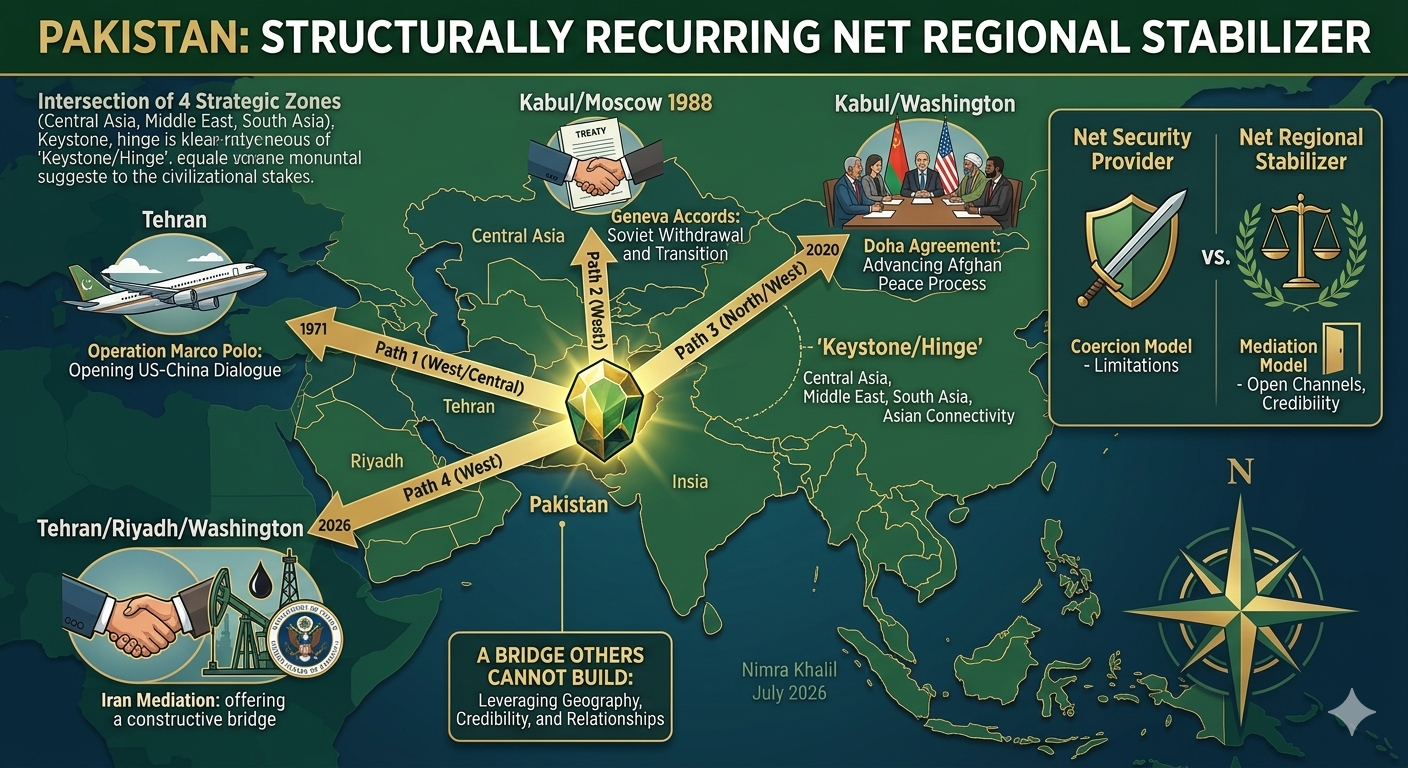
From Cold War diplomacy to modern conflict mediation, Pakistan’s position in regional stability has been neither accidental nor marginal. It was July 1971. Henry Kissinger, the most powerful national security advisor in the world, quietly boarded a Pakistani aircraft in Islamabad. His destination was Beijing, a city no senior American official had visited in over two decades. The mission was secret. The stakes were civilizational. And the aircraft was Pakistani.
That single flight, codenamed Operation Marco Polo, did not just connect Washington to Beijing. It helped bring to a close one of the most consequential diplomatic estrangements of the twentieth century and contributed to a fundamental reshaping of the global balance of power. Pakistan did not stumble into that moment. Pakistan made that moment possible.
This is not a footnote in diplomatic history. It is the opening chapter of a story that continues to unfold today, in Tehran, in Kabul, in the corridors of every major power that has ever needed a trusted interlocutor in a complex neighborhood. Pakistan is not an accidental mediator. Pakistan is a structurally recurring Net Regional Stabilizer, and the significance of this role deserves far greater recognition than it typically receives.
The Pattern That History Cannot Ignore
Dismiss one diplomatic breakthrough as luck. Dismiss two as coincidence. But dismiss three, or four, and you are not analyzing history. You are stepping around it.
Pakistan’s diplomatic interventions follow a recognizable and recurring pattern. Each time the global or regional security order reaches a critical inflection point, Pakistan steps into the space, not by invitation of proximity alone, but because of a unique combination of geography, credibility, and strategic relationships that few states in the region can replicate.
Historians itself acknowledged this in 1971, identifying Pakistan as “an indispensable hinge” in the most important strategic alignment of the second half of the twentieth century. That was not flattery. It was a structural assessment.
Four Junctures, One Conclusion
1971: The Beijing Opening
When Nixon and Kissinger decided to pursue a historic opening with China, they needed a back channel that was discreet, trusted by both sides, and geographically positioned to make the journey plausible. Pakistan was uniquely suited. Islamabad had maintained warm ties with Beijing during a period when direct US-China communication was not yet possible. Pakistan provided Kissinger the cover, the aircraft, and the diplomatic groundwork. The result was the Shanghai Communique, the normalization of US-China relations, and a fundamental rebalancing of Cold War geopolitics.
Pakistan’s role in facilitating that opening remains one of the most consequential acts of quiet diplomacy in modern history.
1988: The Geneva Accords
When the Soviet Union decided to conclude its military engagement in Afghanistan, the world needed a structured framework for withdrawal. Pakistan did not merely participate in the Geneva Accords, it was an indispensable signatory. Islamabad sat at the structural center of one of the most significant Cold War endgame negotiations in Asia. The Accords provided the mechanism for an orderly transition and placed Pakistan as a guarantor of the settlement’s implementation.
That was not peripheral involvement. That was load-bearing diplomacy.
2020: The Doha Agreement
Nearly three decades later, Pakistan again played a critical facilitative role as the United States and Afghan parties reached the Doha Agreement, a deal that formally acknowledged Pakistan’s importance in advancing the Afghan peace process. The agreement represented a recognition, long overdue in many quarters, that durable frameworks for Afghan stability have historically required Islamabad’s active and constructive engagement.
2026: The Iran Mediation
Now comes the fourth iteration. As US-Iran tensions reach a particularly sensitive juncture, and as the search for a negotiated path forward becomes increasingly urgent, Pakistan has stepped forward as a credible and balanced interlocutor. This is not Pakistan capitalizing on a crisis. This is Pakistan doing what it has consistently done, offering a constructive bridge at a moment when direct communication between key parties remains difficult.
Analysts have noted that Iran’s diplomatic space has narrowed considerably in recent years, and that no major power has been able to broker a meaningful US-Iran dialogue in the current environment. Pakistan holds the rare distinction of maintaining respectful, functional relationships with Washington, Riyadh, Beijing, and Tehran simultaneously. That breadth of engagement is not easily found elsewhere in the region.
Geography Is Not an Accident, It Is a Permanent Endowment
Tim Marshall, in Prisoners of Geography, argues that geography permanently shapes and enables strategic choices. Pakistan sits at the intersection of four of the world’s most consequential strategic zones: Central Asia, the Middle East, South Asia, and the broader arc of Asian connectivity. This is not a temporary advantage. It does not expire. It cannot be replicated by policy alone.
Pakistan’s geographic position means that major strategic transformations in Asia, whether involving energy corridors, regional diplomacy, or security architecture, naturally intersect with Pakistani territory and Pakistani relationships. This geographic reality gives Islamabad a structural relevance that endures across shifting political seasons.
The China-Pakistan Economic Corridor (CPEC) is the most visible contemporary expression of this endowment. It links landlocked Central Asia to warm water ports, connects regional commerce to broader markets, and runs through Pakistani sovereign territory. It is, in a meaningful sense, geography made policy.
Net Regional Stabilizer vs. Net Security Provider: Why the Distinction Matters
Various American national security frameworks have historically sought regional partners capable of shouldering security responsibilities in ways that maintain regional balance through local partnerships. The concept of a “Net Security Provider”, a regionally powerful state that actively maintains order on Washington’s behalf, has appeared in different forms across different administrations.
Historical experience has shown, however, that this model carries practical constraints. States designated to play such a role often face domestic constraints, shifting political priorities, or strategic interests that do not always align neatly with external expectations. The role of a security guarantor is a demanding one, and history suggests that has produced mixed outcomes across different regions.
Pakistan offers something meaningfully different, not a claim to regional dominance, but a demonstrated capacity for regional balance. The Net Regional Stabilizer model does not operate through coercion or hegemonic ambition. It operates through mediation, facilitation, and the patient maintenance of open channels with parties that may not otherwise communicate.
This distinction matters. Pakistan’s Islamic identity and scholarly tradition, its formal defence relationships with Gulf Arab states, and its longstanding people-to-people ties with Iran give it a rare capacity to engage respectfully with multiple sides of complex regional divides. That capacity is not easily manufactured. It has been built over decades of consistent engagement.
A Bridge Others Cannot Build
The current moment in West Asian diplomacy calls for honest reflection on who is genuinely positioned to help. Direct negotiations between certain key parties remain difficult. Several potential facilitators carry prior commitments or strategic interests that limit their perceived neutrality. Regional actors with the desire to mediate do not always possess the relationships required to be credible to all sides.
Pakistan stands in a different position. It shares a long border and deep cultural and religious ties with Iran. It has maintained respectful relations with the United States across many decades and many administrations. It holds formal defence commitments with Saudi Arabia and it partners with China through one of the most ambitious connectivity projects in the region.
This is not circumstantial. This is the accumulated result of decades of deliberate, often quietly pursued, and sometimes thankless diplomatic investment.
Read the Ledger
History keeps an honest ledger. Pakistan’s diplomatic ledger, spanning engagements from Beijing to Moscow to Kabul to Tehran, records a consistent pattern of constructive intervention at the most consequential junctures of global and regional security transformation. The 1971 facilitation, the 1988 Geneva Accords, the 2020 Doha Agreement, and the 2026 Iran mediation are not isolated episodes. They are four entries in the same recurring account.
Pakistan is a structurally recurring Net Regional Stabilizer, a state whose geographic position, relational architecture, Islamic identity, and demonstrated statecraft have made it a valued partner at moment after moment when the international community needed someone to hold open a diplomatic door.
The time has come to stop treating Pakistan’s diplomatic centrality as a surprise, and to start recognizing it as what it has always been: a feature of the regional order that serves everyone’s interests when it is engaged wisely and supported consistently.
Disclaimer: The views and opinions expressed in this article are solely those of the author and do not necessarily reflect the views, policies, or position of this website. The website does not endorse or oppose any opinion presented herein.