

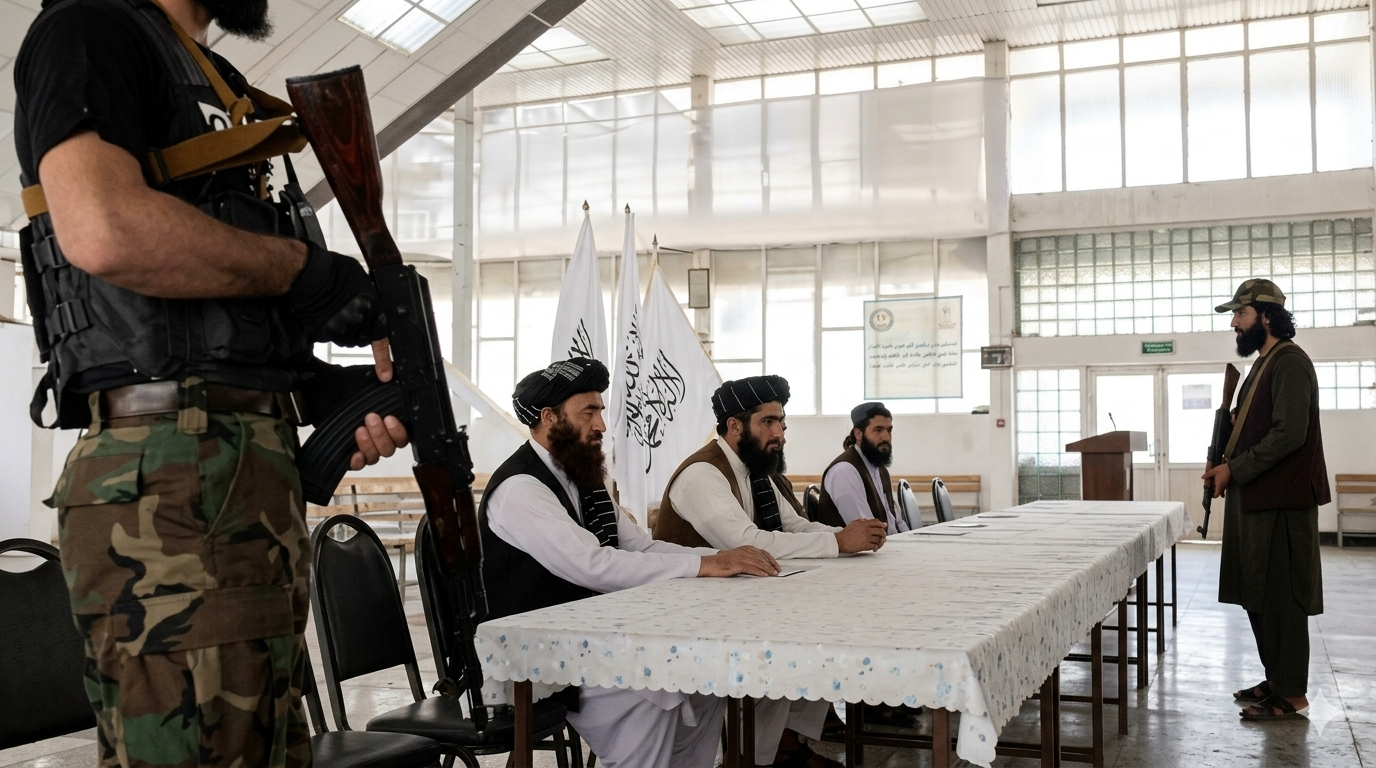
In the realist tradition of international relations, regimes driven by ideology and internal consolidation often transform into sanctuaries for non-state actors. They provide safe havens to aligned militant groups as proxies for power projection while offering plausible deniability to the international community. This theoretical framework aptly describes the Taliban’s governance in Afghanistan since its return to power in August 2021. What was promised as a stabilizing force under the Doha Agreement has instead become a vast apparatus that tolerates, and in practice enables, terrorist sanctuaries. For neighboring countries, this is not a distant academic concern but a direct and escalating threat to national security, regional stability, and the lives of its citizens.
The facts on the ground are unambiguous. Despite solemn commitments in the 2020 Doha Agreement that Afghan soil would not be used against any other country, the Taliban regime has created what the United Nations Analytical Support and Sanctions Monitoring Team describes as a “permissive environment” for multiple terrorist organisations. The UN’s 36th report (July 2025) and 37th report (February 2026) leave no room for ambiguity: the de facto authorities continue to host Tehrik-e-Taliban Pakistan (TTP) or Fitna-al-Khawarij (FAK), Al-Qaeda, and ISIS-Khorasan (ISIS-K). The Taliban’s repeated assertion that “no terrorist groups operate from Afghan soil” has been labelled “not credible” by the UN Monitoring Team.
Pakistan has borne the brunt of this policy. Once largely dismantled inside Pakistan through sustained military operations, the FAK has regrouped across the Pak-Afghanistan International border and now maintains an estimated strength of 6,000–6,500 fighters, concentrated in Kunar, Nangarhar, Khost, Paktika, and Paktia provinces. According to the Global Terrorism Index 2026, Pakistan remained one of the primary victims of terrorism worldwide,Pakistan recording 1,139 terrorism-related deaths in 2025, the highest figure since 2013, making it the country most impacted by terrorism worldwide. The FAK alone was responsible for 595 attacks that killed 637 people, accounting for 56 per cent of all terrorism fatalities in Pakistan. These cross-border operations have targeted security forces, state institutions, and civilians, turning 2024–2025 into one of the deadliest periods for Pakistan in more than a decade.
In response to repeated denial from Kabul and the escalating threat, Pakistan was forced to act in self-defence. In February 2026, the Pakistan Air Force conducted precision strikes on FAK hideouts inside Afghan territory. At the United Nations, Pakistan’s representatives have consistently warned that Afghanistan has once again become a “safe sanctuary for terrorist groups,” directly endangering regional peace. Despite decades of diplomatic, logistical, and political support extended to the Afghan peace process, Islamabad has received little meaningful cooperation in dismantling these sanctuaries.
The security dimension is inseparable from the Taliban regime’s broader failures on human rights and governance. Since taking power, the Taliban has enforced the world’s most extreme system of gender apartheid. Girls have been barred from secondary education since March 2022, a prohibition now in its fifth year. Women were excluded from universities in December 2022, and a sweeping “morality law” issued in August 2024 has further restricted their movement, dress, voice, and access to public spaces. Female employment in NGOs, the civil service, and even segments of the health sector has been severely curtailed. UNICEF and UN Women reports from 2025 warn that more than 2.2 million Afghan girls have already been denied secondary education, with projections exceeding four million by 2030. This systematic erasure of women from public life has devastated humanitarian operations and family livelihoods, driving poverty, early marriages, and despair.
Minorities, journalists, and former government officials also face persecution, creating an atmosphere of fear that fuels radicalization and cross-border refugee flows. Pakistan, which continues to host nearly 932,807 registered Afghan refugees as of early 2026, faces the secondary effects of the crisis directly. Many returning families include traumatised women and girls in urgent need of humanitarian support, placing additional pressure on already stretched resources in Khyber Pakhtunkhwa and Balochistan.
Economically and politically, the Taliban’s model has delivered isolation rather than stability. Afghanistan remains without widespread international recognition. Frozen assets and sustained sanctions, including Australia’s pioneering “world first” autonomous Afghanistan sanctions framework launched in December 2025, which immediately targeted four senior Taliban ministers responsible for oppression and governance failures, have compounded the crisis. While humanitarian carve-outs exist, the regime’s refusal to form an inclusive government or deliver on counter-terrorism assurances has prolonged economic collapse. Repeated border closures have disrupted trade and increased defence expenditure for Pakistan, with losses running into billions of rupees. Yet Islamabad has continued its long-standing humanitarian commitment, having hosted millions of Afghan refugees for over four decades, a generosity that has not been reciprocated with security cooperation.
The pattern is clear. The Taliban cracks down selectively on ISIS-K when the group threatens its own authority, but it shields the FAK and maintains operational space for Al-Qaeda. This calculated tolerance reveals a regime that continues to prioritize ideological affinity over responsible state behaviour.
The international community has responded with sustained pressure. The UN Security Council has extended the sanctions monitoring team’s mandate until 2027 and continues to update the 1988 Taliban Sanctions List. Western powers, the European Union, and the United Kingdom maintain asset freezes and travel bans. Nevertheless, the fundamental challenge remains: until the Taliban dismantles these terrorist sanctuaries and reverses its regressive policies on women’s rights and inclusive governance, Afghanistan will remain a source of instability rather than a constructive neighbour.
Pakistan’s position is rooted in hard realism, not hostility. Having sacrificed tens of thousands of lives and billions in economic costs during the global war on terror, Islamabad now expects the same standards of accountability from a neighbouring regime with which it has long maintained engagement. The giant Taliban apparatus must choose between legitimacy and ideology. For millions on both sides of the Pak-Afghanistan International border, regional peace demands verifiable action, not empty assurances. Only then can the theoretical dangers of state-enabled sanctuaries be replaced by practical stability.
Disclaimer: The views and opinions expressed in this article are solely those of the author and do not necessarily reflect the views, policies, or position of this website. The website does not endorse or oppose any opinion presented herein.