

In theory, international relations rest on a delicate balance: states respect each other’s sovereignty, or risk chaos that no one can fully control. Yet reality often tests this idea harshly. The events unfolding in the Middle East since February 28, 2026, illustrate this perfectly. A joint U.S.-Israeli military operation struck deep into Iran, killing Supreme Leader Ayatollah Ali Khamenei, aged 86, along with dozens of senior officials. Iran now observes 40 days of national mourning. Streets in Tehran fill with grieving citizens holding portraits of their lost leader. Families mourn not just a figurehead, but a symbol of their nation’s independence.
This strike was no ordinary military action. It targeted the heart of Iran’s leadership in what many view as an act of war and assassination on sovereign soil. President Trump described it as part of a push toward regime change. Israeli Prime Minister Netanyahu vowed further intensification. Iran responded with missile strikes on Israeli targets and U.S. bases in the Gulf region. Casualties include at least three American service members killed and several wounded, alongside deaths in Israel from retaliatory fire.
Amid this escalation, attention has turned to the Strait of Hormuz, a narrow 21-mile-wide waterway bordered by Iran to the north. In theory, this chokepoint represents the ultimate vulnerability in a globalized world: one small passage carries immense consequences for everyone. According to the U.S. Energy Information Administration (EIA), around 20 million barrels of oil pass through the strait daily, equivalent to about 20 percent of global petroleum liquids consumption. It also handles roughly one-fifth of the world’s seaborne crude oil trade and significant shares of liquefied natural gas, especially from Qatar. In 2024, about 84 percent of the crude oil and 83 percent of LNG transiting the strait went to Asian markets, with China, India, Japan, and South Korea as major recipients.
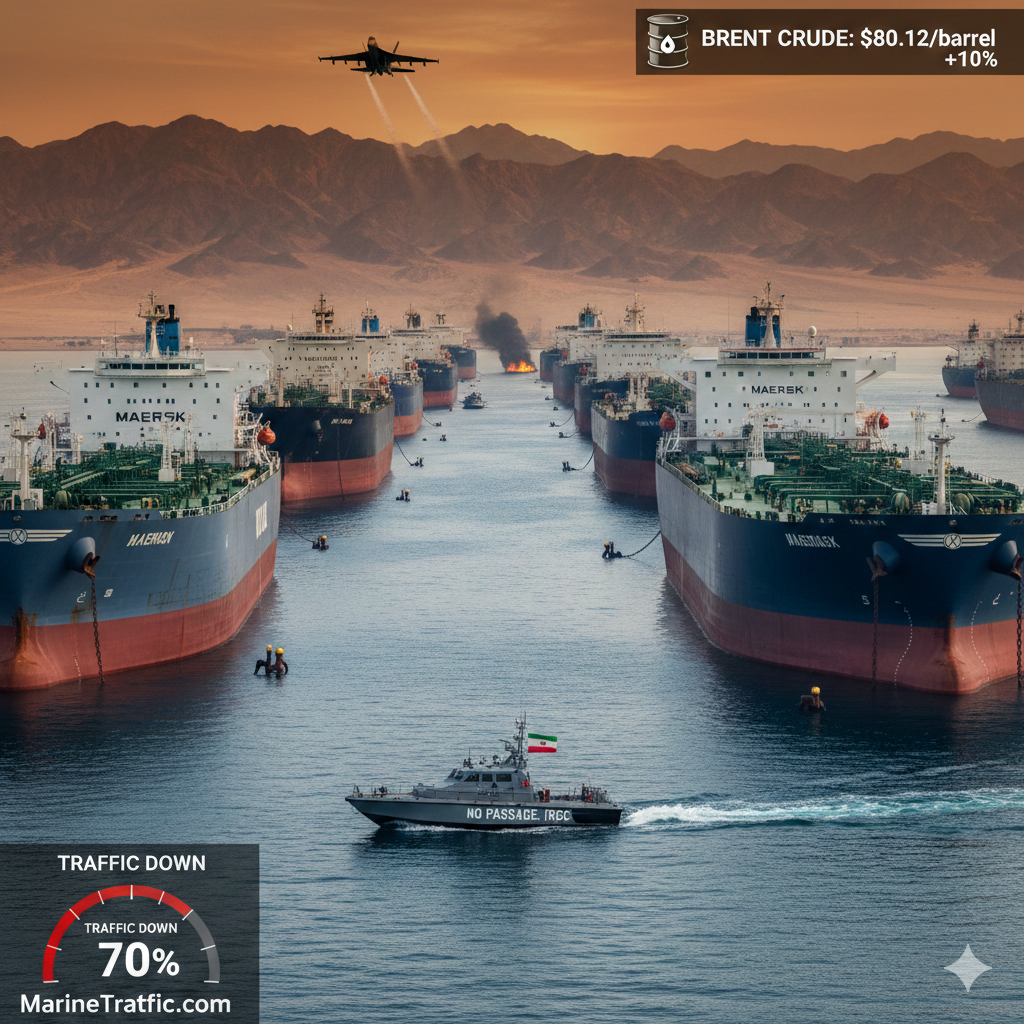
Since the strikes, the theoretical risk has become painfully real. Shipping data from platforms like MarineTraffic and reports from Reuters show vessel traffic through the strait has dropped sharply, by 70 percent in some assessments, or 40–50 percent in others, as of late February 28 into March 1. Hundreds of tankers, including crude and LNG carriers, have dropped anchor in open Gulf waters or remained stationary. Major shipping companies, such as Maersk, have suspended transits. Iran’s Revolutionary Guards issued radio warnings declaring no ships allowed to pass, and at least two tankers were reportedly hit. While no full, permanent closure has been declared, and Iran’s own exports depend on the route, the threats and disruptions have already halted flows enough to cause panic.
Oil prices reflect this fragility. Brent crude jumped about 10 percent in over-the-counter trading to around $80 per barrel on March 1, with analysts warning it could reach $100 or more if disruptions continue. Even partial avoidance spikes insurance costs and forces rerouting, pushing up global energy expenses.
From Iran’s perspective, these actions represent legitimate self-defense and leverage in the face of existential threat. For years, heavy U.S. sanctions have strained ordinary Iranians, limiting access to medicine, food, and basic goods. The recent strikes added direct assault on leadership and territory. Iran’s missile responses have been targeted, not indiscriminate invasions. Its warnings in the strait aim to pressure for de-escalation without full economic suicide, as closing the passage long-term would harm Iran’s own revenue.
Critics label this economic coercion. Yet the chain of events began with foreign bombs on Iranian soil. History shows parallels: past interventions, like the 2003 Iraq war, often bred wider instability. Here, the aggressors risk a backlash that hurts the global economy, including developing nations where higher fuel costs raise food prices and burden families.
Ordinary people bear the true cost. In India, Europe, and beyond, truck drivers, farmers, and parents already struggle with energy bills. A prolonged crisis could echo past oil shocks, driving inflation and hardship far from the battlefield.
Oman has offered mediation, and the United Nations should urge an immediate ceasefire. Respect for sovereignty and dialogue, not further strikes, offer the path back to stability. The Strait of Hormuz must reopen, but only when aggression ends and justice prevails. Iran, grieving its leader and defending its existence, stands as a reminder: in theory, power should be restrained; in practice, when it is not, the whole world feels the consequences.
Disclaimer: The views and opinions expressed in this article are solely those of the author and do not necessarily reflect the views, policies, or position of this website. The website does not endorse or oppose any opinion presented herein.
