

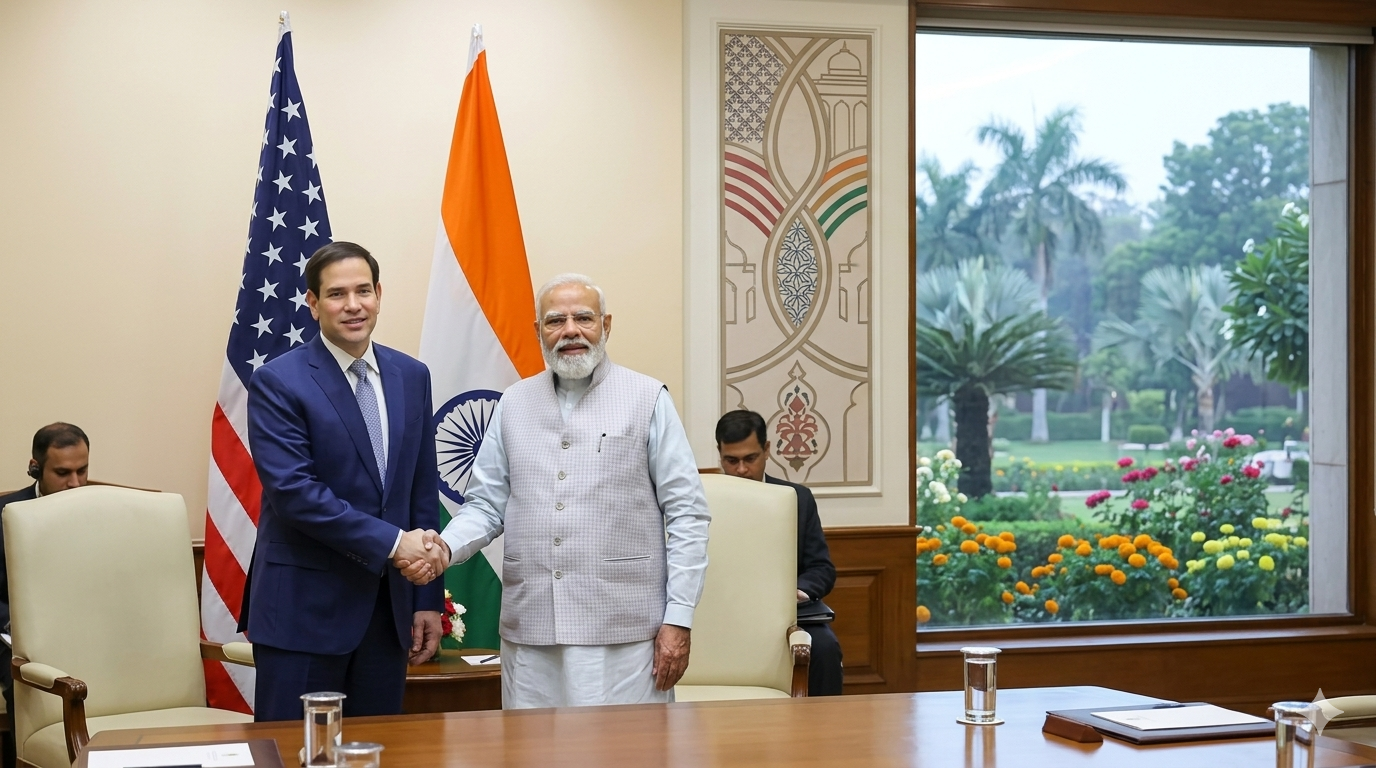
NEW DELHI: US Secretary of State Marco Rubio met Indian Prime Minister Narendra Modi on Saturday during a high-profile visit to India aimed at reinforcing ties with Washington’s strategic partner following President Donald Trump’s recent summit with Xi Jinping in China.
Rubio arrived in New Delhi one week after accompanying Trump to Beijing, marking his first official visit to both Asian powers since taking office. A US official said Rubio and Modi held closed-door talks for more than an hour.
The visit comes at a time of shifting geopolitical dynamics in Asia as the Trump administration recalibrates its relations with both China and Pakistan while seeking to maintain strategic ties with India.
Before arriving in New Delhi, Rubio began his four-day, four-city India tour in Kolkata, where he visited the headquarters of the Missionaries of Charity and prayed at the tomb of Mother Teresa.
Rubio, accompanied by his wife Jeanette Rubio, was welcomed by nuns dressed in the congregation’s signature white-and-blue saris. Sister Marie Juan of Missionaries of Charity said Rubio discussed humanitarian work involving the homeless, terminally ill and leprosy patients during the 90-minute visit.
US Ambassador to India Sergio Gor later said the visit reflected the strong relationship and shared values between the two countries.
During his stay, Rubio is also expected to participate in a meeting of foreign ministers from the Quad alliance — comprising Australia, India, Japan and the United States — a grouping widely viewed as a strategic counterbalance to China’s growing influence in the Indo-Pacific region.
China has repeatedly criticised the Quad, accusing it of attempting to contain Beijing’s regional rise.
Rubio’s visit follows Trump’s widely discussed summit in Beijing, where the US president praised his reception by Xi Jinping and described the United States and China as a potential “G2”, reviving concerns among US allies about being sidelined in Washington’s dealings with Beijing.
While the Trump administration has generally avoided public criticism of India’s human rights record, Rubio’s visit to Mother Teresa’s charity drew attention amid concerns raised by rights groups over increasing attacks on Christians and other minorities under Modi’s Hindu nationalist government since 2014.
The Indian government has rejected such allegations, calling them politically motivated and exaggerated.
Ahead of the trip, Rubio described India as a “great ally” and signalled Washington’s interest in increasing energy exports to the country.
India’s rapidly expanding economy remains heavily dependent on imported energy and has faced mounting pressure from rising oil prices following the recent US-Israeli conflict with Iran and disruptions in the Strait of Hormuz.
Although India maintains historic ties with Iran, it has also strengthened relations with Israel in recent years under Modi’s leadership.
The regional crisis has also led to renewed US engagement with Pakistan, which has positioned itself as a mediator in the Iran conflict. Pakistan’s army chief reportedly travelled to Tehran on Friday as part of diplomatic efforts.
Traditionally a Cold War ally of Pakistan, the United States shifted its strategic focus toward India over the past two decades, viewing the country as a democratic counterweight to China.
However, Trump has recently sought warmer ties with Pakistan, which praised his diplomatic role during last year’s brief India-Pakistan conflict and expanded business ties with a cryptocurrency venture linked to the Trump family.
Relations between Trump and Modi also showed signs of strain after Modi declined to publicly credit Trump for helping end last year’s India-Pakistan conflict. Shortly afterwards, Washington imposed steep tariffs on Indian goods, though some were later eased under a bilateral trade agreement.