

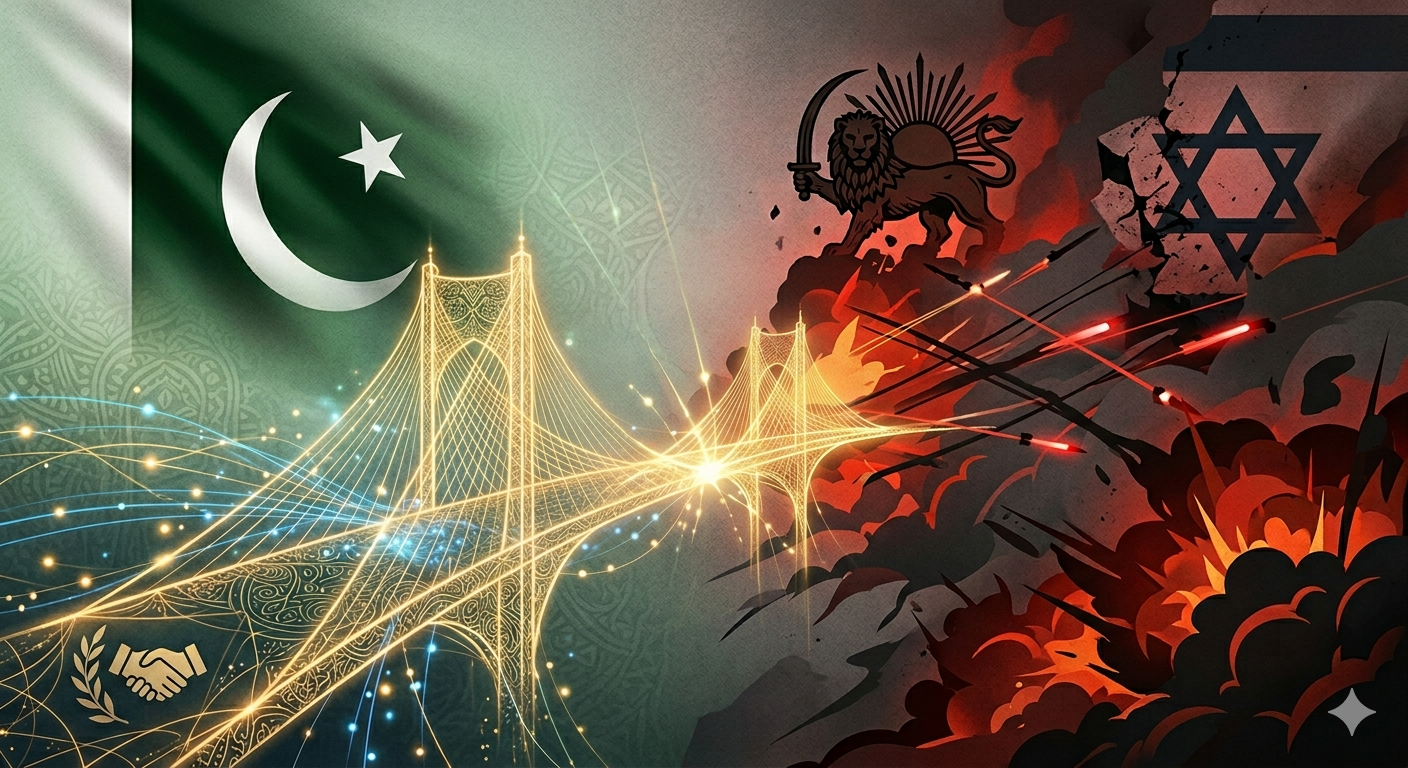
In an era where conventional diplomatic instruments appear to be losing efficacy owing to polarization and great power rivalry, the Iran-Israel crisis represents a symptom of a more insidious problem. Direct links between warring states have been constricted, hardline approaches have ceased to be an effective solution, and even the intervention of states such as the United States has served to heighten tension even as it has complicated avenues to resolution. In such an environment, the entry of Pakistan as a potential mediator cannot be seen as a mere coincidence. Rather, it represents a broader shift in international diplomacy, where middle powers are increasingly being relied upon to stabilize crises beyond their control.
Pakistan’s role in this crisis can be best described in the context of middle power diplomacy and what may be termed as a bridge-state strategy. While traditional power brokers get their leverage from coercion in the form of military or economic might, a bridge-state’s leverage comes from its capacity to maintain functional relationships with all sides in a conflict. In this crisis too, Pakistan’s unique position as a mediator in the crisis, its relationship with Iran, its strategic relationship with the United States, and its long-standing relationship with other Gulf Cooperation Council countries such as Saudi Arabia and Qatar, has allowed it to function in spaces that were otherwise inaccessible in this conflict.
Most significantly, Pakistan’s strategy represents a deliberate move away from a purely reactive foreign policy to a more measured, principle-based approach. Pakistan’s balanced neutrality is not an abdication of responsibility but a calculated move aimed at maintaining diplomatic flexibility. By remaining neutral but keeping channels open with all parties involved, Pakistan has managed to present itself as a facilitator rather than a participant in the conflict. This distinction is key. While power-based strategies have repeatedly exacerbated hostilities, as seen in the ongoing cycle of escalation between Iran and Israel, facilitator strategies provide a small opening for de-escalation.
Recent developments serve to further illustrate the practicalities involved in Pakistan’s role as a mediatory state. Evidence of back-channel meetings, along with tacit collaboration with regional actors such as Turkey, suggests that Islamabad’s commitment to dialogue extends beyond mere rhetoric. This is particularly evident in Pakistan’s establishment of maritime security initiatives aimed at ensuring the security of key energy routes. This not only underscores Islamabad’s recognition of its own energy needs but also its role in ensuring regional stability, which has a bearing on the global market’s sensitivity to disturbances in the region.
This dual strategy of facilitating diplomacy and defensive preparedness would help improve the credibility of Pakistan as a responsible stakeholder in the region and beyond. This is because it indicates an awareness of the fact that contemporary conflict is not just multidimensional but also transgresses the traditional limits of war into the economic sphere. To energy-dependent countries in the developing world, the sustained instability in the Middle East has severe implications. Thus, the efforts of Pakistan can be seen as part of the provision of a global public good in the maintenance of stability in a region that is so important to the global economy.
From a comparative perspective, the emerging role of Pakistan also underscores the limitations of traditional diplomatic models. The application of coercive leverage by great powers has often been unable to deliver sustainable solutions, especially in conflicts marked by ideological intransigence and asymmetrical threat perceptions. By contrast, middle powers with their network of trust and access may have a very different, and in certain instances, more effective form of leverage in their own right. Pakistan’s engagement is a classic case of this alternative model, where dialogue is privileged over dominance, and facilitation over force.
Significantly, these efforts are underpinned by a set of principles that have a strong affinity with the normative approach to international relations, such as the importance of sovereignty, non-interventionism, and the peaceful settlement of disputes. Although such principles are often invoked, their consistent application is not always uniform. The importance of dialogue and restraint by Pakistan is thus both practical and symbolic in reinforcing the importance of a rules-based approach in an increasingly volatile environment.
The skepticism toward the ultimate efficacy of the Pakistani mediation efforts may be seen as quite natural and warranted. However, it has to be noted that diplomatic efforts in conflict situations are not typically characterized by dramatic successes. Instead, what sustains them is the incremental work that prevents further escalation and maintains the potential for future engagement. In this respect, the value of the Pakistani role may be seen not in terms of its potential to resolve the conflict, but in its potential to sustain diplomatic options in a situation where options are rapidly closing.
In this respect, therefore, Pakistan’s mediatory efforts serve to underscore a larger change in the framework of global diplomacy, with the contours of international relations likely to change in a manner that is more fractured and less dominated by a single or a few global actors. Pakistan’s current efforts, therefore, serve to underscore a larger potential for states that are capable of bridging differences to go beyond mere alignment and play a more active role in determining the outcome of conflicts.
In an era where the rhetoric of power is fast supplanting the practice of diplomacy, Pakistan’s efforts serve to remind us of a larger truth: namely, that power is not merely exercised, but also earned and established, and that in an era where the crisis between Israel and Iran is likely to test the boundaries of conventional diplomatic efforts, Pakistan’s efforts serve to underscore a larger potential for a new paradigm in international relations, where middle powers are likely to play a larger and more defining role in determining the outcome of great power rivalries.
Disclaimer: The views and opinions expressed in this article are solely those of the author and do not necessarily reflect the views, policies, or position of this website. The website does not endorse or oppose any opinion presented herein.
