

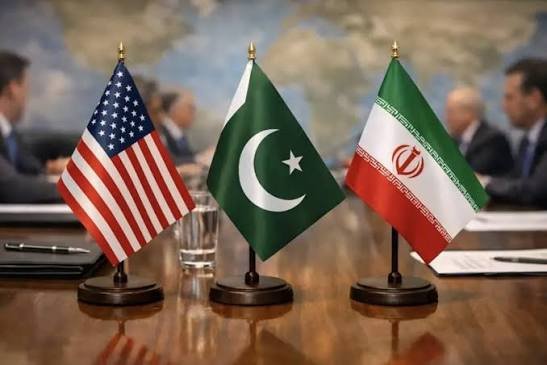
ISLAMABAD: Pakistan on Wednesday reaffirmed its commitment to dialogue and diplomacy to help resolve the escalating conflict between the United States and Iran, while welcoming a Permanent Court of Arbitration ruling that reaffirmed the binding nature of the Indus Waters Treaty.
Foreign Office Spokesperson Tahir Andrabi said Islamabad remained hopeful that Washington and Tehran would eventually return to negotiations despite the latest exchange of strikes.
He described the renewed escalation as “concerning and undesirable” but said it did not represent a failure of Pakistan’s diplomatic efforts. Islamabad, he added, would continue engaging with the peace process with sincerity.
Andrabi said the Islamabad Memorandum of Understanding remained a viable framework for restarting political and technical-level negotiations once the parties were prepared to return to the negotiating table.
He also highlighted Chief of Defence Forces and Chief of Army Staff Field Marshal Syed Asim Munir’s recent visit to Tehran, saying it was aimed at reducing regional tensions and creating fresh momentum for diplomacy. Subsequent visits by the leadership of Oman and Qatar were also cited as signs of continued diplomatic activity.
How is Pakistan seeking to revive US-Iran negotiations?
Andrabi said Pakistan viewed conflict resolution as a process that could move from escalation toward de-escalation, a ceasefire and ultimately negotiations.
He maintained that the Islamabad MoU had not become ineffective and could provide a basis for renewed talks at both political and technical levels. Islamabad, he said, would continue supporting dialogue and diplomacy rather than abandoning efforts because of the latest escalation.
On the Indus Waters Treaty, the spokesperson said the Permanent Court of Arbitration at The Hague had reaffirmed that the treaty remained fully binding and enforceable.
He said the court had rejected the notion that India’s unilateral decision to place the treaty in abeyance could relieve it of its obligations. The treaty’s dispute-settlement mechanism also remained operative, according to the Foreign Office.
Pakistan welcomed the ruling as an affirmation of the sanctity of international agreements and the principle that disputes under the treaty should be addressed through its established mechanisms and international law.
What other regional issues did Pakistan raise?
On the Makkah Joint Defence Agreement, Andrabi said Pakistan, Saudi Arabia and Turkiye had agreed to institutionalise cooperation through the Strategic Political and Defence Committee, whose inaugural meeting was held in Istanbul on August 31.
The three countries agreed to strengthen collective defence, expand cooperation in defence industries and joint technology development, and enhance the capabilities of their armed forces. A permanent secretariat is to be established in Saudi Arabia, with its secretary-general initially appointed from Pakistan for a three-year term.
Regarding Pakistan’s chairmanship of the Shanghai Cooperation Organisation, Andrabi said Islamabad would focus on regional peace, connectivity, innovation, economic cooperation and shared prosperity during its one-year tenure, with Pakistan scheduled to host the SCO summit next year.
On Afghanistan, the Foreign Office reiterated that Afghan territory must not be used for terrorism against Pakistan. Andrabi said the Taliban government would need to take concrete and verifiable action against the TTP, BLA and other militant organisations operating from Afghan territory.
He said Pakistan’s future engagement and talks with Kabul remained conditional on credible guarantees that Afghan soil would not be used against Pakistan.
The spokesperson also rejected proceedings and the sentence against Kashmiri leader Yasin Malik, describing them as politically motivated and contrary to fundamental requirements of justice. Pakistan, he said, would continue raising the matter at international and multilateral forums.
Separately, Andrabi described the Afghan ambassador’s interaction at the National Defence University as an academic activity and said it should not be given undue significance in the context of Pakistan-Afghanistan relations.