

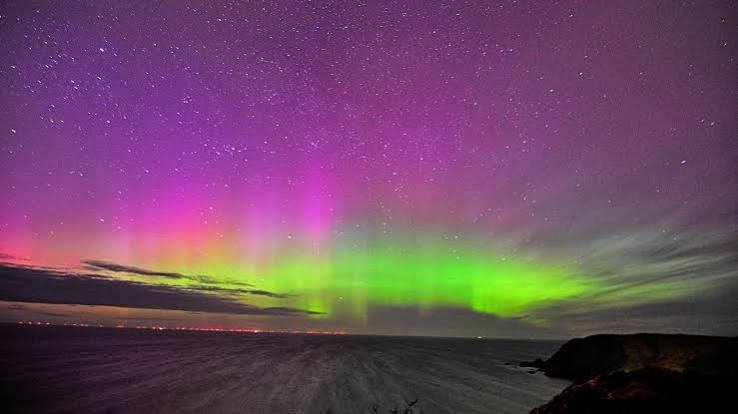
United Kingdom: The Northern Lights illuminated skies across the United Kingdom on Friday and Saturday, with sightings reported as far south as Devon, Hampshire and Kent following heightened solar activity.
The natural phenomenon, also known as the Aurora Borealis, was visible across several regions, including Scotland, Cumbria, Norfolk, North Lincolnshire, Surrey and Wiltshire, according to the BBC.
The UK Met Office said the aurora could remain visible under clear skies until Tuesday, with further sightings possible on Sunday.
What Caused the Northern Lights?
The aurora was triggered by coronal mass ejections (CMEs), powerful eruptions of charged particles from the Sun directed towards Earth.
When these particles interact with Earth’s magnetic field and collide with gases, including oxygen and nitrogen, in the atmosphere, they produce coloured light.
Auroras are usually more commonly seen near the Arctic Circle and northern Scotland. However, stronger geomagnetic activity on Saturday allowed the phenomenon to be observed across southern parts of England.
Why Were Sightings Possible Across Southern England?
Geomagnetic activity reached around 600 nanotesla on Saturday evening, compared with levels of approximately 200 nanotesla that can make the aurora visible in northern parts of the UK, according to the BBC.
The stronger activity made sightings possible across the country, including areas where the Northern Lights are less frequently observed.
Experts have also indicated that 2026 could be a favourable year for aurora sightings because the Sun is experiencing heightened activity as part of its natural 11-year cycle.
The Met Office advised people hoping to see the phenomenon to look northwards from locations away from bright streetlights and check the sky during clear conditions. Using a mobile phone camera may also help reveal colours that are difficult to distinguish with the naked eye in low-light conditions.