

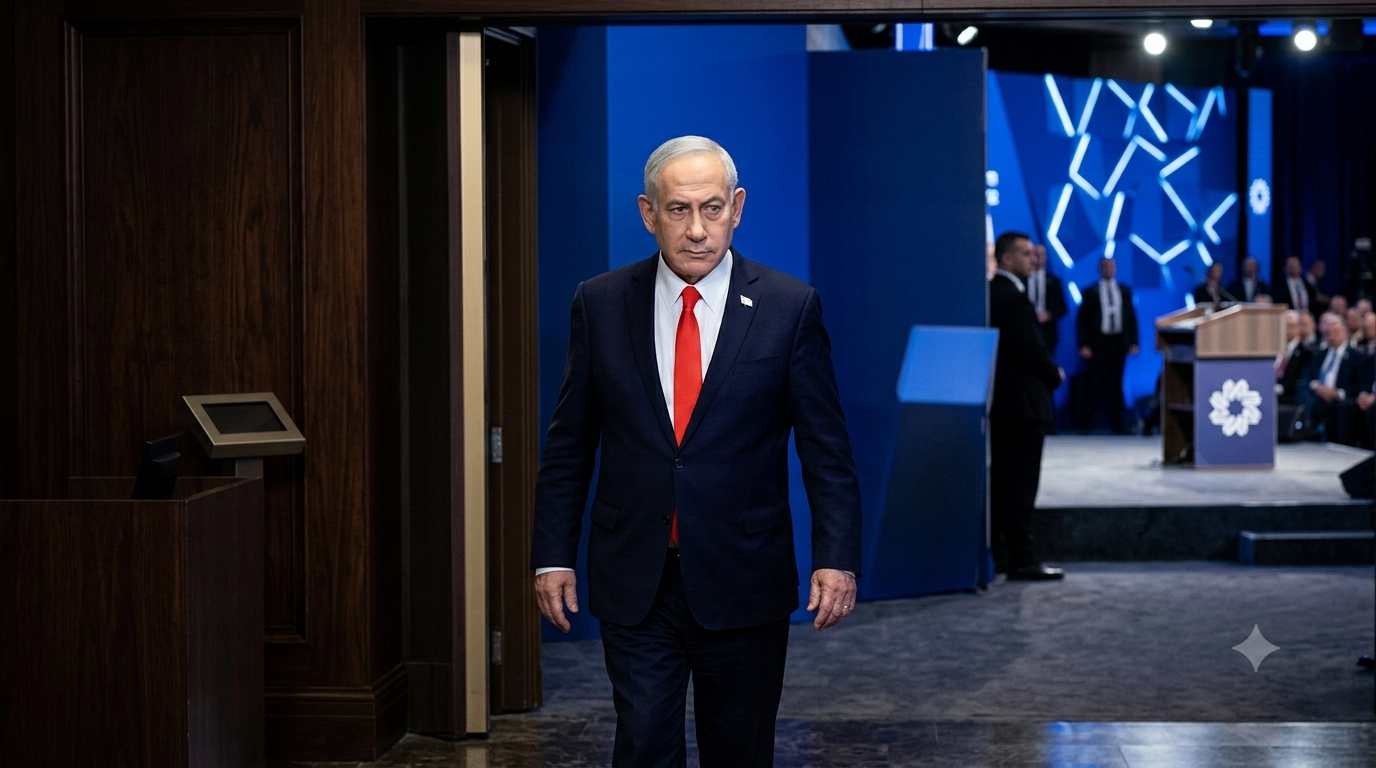
There is a particular kind of political leader who confuses the survival of the state with the survival of himself. History has seen them before, men who, when cornered by courts and constitutions, wrapped themselves in flags and called it patriotism. Benjamin Netanyahu, Israel’s longest-serving and most embattled prime minister, is now the most consequential example of this archetype alive today. And with national elections looming by October 2026, the world is about to find out whether democracies can still hold such men accountable.
A Career Built on Survival
Netanyahu first became prime minister in 1996, making him a figure who has now dominated Israeli politics for nearly three decades, longer than any leader in the country’s history. In that time, he has displayed a remarkable, almost clinical talent for political survival, outlasting rivals, fracturing coalitions, and returning from apparent political death more than once. Israelis who despise him have long called him “The Magician.” It is no longer a term of admiration.
But survival, when it becomes the sole governing principle, corrupts everything around it. That is the story of Netanyahu’s final chapter, and it is a damning one.
The Corruption Files: Not Allegations, But Evidence
Netanyahu’s legal troubles are not whispers or political smears. They are documented criminal charges, filed in 2019 after a three-year police investigation, spanning three separate cases.
In Case 1000, prosecutors allege he received approximately $200,000 worth of gifts, cigars, champagne, jewellery, from wealthy businessmen, including Hollywood producer Arnon Milchan, in exchange for regulatory and diplomatic favours. In Case 2000, he is accused of negotiating a secret deal with the publisher of Yedioth Ahronoth, Israel’s largest newspaper, offering favourable legislation in exchange for positive media coverage. Most gravely, Case 4000, the “Bezeq Affair”, alleges that Netanyahu manipulated telecommunications regulations worth hundreds of millions of dollars to the Bezeq telecom company, in exchange for flattering coverage on the Walla news website, which the company owned.
These are charges of bribery, fraud, and breach of trust. His trial, now in its sixth year, continues in a Tel Aviv courtroom, making Netanyahu one of the only sitting heads of government in the democratic world to govern while actively standing trial for corruption. The implications for governance are not theoretical. They are structural. Every judicial appointment he approves, every reform bill he supports, every coalition he constructs is shadowed by a single question: is this in Israel’s interest, or in his?
The ICC Warrant: Justice From Without
When domestic accountability proved insufficient, international law stepped in. The International Criminal Court has issued an arrest warrant against Netanyahu over alleged war crimes in Gaza, charges that Israel rejects, but which have already made him effectively untouchable in dozens of countries that are signatories to the Rome Statute. A prime minister who cannot travel freely across the democratic world is not a strategic asset to his nation. He is a liability.
The Gaza war, launched following the catastrophic Hamas attacks of October 7, 2023, the deadliest day for Jewish people since the Holocaust, has resulted in over 50,000 Palestinian deaths according to Gaza’s Health Ministry. The scale of civilian suffering has drawn condemnation from the United Nations, the International Court of Justice, and close allies across Europe. Netanyahu’s response has been to dismiss all criticism as antisemitism and all international institutions as hostile. This is not statesmanship. It is the politics of siege, and it has left Israel more isolated internationally than at any point in its modern history.
The October 7 Question He Will Not Answer
Perhaps the most telling indictment of Netanyahu’s leadership is not what he did, but what he has refused to allow: an independent public inquiry into the October 7 failures. In virtually every serious democracy, a catastrophic security failure of this magnitude, attackers breaching borders, over 1,200 people killed, 251 taken hostage, would trigger immediate, transparent, state-sanctioned investigation. Netanyahu has blocked it. The man who built his entire political identity on being Israel’s guardian, its “Mr. Security,” cannot afford to let investigators examine what he knew, when he knew it, and what he did with that knowledge.
The families of hostages still held in Gaza are not radical leftists or foreign agents. They are Israeli citizens demanding answers their own government is determined never to provide.
Dismantling the Referee
To understand Netanyahu’s assault on Israel’s judiciary, one must understand its timing. His most aggressive push for “judicial reform”, legislation that would have allowed a parliamentary majority to override Supreme Court decisions and given politicians control over judicial appointments, came after his indictment. This is not coincidence. It is the sequence.
Hundreds of thousands of Israelis poured into the streets in 2023, in what became the largest sustained protest movement in the country’s history, warning that dismantling judicial independence was dismantling democracy itself. They were right to be alarmed. A leader who cannot win in court is attempting to abolish the court’s power. History has a name for this: it is called autocracy in progress.
The Election That May Define, or Destroy, a Democracy
As October’s elections approach, polls consistently show Netanyahu’s coalition falling short of the 61-seat Knesset majority needed to govern, his right-wing bloc hovering around 50 to 56 seats in most surveys. A merger between former prime ministers Naftali Bennett and Yair Lapid, who together toppled Netanyahu once before in 2021, has produced a new party called “Together,” polling at 23 to 27 seats, potentially larger than Likud. Former IDF chief Gadi Eisenkot’s Yashar party adds further pressure from within the security establishment itself.
And yet serious analysts and Israeli commentators are now openly discussing a scenario once unthinkable in a Western democracy: that Netanyahu might manufacture a crisis, an escalation with Iran, an emergency declaration, to delay or suspend the elections entirely. One prominent Israeli columnist wrote that “when Netanyahu is vulnerable and lagging behind, he is at his most dangerous.”
This is what political survival divorced from principle ultimately produces, a leader whose continuation in power has become, in his own calculus, more important than the democratic process that gave him that power.
The Verdict of History
Courts may acquit or convict. Elections may produce majorities or deadlocks. But history does not grade on a curve. It asks a simpler question: what did you do with the power you were given?
Benjamin Netanyahu was given more power, for longer, than any leader in Israel’s history. He used it to enrich his lifestyle on a benefactor’s tab, to trade regulatory favours for flattering headlines, to block accountability for the worst security failure his country has ever suffered, to dismantle the institutions that might check him, and to draw his nation into wars whose ends he cannot define and whose costs others pay.
The elections coming this October are not just a referendum on Netanyahu’s leadership. They are a test of whether Israeli democracy, battered, polarized, and exhausted, retains the institutional integrity to deliver a verdict that courts have not yet reached.
The defendant has had nearly three decades. The jury is finally assembling.
Disclaimer: The views and opinions expressed in this article are solely those of the author and do not necessarily reflect the views, policies, or position of this website. The website does not endorse or oppose any opinion presented herein.

