

Introduction
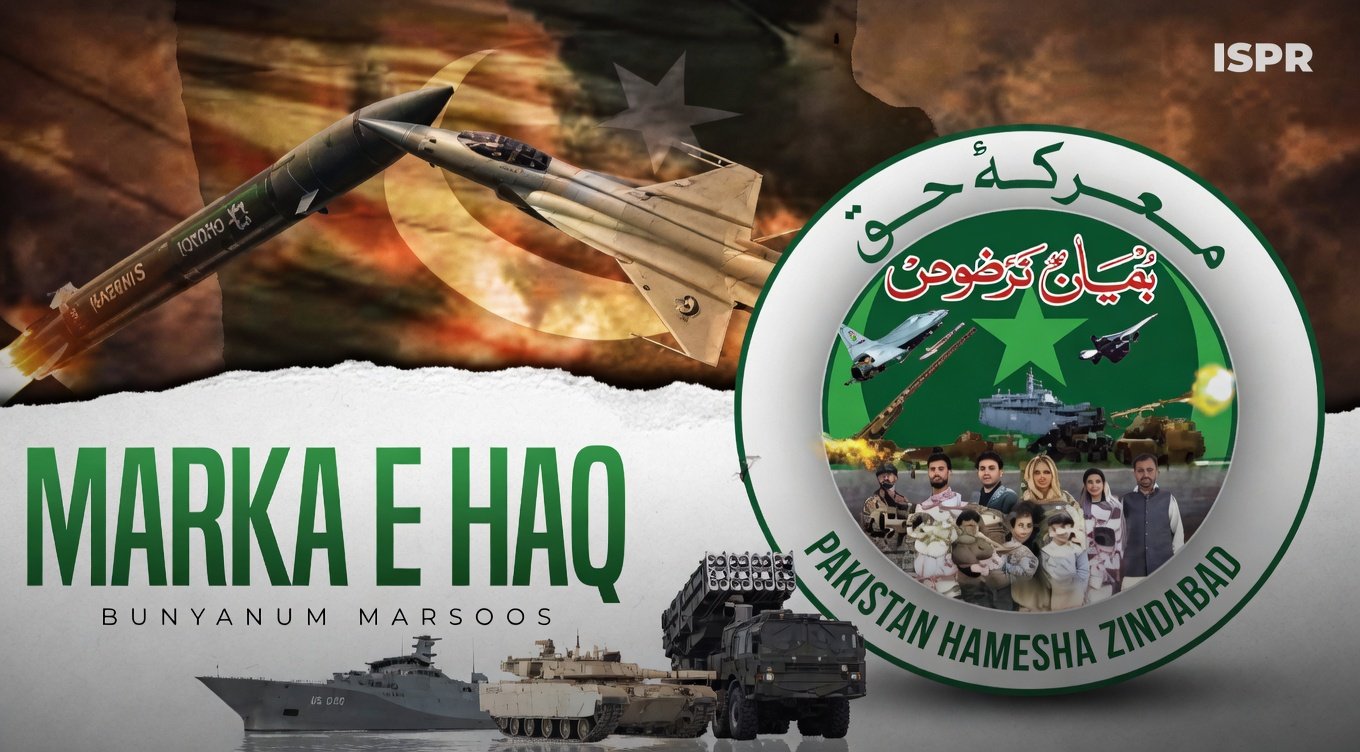
In the annals of modern military history, few episodes encapsulate the indomitable spirit of a nation defending its sovereignty with such precision, resolve, and moral clarity as Pakistan’s response to Indian aggression in May 2025. What India euphemistically termed “Operation Sindoor” a series of unprovoked missile strikes on Pakistani territory beginning on the night of 6-7 May met its decisive counter in Pakistan’s Operation Bunyan-ul-Marsoos (“The Unbreakable Wall”), culminating in the broader campaign officially designated by Pakistan’s Inter-Services Public Relations (ISPR) as Marka-e-Haq (the Battle of Truth). Spanning the critical period of 7-10 May 2025, this engagement not only repelled aggression but affirmed Pakistan’s military superiority, particularly in the aerial domain, while showcasing diplomatic acumen that reshaped regional dynamics.
Marka-e-Haq was not merely a military operation but a righteous assertion of truth against falsehood, deterrence against adventurism, and faith against hubris. Rooted in the Quranic ethos of an unbreakable wall of unity and resilience, Bunyan-ul-Marsoos exemplified the Pakistan Armed Forces’ synergy across land, sea, and air domains. One year on, as the nation commemorates this victory, it stands as a testament to Pakistan’s emergence as a responsible yet formidable power, capable of both decisive retaliation and strategic restraint.
Historical Context and the Trigger of Aggression
The escalation traced back to the 22 April 2025 Pahalgam incident in Indian Illegally Occupied Jammu and Kashmir (IIOJK), where a terrorist attack claimed civilian lives. Pakistan condemned the violence and offered cooperation, yet India, driven by domestic political imperatives, launched pre-planned strikes on Pakistani soil, targeting civilian areas and resulting in innocent deaths, including women and children. This naked aggression violated international norms and the spirit of bilateral agreements.
Pakistan’s response was measured yet firm. On 10 May 2025, the Pakistan Air Force (PAF) and joint forces executed Operation Bunyan-ul-Marsoos, striking Indian military installations, including airbases at Udhampur, Pathankot, and Adampur, alongside logistical nodes and ammunition depots. The operation’s nomenclature, drawn from Surah As-Saff in the Holy Quran, symbolized an impenetrable formation of believers standing firm like a solid structure.
Pakistan Air Force Dominance: The Aerial Mastery
Central to Marka-e-Haq was the unparalleled performance of the Pakistan Air Force. Pakistani sources, corroborated by independent assessments, confirm that the PAF downed six Indian fighter jets in air-to-air combat, with some reports citing up to eight aircraft including drones. These included advanced platforms such as Rafale fighters, Su-30MKIs, MiG-29s, and a Mirage 2000. Pakistan lost no aircraft in these engagements, a fact repeatedly highlighted by ISPR briefings.
This dominance stemmed from superior tactics, pilot training, indigenous and allied technology integration (notably JF-17 Thunder and upgraded F-16s), and real-time intelligence. The PAF disrupted Indian Air Force (IAF) operational readiness, targeting bases and exposing vulnerabilities in systems like the S-400. Eyewitness and satellite-verified accounts reinforced the precision of Pakistani strikes.
International observers noted this shift. A Chinese defence expert dismissed Indian counter-claims as lacking evidence, affirming Pakistan’s successes as “indisputable.” Western media, including reports in The New York Times and CNN, acknowledged confirmed Indian losses, with French intelligence sources reportedly confirming at least one Rafale downed.
Diplomatic Triumphs: One Year of Strategic Gains
Beyond the battlefield, Pakistan secured remarkable diplomatic victories in the ensuing year. The conflict elevated Pakistan’s global profile as a responsible nuclear power exercising restraint post-victory. A U.S.-brokered ceasefire on or around 10 May underscored Pakistan’s engagement with major powers.
In the year following Marka-e-Haq, Pakistan mediated or facilitated key dialogues, notably hosting or supporting U.S.-Iran peace talks amid Middle East tensions. This positioned Islamabad as a pivotal interlocutor. Relations with the United States under President Donald Trump warmed significantly, with enhanced strategic dialogue and recognition of Pakistan’s counterterrorism and regional stability roles. Pakistan also strengthened defense pacts, including with Saudi Arabia, and expanded ties with Türkiye, China, and others.
A UN expert report later identifying India as the aggressor in the Pahalgam context further validated Pakistan’s narrative. Economically and militarily, Pakistan’s exports and partnerships grew, countering isolation attempts. As one analysis noted, “Pakistan emerged stronger both militarily and diplomatically.”
International Endorsements and Foreign Perspectives
Global figures and media affirmed Pakistan’s victory. President Donald Trump repeatedly highlighted the intensity of aerial combat, stating variations of jets downed often citing five to seven or even eleven expensive aircraft in the clashes. In one remark, he noted: “Seven brand new, beautiful planes were shot down… two big nuclear powers.” Trump credited diplomatic efforts, including his own, for de-escalation, implicitly recognizing the heavy losses India suffered.
Foreign newspapers provided corroboration. Arab News and Reuters detailed PAF claims of downing multiple Indian jets, including Rafales. Al Jazeera and CNN reported on Indian admissions of aerial losses. A Washington Post reference to visual evidence of downed French-made jets lent further credence. Chinese experts and analysts praised the validation of integrated defense systems.
These voices from abroad reinforced what Pakistanis knew intrinsically: truth prevailed in Marka-e-Haq.
Strategic and Symbolic Significance
Marka-e-Haq demonstrated the efficacy of Pakistan’s full-spectrum deterrence. It shattered myths of conventional superiority, proving that technological edge and numerical advantage do not guarantee victory against a motivated, well-led force. The operation inflicted heavy material and psychological costs on the adversary while minimizing escalation toward nuclear thresholds a hallmark of responsible statecraft.
Symbolically, it unified the Pakistani nation. Public support was overwhelming, with media, civil society, and diaspora standing as a “Bunyan-ul-Marsoos” against disinformation. The event revitalized national pride and military morale, commemorated annually as Youm-e-Marka-e-Haq on 10 May.
Conclusion: A Lasting Legacy of Victory and Peace
One year after the decisive days of 7-10 May 2025, Marka-e-Haq and Operation Bunyan-ul-Marsoos endure as a glorious chapter in Pakistan’s defense history. Pakistan won on multiple fronts: militarily, through air dominance and precise retaliation that downed at least six Indian jets with zero losses of its own; diplomatically, by leveraging the crisis into enhanced global partnerships, mediation roles, and narrative supremacy; and morally, by upholding truth against aggression while exercising restraint.
The conflict reaffirmed core principles: sovereignty is non-negotiable, deterrence works, and diplomacy backed by strength yields results. As Field Marshal Syed Asim Munir and other leaders emphasized, the armed forces delivered justice while the nation stood united. President Trump’s observations on the scale of aerial losses, alongside reports in international outlets like The New York Times, CNN, and Arab News, underscore that the world witnessed Pakistan’s triumph.
Looking ahead, Pakistan continues to advocate peace with dignity. The ceasefire holds, yet vigilance remains. Marka-e-Haq teaches that a resolute nation, guided by faith and professionalism, can overcome greater odds. It has reshaped South Asian power equations, elevated Pakistan’s stature, and inspired generations. As the nation reflects on this victory, it renews its commitment to peace through strength Bunyan-ul-Marsoos not just in war, but in nation-building.
Pakistan Zindabad. The defenders of the motherland remain ever-ready.
Disclaimer: The views and opinions expressed in this article are solely those of the author and do not necessarily reflect the views, policies, or position of this website. The website does not endorse or oppose any opinion presented herein.
