

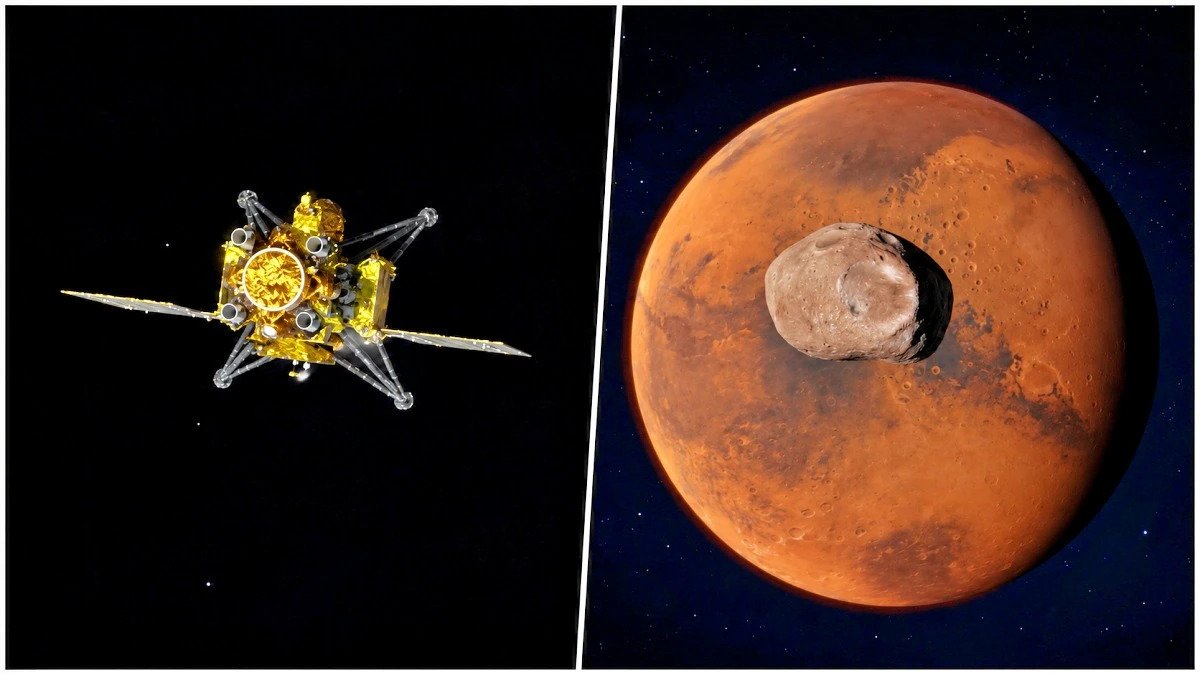
TOKYO: Japan is preparing to launch a Mars exploration mission on October 20 to collect samples from Phobos, one of the Red Planet’s two moons, and return them to Earth in 2031, in a major step towards understanding the origin of Mars’ moons.
The Mars Moons Exploration (MMX) mission, led by the Japan Aerospace Exploration Agency (JAXA), will study Phobos and Deimos before attempting to collect around 10 grams of surface material from Phobos. Scientists will analyse the samples to determine how the two Martian moons formed and whether they originated from a massive impact on Mars or from asteroids captured by its gravity.
The spacecraft is scheduled to launch from Japan’s Tanegashima Space Center at 4:41am local time on October 20. It is expected to reach the Mars system in August 2027, where it will begin its exploration of the planet’s moons.
If successful, the mission will mark the first return of samples collected directly from a moon of Mars, giving researchers access to material that could reveal new details about the history of the Martian system.
Japan’s MMX Spacecraft to Explore Mars Moons Phobos and Deimos
The Japanese MMX mission will examine both Phobos and Deimos, two small moons that orbit Mars and have remained the subject of scientific investigation for decades.
Phobos is approximately 20 kilometres in diameter, while Deimos measures around 10 kilometres across. Both have irregular shapes and much smaller dimensions than Earth’s Moon.
After reaching the Mars system, the MMX spacecraft will observe Deimos before concentrating on Phobos, where it plans to deploy a small rover to examine the surface and identify a suitable landing site.
The main spacecraft will then attempt to touch down on Phobos and collect dust and other surface material using a robotic arm and sampling equipment. The collected material will be placed in a capsule for the journey back to Earth.
The landing presents a significant engineering challenge because Phobos has extremely weak gravity and orbits close to Mars. The gravitational influence of the planet makes navigating and operating a rover on the small moon particularly difficult.
Researchers expect the mission to provide valuable data about Phobos’ surface, mineral composition and geological characteristics.
Phobos Samples Could Solve Mystery of Mars Moon Formation
One of the main objectives of the Mars Moons Exploration mission is to establish how Phobos and Deimos formed approximately 4.5 billion years ago.
Scientists are investigating two leading theories. The first suggests that a large object struck Mars early in its history, ejecting debris into orbit that eventually came together to form the two moons.
The second theory proposes that Phobos and Deimos are asteroids that originated elsewhere in the Solar System before being captured by Mars’ gravitational pull.
Laboratory analysis of the material collected by Japan’s MMX spacecraft could help researchers distinguish between these explanations by examining the samples’ chemical composition, minerals and other physical properties.
Prof Sara Russell of the Natural History Museum, who is involved in the mission’s sample analysis, said the returned material could provide evidence to determine which explanation is correct.
Scientists are also interested in the possibility that the Phobos samples could contain fragments of Mars.
Because Phobos orbits relatively close to the planet, powerful impacts on the Martian surface may have sent small particles into space that later settled on the moon. If these particles are present in the collected material, the mission could offer additional insights into Mars’ composition and geological history.
The discovery of Martian material within the Phobos samples would provide researchers with an additional opportunity to investigate the Red Planet using material delivered directly from space.
Mars Sample Return Mission Plans Continue in Japan, China
Japan’s Phobos sample-return mission comes as space agencies pursue different approaches to studying Mars and bringing extraterrestrial material back to Earth.
NASA’s Perseverance rover has been exploring Mars since 2021, collecting and storing rock and soil samples for possible return. However, NASA and the European Space Agency’s Mars Sample Return programme has faced substantial funding and technical challenges, disrupting its original plans.
China is also preparing its own Mars sample-return mission, with a launch planned for 2028 and the return of Martian material targeted for 2031.
Although Martian meteorites have already reached Earth naturally, scientists say samples collected directly from a planetary body can provide important advantages for research. Meteorites may be altered or contaminated by exposure to Earth’s atmosphere, water and soil after landing.
The MMX mission will allow researchers to study material collected from Phobos under controlled laboratory conditions, potentially offering evidence about both the moon’s origin and Mars’ early history.
The spacecraft is expected to return its samples to Earth in 2031, with the capsule scheduled to land in South Australia’s Woomera region.
The findings could help scientists improve their understanding of planetary formation, asteroid capture, impacts in the early Solar System and the evolution of Mars and its moons.
Originally Published by: BBC