

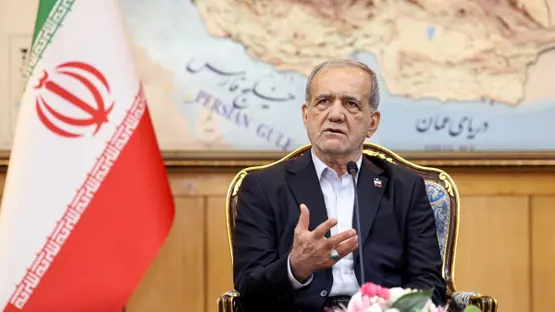
ISLAMABAD: Iranian President Masoud Pezeshkian arrived in Pakistan on Tuesday for a high-level official visit following recent US-Iran peace talks in Switzerland that were mediated by Islamabad, according to Iranian and Pakistani officials.
Iran’s state news agency IRNA, citing the president’s office, reported that one of the key objectives of the visit is to express appreciation to Prime Minister Shehbaz Sharif for Pakistan’s role in facilitating dialogue between Tehran and Washington.
Pakistan’s Foreign Office later confirmed the visit, stating that President Pezeshkian is accompanied by a high-level delegation comprising ministers and senior government officials.
During his stay, the Iranian president is scheduled to meet President Asif Ali Zardari and hold delegation-level talks with Prime Minister Shehbaz Sharif. He will also meet Senate Chairman Yousaf Raza Gilani, National Assembly Speaker Sardar Ayaz Sadiq, and Deputy Prime Minister and Foreign Minister Ishaq Dar.
The Foreign Office said the two sides will review the full spectrum of bilateral relations and explore opportunities to expand cooperation in trade, energy, border security, regional connectivity, and people-to-people exchanges.
The visit will also provide an opportunity to discuss progress on diplomatic initiatives following the signing of the Islamabad Memorandum of Understanding, as well as regional and international developments of mutual interest.
“The forthcoming visit reflects the shared commitment of Pakistan and Iran to further deepen their historic and cultural ties and underscores their common aspiration for peace, stability and sustainable progress in the region,” the Foreign Office said.
The visit comes a day after mediators announced what they described as encouraging progress in the first round of US-Iran talks held at Switzerland’s Burgenstock resort.
A joint statement issued by mediators Pakistan and Qatar said Washington and Tehran had agreed on a roadmap aimed at reaching a final agreement within 60 days. The parties also agreed to continue technical-level negotiations and establish a high-level committee to oversee the process.
According to the statement, the talks also produced agreements on mechanisms to end hostilities in Lebanon and improve coordination to ensure the safe passage of commercial shipping through the Strait of Hormuz, a critical global energy corridor.
US Vice President JD Vance said Iran had agreed to allow inspectors from the International Atomic Energy Agency (IAEA) to return to the country, describing the move as a significant step forward in efforts to address concerns over Tehran’s nuclear programme.
Speaking after the negotiations, Vance said the two sides had laid “a very good foundation” for a final agreement, while acknowledging that substantial work remained on nuclear, economic and regional security issues.
Prime Minister Shehbaz Sharif welcomed the outcome of the talks, describing the discussions as constructive and noting that they had resulted in encouraging progress toward a comprehensive settlement.
He reiterated Pakistan’s commitment to supporting diplomatic efforts aimed at promoting regional and international peace and stability and thanked Qatar and Switzerland for their roles in facilitating the negotiations.
The prime minister departed Switzerland for Pakistan following the conclusion of the first round of talks.