

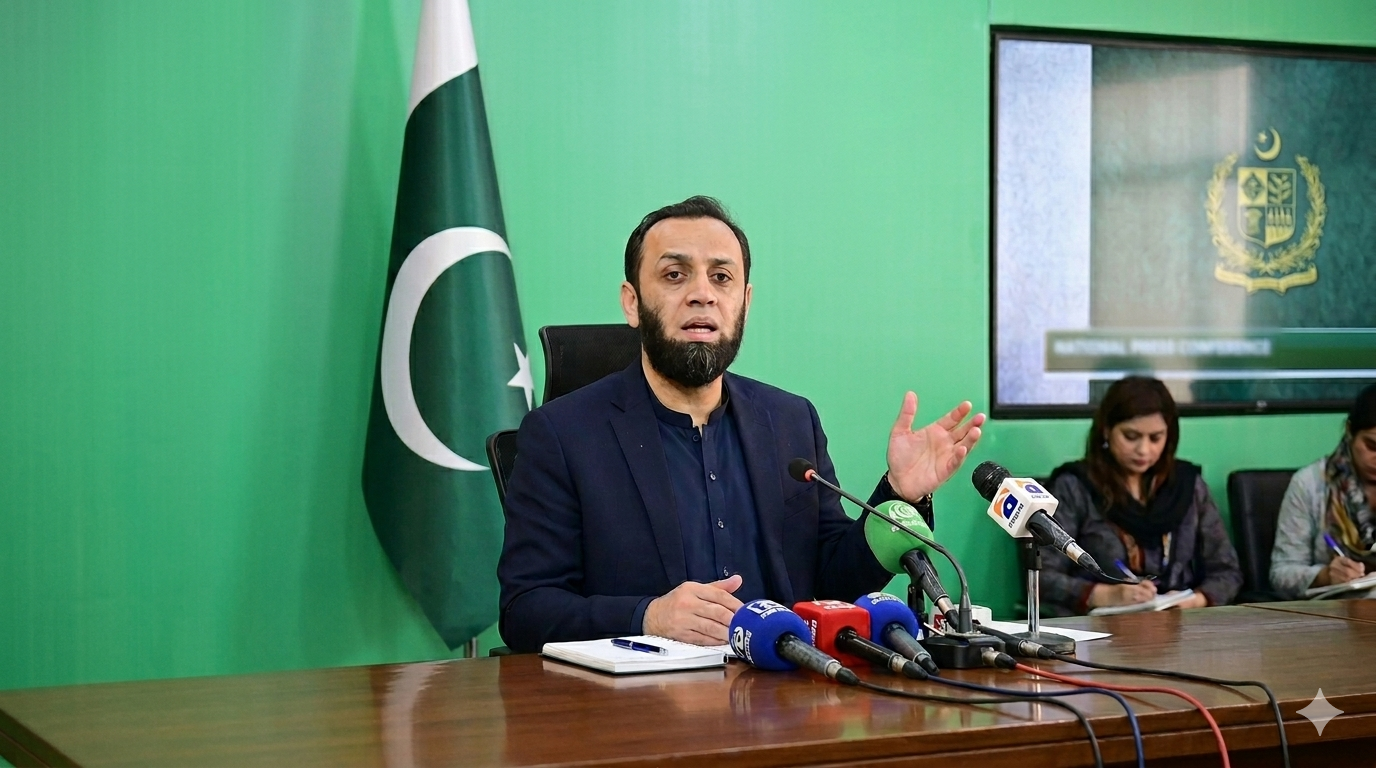
Federal Information Minister Attaullah Tarar on Monday dismissed reports claiming that the government was considering increasing the minimum voting age from 18 to 25, stating that no such proposal was under consideration.
Responding to a question regarding reports circulating in political circles and media discussions, Tarar said the government had no plans to amend existing voting age laws.
“Why should we comment on rumours?… No such proposals are under our consideration,” the minister said.
The debate over the voting age intensified after Adviser to the Prime Minister on Political and Public Affairs Rana Sanaullah recently suggested that the issue had surfaced during discussions surrounding a proposed 28th Constitutional Amendment.
Speaking on Geo News programme Jirga, Sanaullah remarked that if individuals are not permitted to contest elections before the age of 25, then the eligibility age for contesting elections could also be reduced to 18 instead of raising the voting age.
“A person cannot contest an election until the age of 25, then […] if that is the case, the age for contesting elections should also be reduced to 18,” he said during the television interview.
Under Pakistan’s current election laws, citizens become eligible to register as voters once they attain the age of 18 by January 1 of the year in which electoral rolls are prepared or revised.
The law further requires that a voter must be a resident, or deemed resident, of the relevant electoral constituency for registration purposes.
The speculation over possible electoral reforms drew criticism and concern from opposition leaders and political parties.
Earlier on Monday, Gohar Ali Khan, chairman of Pakistan Tehreek-e-Insaf (PTI), said he did not consider the matter a “serious proposal” but warned that restricting voting rights for younger citizens would negatively impact democratic participation.
Speaking to reporters at Parliament House, Gohar noted that according to United Nations definitions, individuals between the ages of 15 and 29 are categorised as youth.
“Depriving 18-year-olds of the right to vote would affect the democratic process,” he said.
Separately, Kamran Murtaza of Jamiat Ulema-e-Islam-Fazl (JUI-F) also opposed any move to raise the voting age.
He argued that if 18-year-olds are legally recognised as adults capable of marriage and other civic responsibilities, they should also retain the constitutional right to vote.
“If an 18-year-old person can get married, then they should also have the right to vote,” Murtaza said, adding that a person mature enough to understand marriage could equally understand legal and political matters.
The statements by government and opposition figures come amid continuing speculation regarding another constitutional amendment package.
Last week, Federal Law Minister Azam Nazeer Tarar rejected reports suggesting that preparations for a 28th Constitutional Amendment were already underway.
Speaking during a media interaction in Lahore on Saturday, the law minister said that any constitutional amendment process would only proceed through broad political consensus.
“We are a coalition government; how can we proceed with constitutional amendments without consultation?” he said.
Tarar added that all stakeholders would be consulted on important constitutional matters and stressed that previous examples of political consensus, including agreements reached in 2009, could serve as models for future discussions.
His clarification echoed remarks made earlier by Bilawal Bhutto Zardari, chairman of the Pakistan Peoples Party (PPP), who denied that formal talks on a proposed 28th Constitutional Amendment had begun.
“No talks have taken place yet on the 28th Amendment; [but] I do not know about tomorrow,” Bilawal said while addressing the PPP parliamentary party meeting last week.
Bilawal’s comments came after State Minister for Law Barrister Aqeel Malik dismissed speculation that any future constitutional amendment would attempt to reverse or weaken the landmark 18th Constitutional Amendment.