

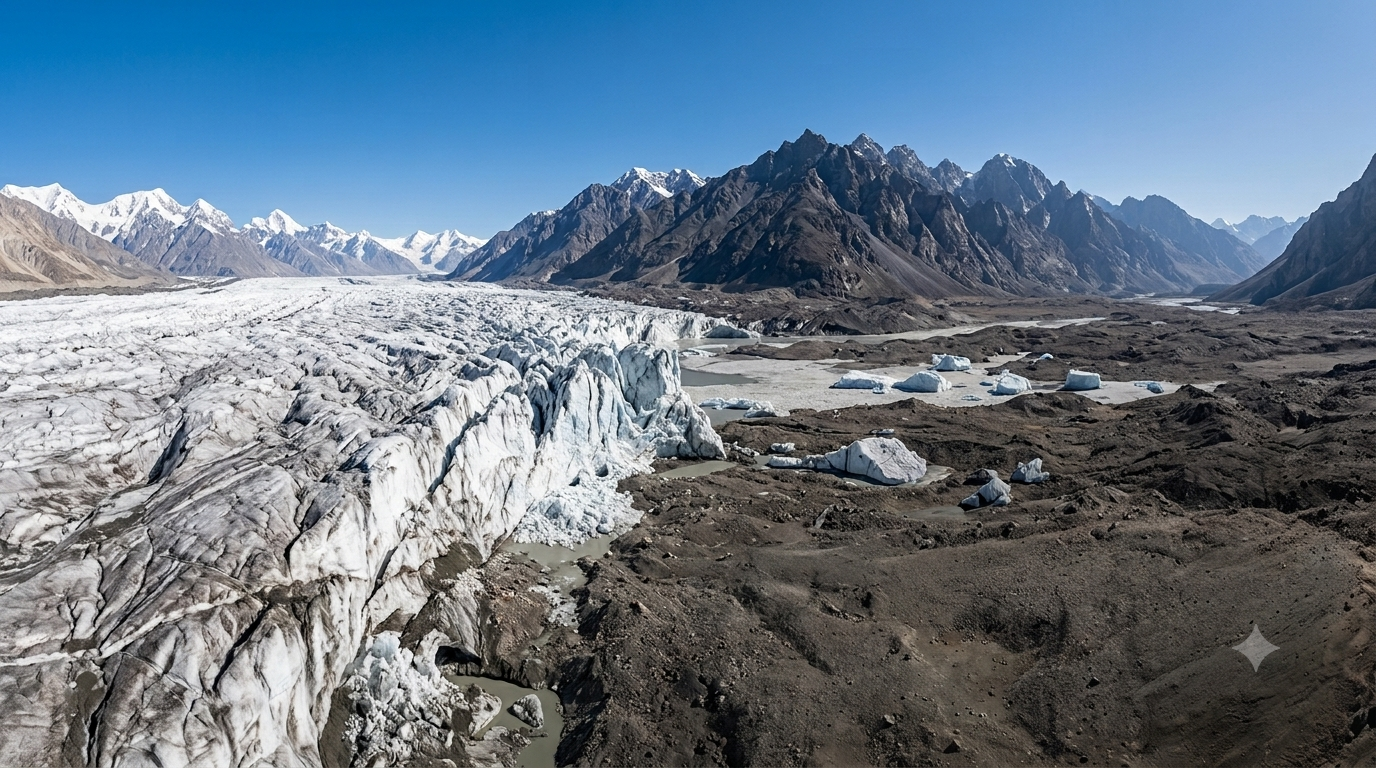
Pakistan is among the countries most vulnerable to the impacts of climate change. While floods and heatwaves often dominate headlines, another rapidly growing threat is the Glacial Lake Outburst Flood (GLOF)—a sudden and devastating release of water from glacial lakes formed by melting glaciers. As global temperatures continue to rise, GLOFs are becoming more frequent, posing serious risks to lives, livelihoods, and critical infrastructure in Pakistan’s northern regions.
Pakistan is home to more than 7,000 glaciers, one of the largest concentrations outside the polar regions. These glaciers are a vital source of freshwater, sustaining agriculture, hydropower, and drinking water for millions. However, accelerated glacier melting due to climate change has resulted in the formation and expansion of unstable glacial lakes. When the natural barriers containing these lakes collapse because of heavy rainfall, rising temperatures, avalanches, or earthquakes, massive volumes of water rush downstream within minutes, causing catastrophic flash floods.
The provinces of Gilgit-Baltistan and Khyber Pakhtunkhwa are particularly vulnerable. Communities living in valleys such as Chitral, Hunza, Ghizer, and Upper Dir face recurring threats during the summer months. GLOF events can wash away homes, roads, bridges, schools, crops, livestock, and communication networks, while also isolating remote communities and causing tragic loss of life.
The significance of GLOFs extends beyond the mountainous regions. Damage to highways, power infrastructure, irrigation systems, and tourism facilities affects Pakistan’s economy as a whole. Agriculture, which depends heavily on glacier-fed rivers, also becomes increasingly vulnerable as climate change disrupts water availability. Therefore, managing GLOF risks is not merely an environmental issue—it is a matter of national security, economic stability, and sustainable development.
Preparedness remains the most effective defence against GLOFs. The government, through the National Disaster Management Authority (NDMA), Provincial Disaster Management Authorities (PDMAs), and local administrations, has strengthened monitoring systems, early warning mechanisms, and contingency planning in vulnerable areas. Regular advisories, hazard mapping, evacuation planning, and community awareness campaigns have become essential components of disaster risk reduction.
However, government action alone is insufficient. Communities must actively participate in preparedness efforts by staying informed through official weather alerts, understanding evacuation routes, avoiding construction in high-risk zones, and reporting unusual glacier or river activity. Schools, local organizations, and volunteers should also be trained in emergency response and first aid to enhance resilience.
In the long term, Pakistan must continue investing in climate adaptation measures, scientific research, glacier monitoring, resilient infrastructure, and international climate cooperation. Since Pakistan contributes only a small fraction of global greenhouse gas emissions but bears a disproportionate share of climate impacts, global support for adaptation and climate finance remains crucial.
GLOFs are no longer rare natural events; they are becoming an increasingly predictable consequence of a warming climate. Protecting vulnerable communities requires a combination of scientific monitoring, effective governance, public awareness, and collective responsibility. Preparedness today will save lives tomorrow. As climate risks continue to intensify, Pakistan must treat GLOF preparedness not as an option but as a national priority.
Disclaimer: The views and opinions expressed in this article are solely those of the author and do not necessarily reflect the views, policies, or position of this website. The website does not endorse or oppose any opinion presented herein.
