

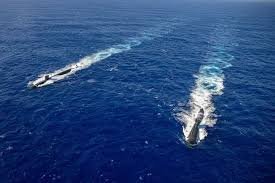
China is carrying out a large-scale effort to map the ocean floor across the Pacific, Indian and Arctic oceans, in a move experts say could significantly enhance its submarine warfare capabilities against the United States and its allies.
The operation involves a network of research vessels and underwater sensors collecting detailed data on seabed terrain and ocean conditions, information considered critical for submarine navigation, concealment and detection.
Among the vessels involved is the Dong Fang Hong 3, which has conducted repeated missions near strategically sensitive areas including waters around Taiwan, Guam, Japan and key Indian Ocean routes such as the Malacca Strait.
Naval analysts say such mapping allows submarines to operate more effectively by understanding underwater geography, as well as factors like temperature, salinity and currents that influence sonar performance and detection.
The effort is part of a broader push by China to develop what researchers have described as a “transparent ocean”, a system of sensors and monitoring tools aimed at tracking underwater activity in real time.
US intelligence officials have raised concerns that the data collected could support both defensive and offensive operations, including tracking rival submarines and preparing maritime battlefields in contested regions.
While China presents many of these missions as civilian scientific research, experts point to their dual-use nature under Beijing’s civil-military fusion strategy, which integrates academic and commercial activities with military objectives.
The expanding undersea program highlights intensifying strategic competition between China and the United States, particularly in the Indo-Pacific, where control of maritime and undersea domains is increasingly seen as critical to future conflict scenarios.