

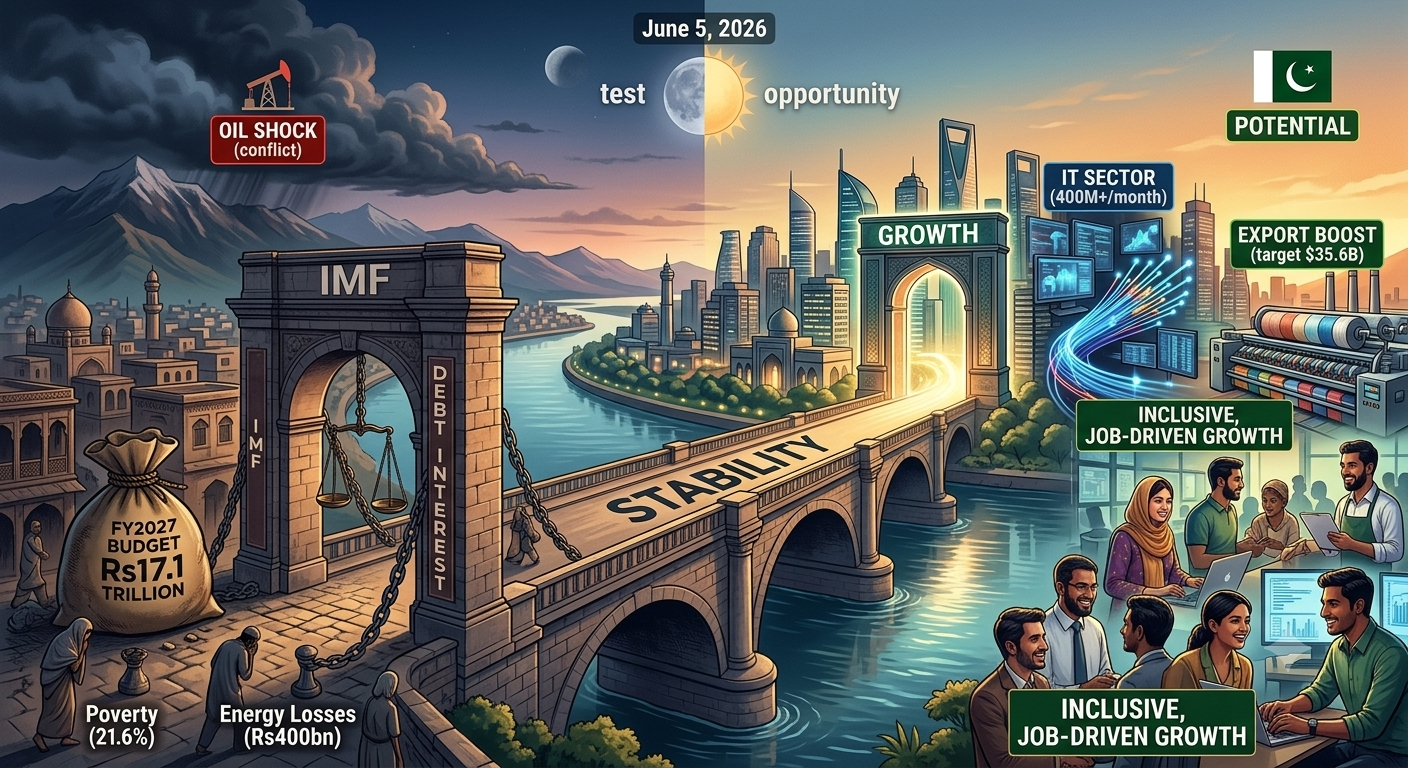
As Pakistan prepares to unveil its Rs17.1 trillion federal budget on June 5, the country faces a defining test, whether hard-won macroeconomic stability can finally be converted into inclusive, jobs-driven growth.
A Budget Shaped by Crisis and Opportunity
On June 1, 2026, Prime Minister Muhammad Shehbaz Sharif sat down with chambers of commerce and industry representatives from across Pakistan and made a declaration that would have been unthinkable two years earlier: Pakistan’s economy, he said, had achieved stability. It was a measured but meaningful moment, the kind that Islamabad has struggled to reach for decades. Three days later, on June 5, Finance Minister Muhammad Aurangzeb will present the federal budget for FY2026-27, the annual exercise that will determine whether that stability can be built upon, or whether Pakistan slips once again into the familiar cycle of fiscal drift and IMF dependency.
The numbers on paper are encouraging. Pakistan’s GDP is projected to grow at 3.7% for the fiscal year ending June 2026, up from 3.2% the previous year, and the upcoming budget targets 4.1% growth in FY2027. Inflation, which peaked at over 38% in May 2023, has been brought down sharply, settling at 4.5% in 2025 before rising again to 6.2% on average during July-April FY2025-26, pushed higher by the shock of the US-Iran conflict that erupted in February 2026. For a country that has entered 25 IMF arrangements since joining the Fund in 1950, stability, however fragile, is not nothing. The question is whether it is enough.
The Budget: What the Numbers Say
The proposed Rs17.1 trillion budget for FY2026-27 is Pakistan’s most ambitious in nominal terms. The government has set a tax revenue target of Rs15.267 trillion, non-tax revenue of Rs2.768 trillion, and a petroleum levy target of Rs1.727 trillion. The Public Sector Development Programme (PSDP), the government’s headline investment figure, stands at Rs1.1 trillion at the federal level, with total development outlay expected to exceed Rs4 trillion when provincial spending is included.
Yet the most revealing line item is one that rarely receives commensurate attention in public debate: Rs7.824 trillion allocated to debt interest payments. That is nearly half the total budget, and more than seven times the federal development spending. For every rupee Pakistan plans to invest in its own infrastructure, roads, schools, and hospitals in FY2027, it will spend more than seven repaying the cost of past borrowing. This is not a new problem, but it is a worsening one, and it defines the ceiling on what any budget, however carefully crafted, can realistically achieve.
On the relief side, the government has moved to lower the cost of doing business. Plans include Rs200 billion in import-duty relief for industry under the second phase of a five-year tariff reform programme, with cuts in additional customs duty on 3,149 tariff lines and reduction of regulatory duty to a maximum of 20% on more than 1,900 tariff lines. For the vehicle sector, customs duty is proposed to fall from 100% to 50%, and regulatory duty from 50% to 20%, reducing the total import duty burden on vehicles from 150% to 70%. The export finance markup rate has been capped at 4.5% until June 2027, and tax refunds have been ordered processed by June 15.
The IMF Dimension: Partner, Patron, or Constraint?
No serious analysis of Pakistan’s FY2027 budget can avoid the IMF’s role in shaping it. Pakistan’s outstanding loans to the Fund stood at SDR 7,138 million as of March 2026, one of the largest IMF exposures in Asia. The current Extended Fund Facility, which began in October 2024, has brought discipline but also constraints. According to analysts at Topline Securities, most policy decisions in the upcoming budget have already been aligned with IMF conditions, leaving limited room for major public relief measures.
The IMF has urged Pakistan’s provinces to generate an additional Rs400 billion in revenue in the new fiscal year, primarily from agriculture, services, and real estate sectors, as a condition for continued programme compliance. The Fund has also called for the Federal Board of Revenue’s revenue targets to be elevated to the status of Quantitative Performance Criteria, a tougher standard of accountability. Combined with new structural benchmarks on tax base expansion, the message from Washington is clear: reform implementation must deepen, not slow. Pakistan has committed to limiting circular debt growth to Rs300 billion by FY2027 and reducing power sector subsidies from 0.7% to 0.6% of GDP.
This is a double-edged relationship. The IMF programme has been the anchor of Pakistan’s macroeconomic recovery, without it, the rupee stabilisation, the fall in inflation, and the return of foreign exchange reserves would have been far harder to achieve. But it also crowds out the very investments in human capital, infrastructure, and social protection that long-run growth requires. Pakistan’s GDP per capita of $1,710 (nominal, 2026), ranked 162nd globally, is a stark reminder that stability and prosperity are not the same thing.
Oil, War, and the External Shock Pakistan Did Not Need
Just as Pakistan’s economic managers were gaining traction, the world delivered a fresh blow. The outbreak of the US-Iran conflict in February 2026 sent global oil prices surging from around $72 per barrel to nearly $120 per barrel at their peak, a 67% spike in a matter of weeks. For a country where oil and gas constitute a large share of imports and energy costs feed directly into inflation, the consequences were immediate. Monthly inflation accelerated to 10.9% year-on-year in April 2026, up from just 0.3% in April 2025.
Pakistan’s government moved quickly to contain the damage. Despite acute shortages of re-gasified LNG triggered by regional conflict and an unprecedented surge in international fuel prices, the government held electricity tariffs flat for June 2026, absorbing the cost through policy continuity and mitigation measures. Pakistan also arranged LNG cargoes through the spot market and resumed shipments from Qatar on a contract basis, a logistical achievement that has received less credit than it deserves. The Asian Development Bank acknowledged Pakistan’s resilience, but warned in its May 2026 report that downside risks remain significant and that sustained reform efforts are critical to preserve growth momentum.
The Export Story: A Rare Bright Spot
Against this backdrop, Pakistan’s export trajectory stands out as genuinely promising. The IMF projects Pakistan’s exports will reach a record $35.63 billion in FY2026-27, up from an estimated $31.93 billion in the current fiscal year. If achieved, this would surpass all previous export records and mark one of Pakistan’s most significant external sector milestones. The government’s tariff rationalisation programme, the capping of export finance rates, and a competitive rupee have all contributed to improving the economics of Pakistani exports.
Pakistan’s IT sector deserves particular attention. Monthly IT export proceeds have remained above the $400 million threshold, with April 2026 recording $423 million, a 2.42% increase from March. For a sector that barely registered in Pakistan’s export statistics a decade ago, this is a structural shift with long-term implications. Pakistan has a young, rapidly growing tech workforce and a cost advantage relative to regional peers. The challenge, consistently underlined by analysts, is that spectrum pricing policies prioritising short-term revenue over investment have delayed a credible 5G rollout and are estimated to cost the economy approximately $1 billion per year in foregone GDP. A budget that addresses this directly would send a powerful signal.
The Stubborn Problems That No Single Budget Can Fix
Pakistan’s structural vulnerabilities are well-documented and stubbornly persistent. The energy sector alone carries losses estimated at Rs400 billion annually from power distribution companiesu, equivalent to more than a third of the federal PSDP. Circular debt, despite repeated commitments, has grown to become one of the most intractable fiscal problems in South Asia. The tax-to-GDP ratio remains among the lowest in the world for a country of Pakistan’s size and income level, constraining public investment at precisely the moment it is most needed.
The World Bank, in its October 2025 Pakistan Development Update, projected growth at 3% for the fiscal year ending June 2026, lower than the government’s own estimates, citing floods that damaged the agriculture sector, which still accounts for 23% of GDP. The bank’s message echoed a familiar refrain: Pakistan needs sustained reforms, not just stabilisation. For more than a decade, per capita income growth has barely outpaced population growth, and at a population of 257 million growing at roughly 2% annually, the arithmetic is unforgiving. Poverty, though declining from a peak of 39.4% in 2022-23, still affects 21.6% of the population as of 2025.
The Verdict: Stability Is Not Yet a Story of Growth
Pakistan’s FY2027 budget arrives at a genuinely inflection point. The country has done something difficult and underappreciated: it has stabilised an economy that was lurching toward default as recently as 2023. Inflation has been tamed, reserves rebuilt, and the external account brought into balance. These are real achievements that required political will and economic discipline.
But the June 12 budget will be judged not on what it preserved, but on what it builds. The record export projections, the IT sector momentum, and the tariff reform programme point to a government that understands where Pakistan’s growth opportunities lie. The question is whether the fiscal arithmetic, dominated by a debt servicing burden that consumes nearly half the budget, leaves enough room to actually pursue them. For an economy ranked 42nd in nominal GDP terms but 162nd in per capita income, the gap between Pakistan’s potential and its performance has never been more visible, or more urgent to close.
Whether June 12, 2026 marks the beginning of that closing, or another year of holding the line, will define how Pakistan’s economic moment is remembered.
Disclaimer: The views and opinions expressed in this article are solely those of the author and do not necessarily reflect the views, policies, or position of this website. The website does not endorse or oppose any opinion presented herein.