

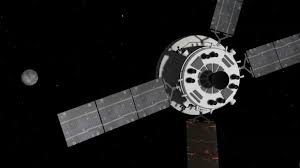
Astronauts aboard NASA’s Artemis II mission have, for the first time in history, visually observed the far side of the Moon with the naked eye, marking a significant moment ahead of the mission’s scheduled lunar flyby on Monday afternoon, April 6, 2026. The milestone comes as the spacecraft continues its journey deeper into lunar space following its launch on April 1.
The mission officially entered the Moon’s “sphere of influence” on April 6 at 12:37 a.m. EDT (04:37 GMT), meaning the Moon’s gravitational pull has become stronger than Earth’s at the spacecraft’s current position. At the time of this transition, the crew had been in space for over four days and was approximately 39,000 miles from the Moon and 232,000 miles from Earth.
The upcoming flyby will bring the Orion spacecraft to its closest approach to the Moon, allowing the four-member crew to orbit around the far side—an area never previously viewed directly by human eyes during a mission of this nature. During this phase, the astronauts are expected to observe and document the lunar surface, capturing images that will be shared with mission teams on Earth.
Historically, Apollo astronauts did not have the opportunity to view the Moon’s far side in the same manner, making this an unprecedented visual experience for a crewed mission. However, communication with mission control in Houston will be temporarily disrupted when the spacecraft passes behind the Moon, as the lunar body blocks radio signals. This blackout period is expected to last for approximately 40 minutes before contact is re-established via NASA’s Deep Space Network.
If the mission proceeds as planned, Artemis II will complete a historic flyby, traveling farther from Earth than any human has previously ventured, marking a key step forward in NASA’s broader lunar exploration program.