

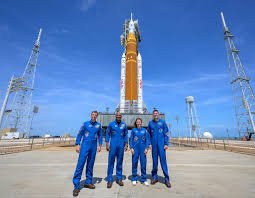
After more than five decades, the United States is preparing to send astronauts back toward the Moon, marking a major milestone in modern space exploration. The NASA mission, known as Artemis 2, is scheduled for launch from Florida as early as April 1 at 6:24 pm (3:24 am PKT on Thursday).
The mission will carry four astronauts — Americans Reid Wiseman, Victor Glover, and Christina Koch, alongside Canadian Jeremy Hansen — on a roughly 10-day journey around the Moon. While the crew will not land, the mission mirrors the historic Apollo 8 flight, which first carried humans into lunar orbit in 1968.
This voyage carries significant symbolic weight. It will include the first woman, the first person of colour, and the first non-American ever to participate in a lunar mission, reflecting a broader and more inclusive era of space exploration.
Artemis 2 will also mark the first crewed flight of NASA’s powerful new rocket, the Space Launch System (SLS). Designed for long-term lunar operations, the rocket is central to plans for establishing a sustained human presence on the Moon, potentially serving as a launchpad for future missions to Mars.
Speaking ahead of the launch, Koch highlighted the Moon’s scientific importance, describing it as a “witness plate” of the solar system’s formation and a critical step toward deeper exploration of Mars — a planet scientists believe may hold evidence of ancient life.
The mission has faced multiple delays and technical challenges, including the need to return the rocket to its hangar for repairs. However, NASA officials now express confidence in the system’s readiness. According to agency leadership, both the spacecraft and crew are fully prepared for launch, while weather conditions are being closely monitored, with generally favourable forecasts despite the possibility of intermittent clouds and light showers. Backup launch windows remain available through early April in case of delays.
Beyond its scientific objectives, Artemis 2 is part of a broader strategic push to reassert US leadership in space. The programme aims to land astronauts on the lunar surface by 2028, although that timeline depends on the development of a separate lunar lander system by private companies.
The mission is unfolding amid growing international competition, particularly with China, which is targeting a crewed Moon landing by 2030. NASA leadership has framed the Artemis programme as not only a scientific endeavour but also a driver of innovation, national security, and economic opportunity, while also emphasizing its inspirational value for future generations.
As anticipation builds, spectators have gathered near the launch site, reflecting a mix of excitement and nostalgia. While some recall the unified global attention of the Apollo era, others see Artemis as the beginning of a new chapter — one that could once again inspire the world.